

















Give reps real enablementthink at least two hours of coaching a week and watch win rates jump from 45 percent to 60 percent.
The right resources don’t just feel helpful; they actually create more closed deals and more revenue. But deriving valuable insights from business data, client cases, or market trends for sales enablement can be a tricky task. However, all the resources are right there, in your company.
In an ideal world, the sales team works alongside the product, marketing, and support teams to ensure the buying process is a smooth, continuous path.
The foundation of this path is the customer journey, which reveals the customer’s experience with sales, marketing, and support. But very often, the reality is that separate teams are working on the same goal but without a common strategy.
Marketing focuses on attracting leads; sales are responsible for winning clients; customer support tends to the needs of current clients to build and maintain relationships; the product team works on improving customer satisfaction with the product. Can you relate to it?
The trickiest part is that the process of attracting, supporting, and retaining a client is complex. But when there is a path that clients perceive as a single whole, why should a company see it differently? Moreover, the sales enablement role is cross-functional; you can’t create and deliver an efficient sales enablement strategy alone inside your sales team.
Here are some working tips on how you can work closely with the marketing, support, and product teams, and don’t lose your cool.
Marketing
That back-and-forth is real: 39.6 percent of sales teams name ‘not enough qualified leads’ as a top frustration, while marketers counter that sales still drop the ball on warm opportunities. Has this happened to you? Of course, it has and nobody is surprised.
Alignment between sales and marketing starts with defining what a quality lead is for the company, rather than for the teams separately.
A buyer persona is a holy grail that gives everyone a clear picture of how your ideal customer behaves and communicates. Based on the buyer persona, teams communicate to set common goals and create a plan for how each of them will make an impact.
How marketing team can help you
Marketers work closely with the product team on positioning, messaging, and the launch of the product. They produce and develop content that helps clients decide.
This content includes blogs, eBooks, case studies, brochures, videos, and much more. It helps to be consistent with what you sell as a sales representative and what the company offers in reality. There is no place for misunderstanding between teams.
How to assist marketers
You can help marketers by providing them with sales tips that help to win a client. Undoubtedly, the sales team is the first point of communication with customers.
Marketers create hypotheses based on data and behavior patterns, but only sales know the real cases.
Don’t hesitate to share your in-depth industry knowledge with them to improve marketing and sales materials.
 Nicole Ward
Give them your advice and opinions on how content should be presented; only you know why customers choose your company over your competitors.
Support
Why do sales and support teams struggle to work together?
How the support team can help you
The support team is the closest team to the clients. They know the client’s problems and expectations when it comes to the company and its products. Their insights are crucial for the sales team, as they help to improve the quality of the sale.
Ask for a list of pain points and essential features; you might be surprised to find out that a client has fallen in love with a specific feature or product that you have tried to sell for a long time unsuccessfully.
How to assist the support team
The sales team should make a client’s transition from the sale to the customer as smooth as possible, from introducing their customer manager or team to mapping a client’s pain points, requests, and expectations. If the support team is also responsible for upsales, make sure you have shared your insights and ideas.
As you are on the frontline of the process, you can control offers and other methods for getting sales throughout the company, but you should always keep the support team in the loop.
Product
Again, conflicts between these two teams bring chaos to the company, where sales claim that the product team creates an unsustainable product roadmap and produces products and features that the real clients don’t need.
At the same time, the product team blames sales for selling unfeasible and even non-existent products or promising unrealistic deadlines.
Both teams should align with the primary strategy, and it is better when they work on a quality product that fits market needs. Then, there is no place for producing features for the sake of features or selling “whatever to whoever” to meet the KPIs.
How the product team can help you
To stay aware of upcoming products, features, and other product changes, make sure you have access to a product roadmap and backlog. Whereas the roadmap helps the product team capture, organize, and communicate their product’s goals in the following months and years, the backlog contains a useful list of tasks in priority order.
Keeping your sales plans and KPIs in sync with the product roadmap and backlog helps you to organise your work and keep your team members motivated towards your goals. It also helps you keep track of when and how your sale proposal should be updated.
How to assist the product team
At the same time, everyone would benefit if the sales team contributed to the product’s roadmap and backlog. Again, you know what the customer is looking for, how your products or solutions will be of value, and when they’ll need them. Help yourself and motivate the product team to implement the feature as soon as possible. This gives you the best chance of winning the client.
All you need is to remember that sales can’t reach your goals alone — only by receiving support from other teams and giving back will you make progress.
The change in consumer perception and behavior makes it obvious for companies that there are no more separate departments, but rather teams ready to look beyond their own interests to provide cross-functional expertise to the clients.
Why cross-functional alignment matters for sales enablement
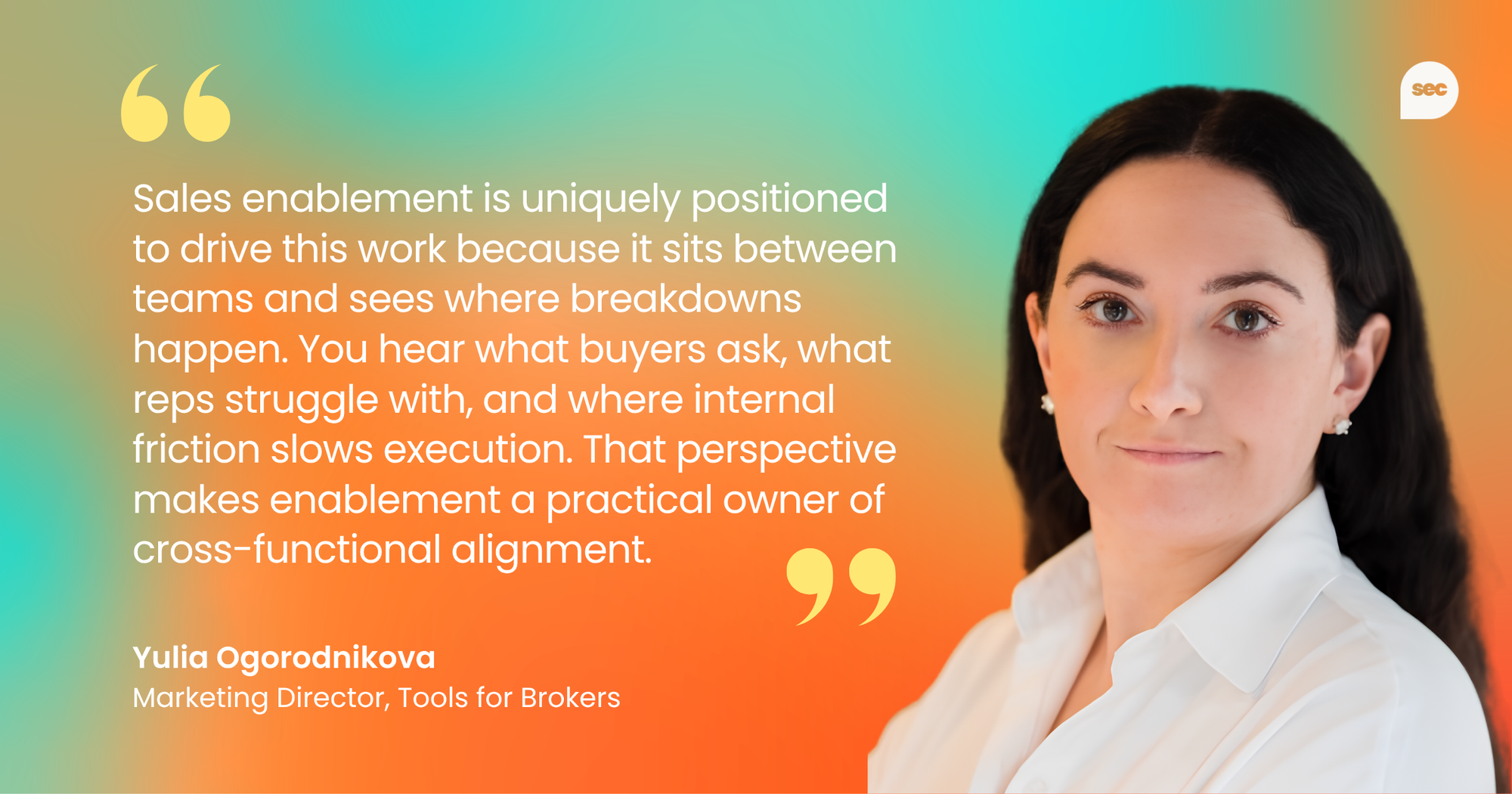
Sales enablement is uniquely positioned to drive this work because it sits between teams and sees where breakdowns happen. You hear what buyers ask, what reps struggle with, and where internal friction slows execution. That perspective makes enablement a practical owner of cross-functional alignment.
Share knowledge, share wins: aligned teams average 82 percent quota attainment, while siloed peers stagger at 32 percent.
How to drive cross-functional alignment: a practical framework
Cross-functional alignment rarely happens accidentally. It improves when teams agree on how they'll work together, how success gets measured, and where key information lives. Here's a simple starting point for sales enablement.
1. Agree on shared goals and KPIs
Bring sales, marketing, product, and support together to define the outcomes that matter across functions - pipeline quality, win rate, retention, expansion, and NPS.
You feel the friction when goals differ; so does the data. Only 51 percent of enablement pros agree with leadership on how success gets measured, leaving the rest to wrestle with mismatched KPIs. If it helps, formalize these outcomes through OKRs.
2. Establish a communication cadence
Set a regular rhythm for collaboration instead of relying on ad hoc updates. Weekly or biweekly syncs, monthly reviews, and quarterly planning sessions keep teams aligned on priorities, blockers, and market shifts.
3. Create a single source of truth
Pick one trusted place for messaging, customer insights, roadmap updates, and enablement materials. Whether that's your CRM, enablement platform, or a shared workspace, every team should know where to find the latest version of what's true.
 Ivan Nyagatare
4. Measure and iterate
Track how alignment is showing up in practice. Look at content usage, handoff quality, feedback loops, retention signals, and how quickly cross-functional requests get acted on. Review results regularly and adjust when gaps appear.
Cross-functional alignment FAQs
How do you drive cross-functional alignment?
Start by setting shared goals that multiple teams are accountable for, then agree on the KPIs that measure progress. From there, create a regular communication cadence and maintain a single source of truth for customer insights, messaging, and priorities.
What's an example of cross-functional alignment?
A common example is sales, marketing, and product aligning around the same ideal customer profile and shared KPIs such as pipeline quality and retention.
Marketing adjusts campaigns based on deal feedback, product prioritizes features tied to customer demand, and sales uses messaging that reflects the actual roadmap.
What's another term for cross-functional alignment?
Other common terms include cross-functional collaboration, organizational alignment, interdepartmental alignment, and inter-functional integration. Each describes teams working toward shared outcomes rather than operating in silos.


Sales enablement insider
Thank you for subscribing
Level up your sales enablement career & network with sales enablement experts.
An email has been successfully sent to confirm your subscription.
 Follow us on LinkedIn



.svg)

Start the conversation
Become a member of Sales Enablement Collective to start commenting.
Sign up now