


When does the customer journey begin? In your organization, it might depend on who you ask:
- Sales: “When I arrange a call with them.”
- Marketing: “When they see our ad on Google.”
- Customer success: “When we begin onboarding them.”
- Finance: “When they sign the contract.”
It can be easy for each department to focus on the channel that they ‘own’ - but your customers don't care about that.
Customers bail when buying feels like a chore. Our 2025 Impact of Enablement Report shows 21% of teams share only a fifth of their customer-facing content with prospects—proof that information gaps drive them straight to competitors.
Your job as a sales enabler is to empower sales reps to engage with customers, so it makes sense that you embed an understanding of the customer journey and experience into their minds.
The buyer’s experience should be the bedrock of sales enablement.
While your reps might only consider the ‘sales’ journey from their own perspective, in reality it’s more important for your organization to understand the entire customer sales journey - which starts before your salespeople interact with a prospect, and continues after the deal is closed.
In fact, Gartner reports that "when B2B buyers are considering a purchase‚ they spend only 17% of that time meeting with potential suppliers.
"When buyers are comparing multiple suppliers‚ the amount of time spent with any one sales rep may be only 5% or 6%."
And according to the Aberdeen Group, only 36% of companies currently have a process in place for mapping customer journeys. Yet for sales teams, customer journey maps can be a powerful tool.
What is a customer sales journey map?
A customer sales journey map visualizes every interaction between your prospect and your company—from initial awareness through post-purchase advocacy. Unlike a sales funnel that focuses solely on conversion, the journey map captures the complete relationship lifecycle.
Think of it this way: while your sales funnel tracks how leads move toward purchase, your customer journey map shows how people actually experience your brand across all touchpoints. It's the difference between your internal process and their lived experience.
Customer journey vs sales funnel: What's the difference?
Your sales funnel represents internal stages—qualified leads, opportunities, closed deals. But customers don't think in those terms. They're trying to solve problems, comparing options, and building trust.
The journey encompasses their entire experience:
- Before they're leads: Research, peer recommendations, content discovery
- During sales: Evaluation, negotiation, decision-making with multiple stakeholders
- After purchase: Onboarding, adoption, renewal, advocacy
While funnels optimize for conversion efficiency, journey maps optimize for customer experience and long-term value.
Key components of effective journey maps
Every journey map should capture:
- Stages: The major phases customers move through (typically awareness through advocacy).
- Touchpoints: Where customers interact with your brand—website, sales calls, support tickets, community forums.
- Emotions: How customers feel at each stage—frustrated by complexity, confident in their choice, delighted by support.
- Actions: What customers do—search for solutions, request demos, share feedback.
- Opportunities: Where you can improve their experience and remove friction.
Understanding the customer journey allows you to see those touchpoints in a more meaningful context. You can map their journey to identify areas for improvement:
- Increase engagement through better targeting
- Eliminate ineffective touchpoints
- Increase conversion
- Retain/upsell
- Ultimately, improve the customer experience
The ideal outcome puts you in a position to use this map to align your sales process - in terms of cadence, sales script, the content or information provided - with the customer journey so prospects are given just the right experience at the right time.
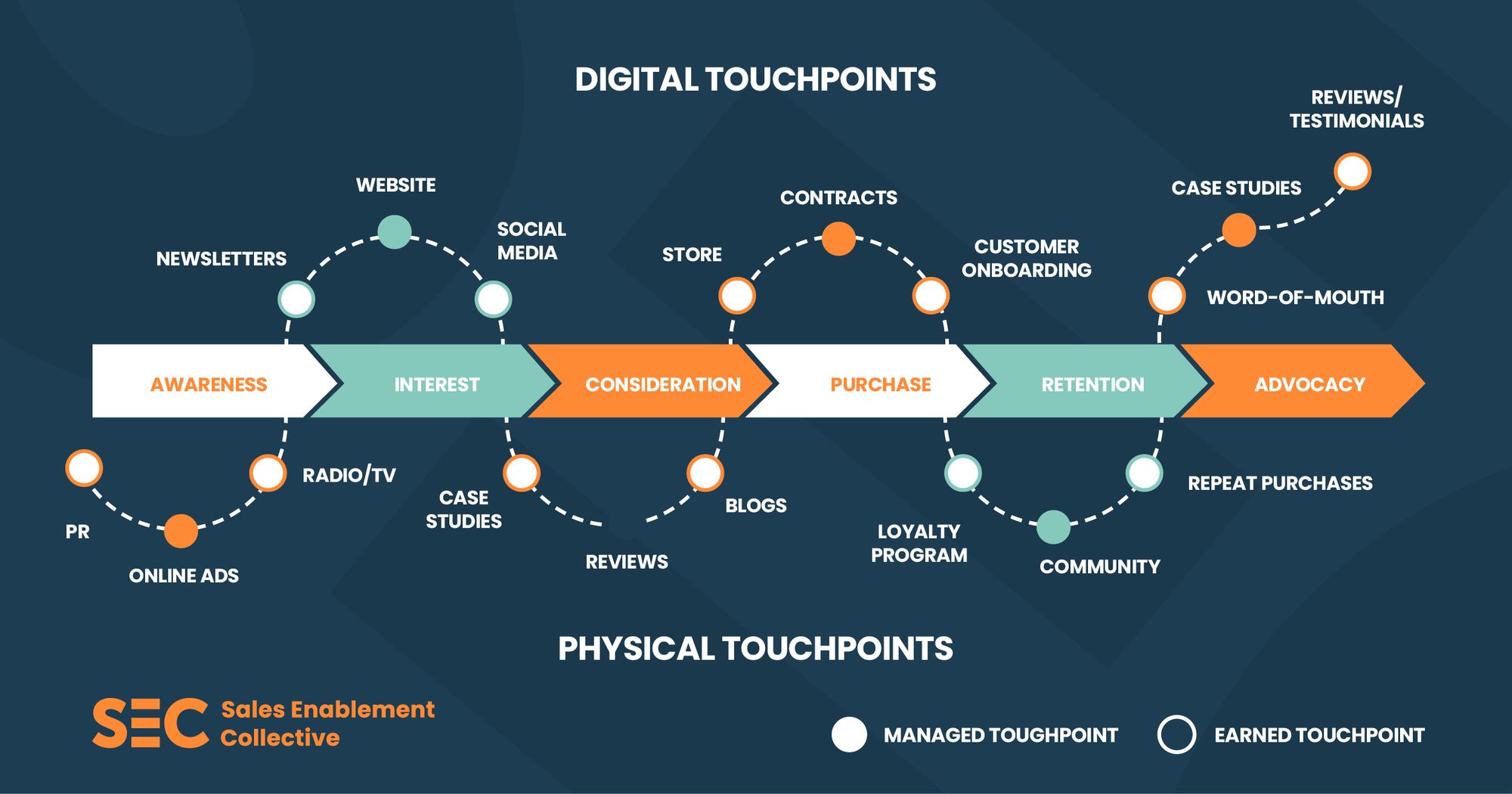
For enablement, and your company as a whole, laying out the customer journey like this helps to:
- Identify and optimize moments of truth in the CX.
- Shift to a customer-focused perspective.
- Break down silos between departments and facilitate cross-functional collaboration.
- Assign ownership of various customer touchpoints to increase employee accountability.
Why customer journey mapping drives sales success
You, your sales reps, marketing, and the C-suite may think you already know what your customer journey looks like. You may all have different perspectives. You need hard truths so that you can map a realistic journey that uncovers areas of friction for customers and identifies solutions that allow sales to address them.
With the rise of mobile internet use and voice search, your target audience now has information at their fingertips. Expectations have skyrocketed. Salesforce’s 2023 State of the Connected Customer found 88% of business buyers rank experience on par with product—up from 80% just three years earlier.
They expect:
- To be able to easily find information and resources to inform them of the options available.
- To be able to easily find detailed information on your website (and other online presence, such as social media or customer reviews) about your product, pricing, and differentiation.
- To have access to onboarding and training on how to use your product, as well as continuous support.
Revenue impact: Why journey mapping pays off
Fix the buyer moments that matter and the numbers will move. The 2024 Sales Enablement Landscape Report found teams that tuned critical touchpoints lifted win rates from 45% to 50% and nudged sales velocity from 29% to 32%.
Consider this: your prospects spend only 17% of their purchase time with sales reps. The rest? They're researching independently, building consensus internally, and comparing alternatives. Journey mapping reveals what happens in that other 83% (and how to influence it).
When you understand the full customer experience, you can:
- Reduce sales cycle length by providing the right content at the right time.
- Increase win rates by addressing concerns before they become objections.
- Boost deal sizes by identifying upsell moments throughout the relationship.
Breaking down silos with journey insights
Journey mapping forces cross-functional alignment. Marketing discovers why MQLs don't convert. Sales understands which content actually helps buyers decide. Customer success sees how pre-sale experiences affect retention.
This shared view transforms how teams work together:
- Marketing creates content for specific journey stages, not generic campaigns.
- Sales reps know exactly which resources match each buyer's context.
- Support teams anticipate issues based on customer paths.
The result? A coherent customer experience that builds trust instead of friction.
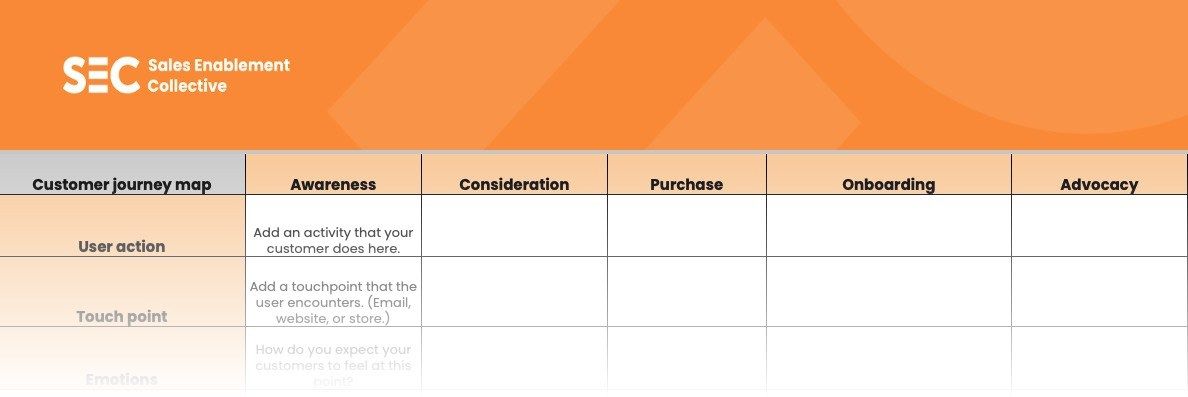
Become an SEC Pro member and gain access to this template and a whole host of other benefits, including hundreds of hours of event footage, mentorship opportunities, and more.
So put yourself in the shoes of the customer:
- What's it like to experience your company from their perspective?
- How easy is it to find what you’re looking for (through a web search, site navigation, even social media?)
- How helpful and engaging are the touchpoints?
Once you understand your existing customer experience, you can start mapping out the ideal sales journey and innovate to stay ahead of the competition.
Having today's journey and your ideal journey defined will help you discover and fill in the gaps of those experiences.
From your marketing strategies, to sales processes, to how you work with existing customers, creating a customer journey map can provide fresh perspectives on your customer interactions.
How to map the customer sales journey: getting started
As we've established, creating a map of the customer sales journey is a powerful way to align cross-functionally and empower your sales reps to understand their prospects.
Here's how to actually get started with mapping. 👇
1. Define the scope of your map
Most organizations won’t have one definitive customer journey - the number of products you sell, types of customer and possible situations are complex.
A financial services company, for example, may offer advice on investment planning and retirement planning, as well as corporate financial services and mortgage brokering - all completely different.
So start by focusing on one customer segment and one customer journey for one product or service - don’t try to do everything at once. This can then serve as a model or template in the future.
2. Identify your customer
Time to refer to those customer (or buyer) personas and pick one whose shoes you're going to step into. What are their motivators, their challenges? Who do they report to?
This gives you a starting point for framing things from the potential customer’s viewpoint and painting a true picture of their trajectory.
3. Define customer touchpoints
Think about each stage of the sales journey and about the customer’s objectives at each point. This means considering the challenges and frustrations they may be experiencing, as well as their actions and the channels through which you are reaching them.
Invite input from all stakeholders and build your customer journey map collaboratively to ensure accuracy.
This will help you to evaluate whether you are currently really delivering the experience they expect - and identify where there’s room for improvement.
Awareness
Your customer’s journey may begin much earlier than many in your organization think. It doesn’t start from the first call from someone in sales.
It begins when they first become aware of your brand or product, often through marketing activities such as search engines, social media, advertising, email marketing etc.
Sales reps may not directly be involved in these activities, but they certainly need to be familiar with them so that they know what their prospects/leads already know about your company, where they have found this information and, most importantly, the messaging they have received, to give them the opportunity to offer a seamless experience when they make contact.
Interest
Great, you’ve piqued their interest - they may have signed up for a newsletter, started to follow you on social, or even called your business.
This is the point at which continuing that engagement, and nudging them further along their journey (or through the sales funnel) is paramount.
High-quality content, relevant to their needs, is key to establish trust and brand authority. The prospect should be nurtured.
This may be the point at which your business identifies them as MQLs and begins to research their company, needs, and buying process and makes contact.
Consideration
The customer is evaluating your product and probably comparing it with competitors or other options.
It’s at this point they may be considered SQLs.
They need information to make a rational choice on whether the product is right for them - and this is where reps have their time to shine as thought leaders.
Now coming into play:
- Explaining benefits in detail
- Overcoming objections
- Storytelling using case studies
Remember that, for B2B buyers, this stage usually gets pretty complex.
According to Gartner’s The New B2B Buying Journey report:
"The typical buying group for a complex B2B solution involves six to 10 decision makers, each armed with four or five pieces of information they’ve gathered independently and must deconflict with the group.
"At the same time, the set of options and solutions buying groups can consider is expanding as new technologies, products, suppliers and services emerge."
Take this into account when assessing pain points and considerations - even if you’re dealing with one individual, there will be other stakeholders that influence whether to buy.
Purchase
The customer has made the decision to buy, and now is the time to follow through on your promises by delivering the product in a way that builds on your brand values and impresses your new client.
Now comes the time for contract negotiations (which can be a pain point, if the customer has a complex and long-winded sign-off process), product delivery and training, and onboarding.
At this point, sales reps often hand over to account managers.
Retention
You’ve got the customer to sign on the dotted line, but that’s not the end of the sales process by any means.
You need to keep these customers. It’s not just about renewal, but also encouraging repeat purchases, upselling and cross-selling where relevant.
This is done by delivering excellent customer service, through:
- Responding to customer queries promptly and effectively.
- Staying up-to-date with customer priorities and challenges.
- Keeping product knowledge up to speed so that you spot opportunities that could be a good fit for them.
- Ultimately, providing your customer with value.
Advocacy
The final stage, which you ideally want every customer's journey to reach is advocacy.
A great experience as a customer means they shout about your brand, helping to strengthen brand recognition and trust - and win new customers.
People trust personal recommendations and social proof more than marketing and sales messages: 92% of B2B buyers are more likely to purchase after reading a trusted review.
Likewise, each negative review costs the average business about 30 customers.
 Christi Loucks
4. Map future states
Now that you’ve visualized your existing customer sales journey, your map will probably show some gaps in your CX, information overlap, poor transitions between stages, and significant pain points or obstacles for customers.
Use mapping tools to plan out potential solutions and compare the current state of the customer journey with the ideal, future state.
Present your findings company-wide to bring everyone up to speed on the areas that need to be improved, with a clear roadmap for expected change and how their roles will play a part in improving the customer journey.
Using a data-based approach to understand your customer sales journey
Follow the above steps and you'll find yourself with a good understanding of the entire customer sales journey - and you'll have the ability to teach that to your sales team as well.
But you can dive even deeper by embracing a data-driven approach to understanding the customer sales journey.
Here's some ways to get started:
Google Analytics provides deep insights into customers’ behavior, from the moment they enter your website:
- Where they came from
- Where they entered your site
- Their browsing activities
- Where they leave
- And much, much more.
This tells you what they’re interested in and what puts them off - a goldmine of info for customer experience optimization.
You also have access to informal and more formal customer feedback. Online reviews, for example, a CSAT (customer satisfaction index), or NPS (net promoter score).
Those data points can (often instantly) inform you of ways to improve the customer sales journey, and make future prospects' interactions with you better.
Lastly, don't ignore the all-important feedback from customer-facing employees. Not just sales reps but your those who deal with customers after the sales, such as account managers and customer success managers.
Gather whatever you can to help inform and continuously update your map, and improve your understanding of how to define success for your organization.
Ready to master customer journey mapping?
You've learned how journey mapping transforms sales performance—now get the tools to make it happen. Pro+ members access everything you need to build world-class customer experiences:
- 60+ battle-tested templates: Including customer journey maps, persona frameworks, and touchpoint analyzers
- Sales Enablement Certified: Core: Master the fundamentals with our flagship certification program
- 400+ hours of expert content: Learn from enablement leaders at Google, Oracle, and LinkedIn
- Monthly Revenue Labs: Live workshops on journey optimization and cross-functional alignment
- Exclusive mentor network: Get 1:1 guidance from seasoned enablement professionals
Join thousands of enablement pros who've accelerated their careers with Pro+.
Become a member and transform how your organization delivers customer value.


Sales enablement insider
Thank you for subscribing
Level up your sales enablement career & network with sales enablement experts
An email has been successfully sent to confirm your subscription.
 Follow us on LinkedIn
Sales enablement insider
Thank you for subscribing
Level up your sales enablement career & network with sales enablement experts
An email has been successfully sent to confirm your subscription.


.svg)
