



Your sales reps are struggling to find the sales enablement materials they need when they need them.
That’s because up until now, all sales enablement has been locked into a push-based model (forcefeeding them information).
Your sales, marketing, and product departments create content. And it’s good content. But it sits behind a silo, hides in files, and drowns in chat threads.
So when the customer call comes in, and your sales rep has to answer a specific question right now… they can’t.
The moment they say, “Let me get you that answer and call you right back,” the deal slows down. Unforgiving prospects might even see that lack of knowledge as a negative.
And now they have to go find the answer, which usually involves spending a lot of wasted time digging through documents, or worse, interrupting a busy coworker who has the expertise.
The good news at the end of all this mess is that AI, and specifically LLMs (large language models), has provided a more efficient process.
Now you have a pull-based model where sales reps can get the answers they need when they need them, instantly with AI.
They maintain the trust of your clients.
And they never have to interrupt another team member.
So… how do you build the AI-ready sales enablement content to make all this possible?
AI has already changed sales enablement
Before we start building, it’s important you understand the what, why, and when of it all.
The push-based model looked like this:
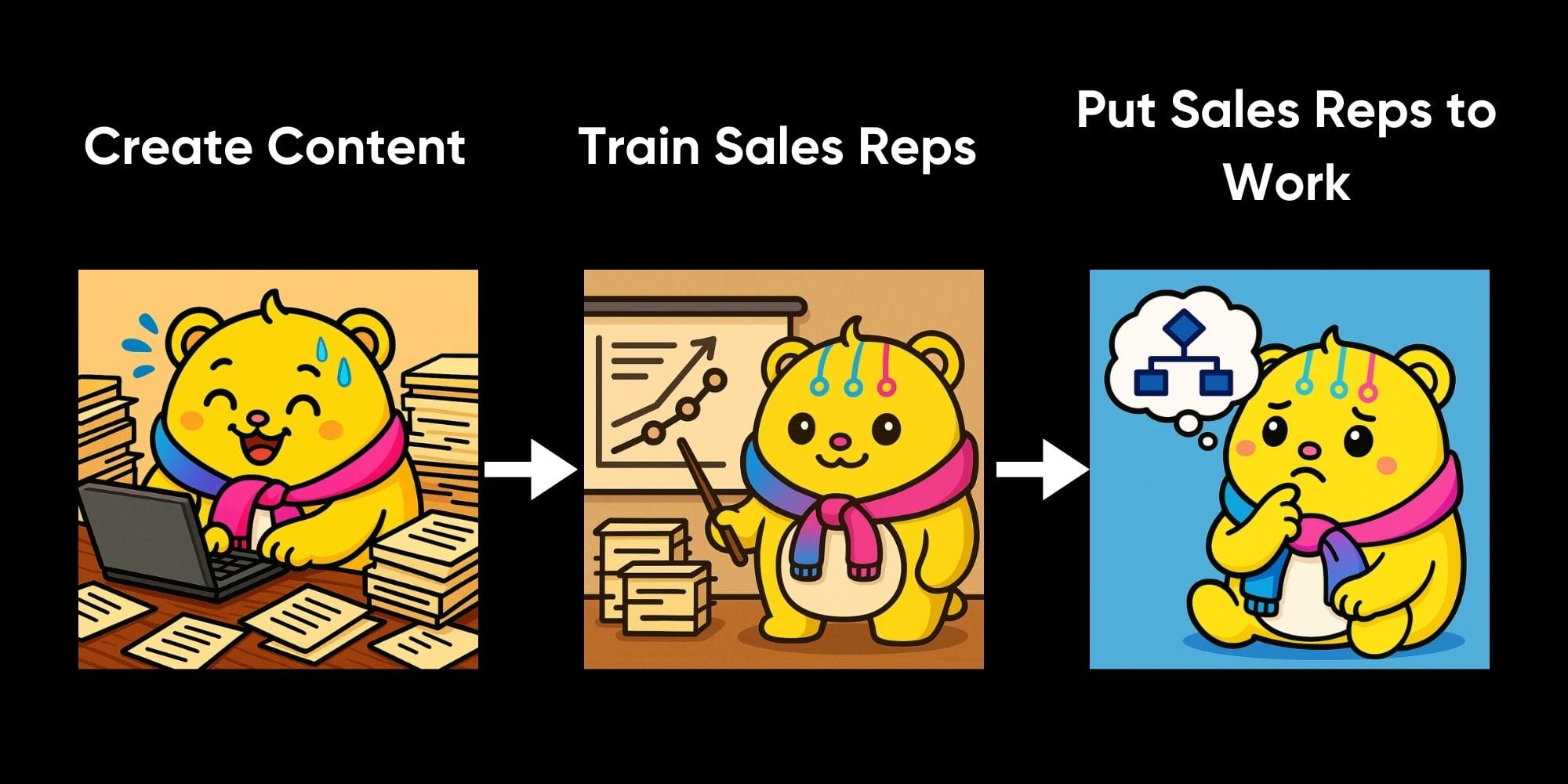
Sales reps need more training and content.
You provide it.
And the cycle repeats itself.
It made sense at the time because it was the only process we knew.
But sales enablement statistics show us things are different now.
Up until now, you would have to create the training and sales content and have it available to the reps when they needed it. And because there was so much information, it was difficult to store in ways that made it all easy to find.
This overload of information resulted in two challenges:
- New reps took a long time to onboard. They wouldn't be really ready to sell for months, or quarters.
- Seasoned reps have a good baseline of knowledge, but learning new things is always a challenge. Every product update / release creates a new set of knowledge to absorb.
AI changed all that.
With the introduction of Large Language Models, the game has officially changed.
Now, you have a pull-based sales enablement approach, which means a sales rep can literally pull the enablement content they need from an AI system and have the answer in seconds.
Now, every sales rep can deal with every issue, from customer objections to competitive comparisons to technical questionnaires, with the help of AI.
The question you’re all asking is, of course, how do you make this shift?
That’s what we’ll cover now.
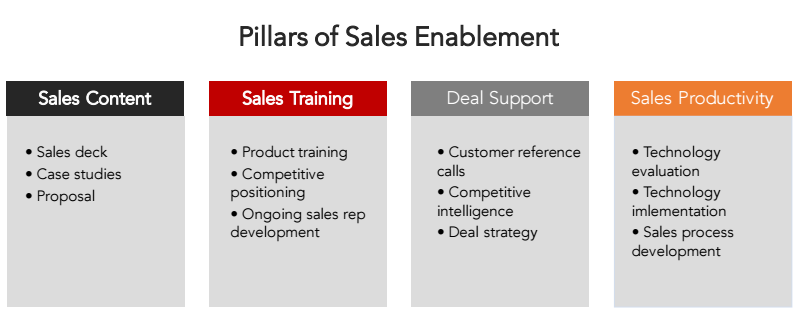
Each one of those pillars from above can now be plugged into the pull-based model.
In practice, this pull-based approach reshapes every core pillar of sales enablement. Instead of static, push-based content, each area now becomes dynamic and on-demand. Here’s how the shift plays out:
- Self-Service Sales Training: Your sales reps no longer have to spend weeks reading binders and taking classes, only to forget everything they’ve learned. Now, they can pull up training materials whenever they need them.
- On-Demand Asset Delivery: Your hard-won sales content won’t go to waste anymore as reps dig to find it. Now, they can simply ask your LLM model for it and get it. Period.
- Quick Responses for Customer Objection Handling: So many great pieces of content for this: battle cards, playbooks, and more. Now, your LLM model can provide responses to virtually any objection in seconds, and your rep can trust the answer because it comes right from the source: you.
- RFP and Questionnaire Automation: These questionnaires can take days to complete because of all the research and expertise needed. But RFP automation with LLMs gets them done in minutes, rather than hours or days.

In any event, AI won’t replace your sales reps. No way.
But the automation will give them new powers.
Before you can automate sales enablement, however, you have to make sure your enablement content is AI-ready.
What it means to build AI-ready content
The goal with building your sales enablement content so that it’s AI-ready is to make it easy for an LLM to find. You also want it to be easily understood.
What this means for you is that you’ll need to have a Knowledge Base.
A strong Knowledge Base will contain all of your internal company files that you want your sales reps to access.
After all, a chatbot’s only job is to get the information from a location and deliver it.
A chatbot will only be as good as your Knowledge Base.
Then, you’ll make sure to limit your chatbot to your Knowledge Base so it can’t hallucinate.
Once you’ve got a Knowledge Base and you connect it to your AI-driven sales enablement platform, you can have the LLM do virtually anything for your sales reps, including:
Training day 1 sales reps, offering smart responses to customer objections, or answering technical questions.
No more dumping content into a file-sharing location and hoping for the best.
AI will pull that information up and deliver it on demand.
Here’s how to make sure your content is AI-ready:
Optimize text for a machine
Machines read text well, images… not so much. At least not yet.
So make sure all of your important company information is based in common text-based formats: PDFs, Word docs, Excel sheets, Google Docs, you get the idea.
Of course, you’re still going to want to use visuals for your customer-facing content, and even in your training materials. But when it comes to answers, your AI will need to pull written text.
Update your Knowledge Base regularly
There are a few things worse than delivering outdated information to a customer who already knows the information has been updated. You don’t want your sales reps falling behind the market. So make sure your Knowledge Base always has the most accurate and up-to-date content in your company.
If you create new content, add it to the Base.
Know when to automate… and when not to
Again, you don’t want all of your processes automated. We’re not trying to replace sales reps with robots.
Why?
Because your customers don’t want to work with robots.
They want to work with humans. And your sales reps, for now at least, are very human.
So, yes, automate talking points, analysis, training, knowledge management, and help finding content.
But don’t automate when it comes to creating new messaging, coaching your team, or speaking with your customers.
Indeed, you want to automate the processes so that your reps will have more time to do the human-facing work they’re so good at.
The bottom line: you want to use AI as an assistant to help you, not to do the important work for you.
Get your people AI-ready as well
Which brings us to perhaps our most important point: get your people on board, so they can use AI to their, and your, advantage.
Communicate to your people that you’re relieving them of the boring, tedious, repetitive work, and that they’ll be able to rely on AI for that. You’ll provide the training necessary, of course, so they can excel at what they do best: sell.
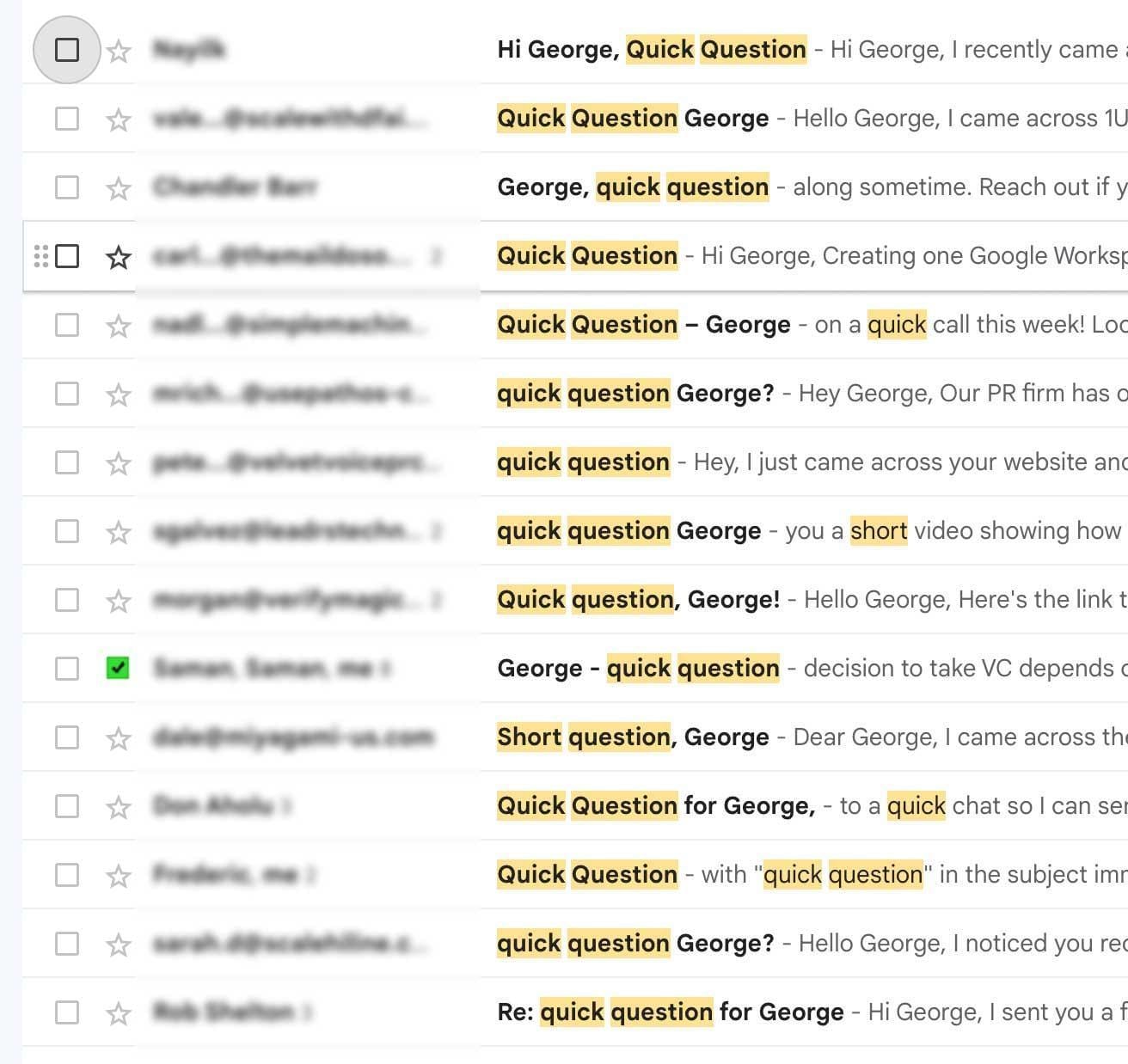
This means that now you can have your people use AI to do deep research into accounts to uncover relationships. They can have AI help them personalize emails. Then, they can pick up the phone and have mission-critical conversations.
That way, they can break through the noise of email spam.
It also means you can empower your people to consolidate the number of tools they use.
AI means you can use far fewer tools, and, ideally, get everything integrated into a single sales enablement platform. We can guarantee your sales reps are tired of bouncing between apps and tools. Narrow it all down to a single space and let AI sort it all out for you.
Put your processes into place
This means you can have strong processes in sales enablement as well. No more massive amounts of tools. No more scattered content. No more haphazard training.
You want to maintain the human element and get rid of the big, drawn-out, weeks-long, binder-filled training.
Instead, gamify training with AI, provide automated access to the materials, and employ coaches to help guide your new hires.
An LMS tool like Docebo will utilize badges, points, and leaderboards to help excite your team and encourage your reps to learn at their own pace.
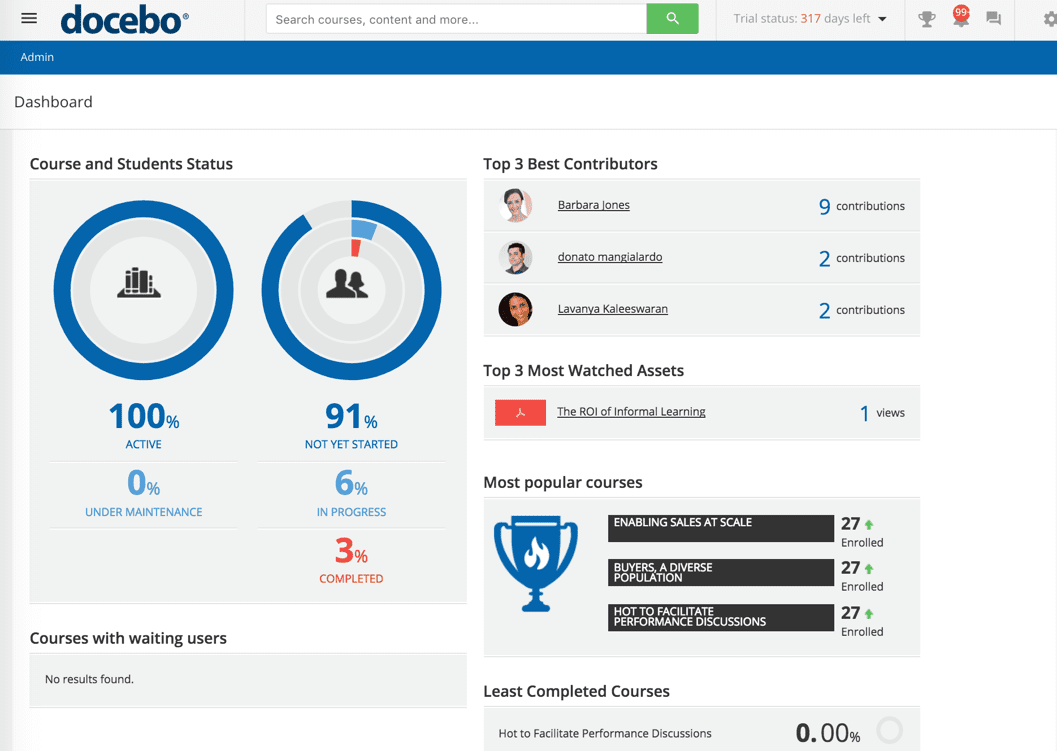
When you make training about learning, getting certified, and ease-of-use, you inspire your team to get the job done.
Keep your sensitive data safe
Finally, you of course don’t want to connect your highly sensitive data to an AI model you don’t trust.
This means you’ll want to lock down anything that contains client information, data, personal details, or proprietary business information.
Here’s how to make sure you do it right:
- Identify and scrub sensitive data: Before uploading anything, clarify what qualifies as sensitive (your public website likely doesn’t). Sensitive information often includes things like customer details, financial records, passwords, roadmaps, or PII (personally identifiable information).
- Always sanitize before use: Strip out unnecessary identifiers, redact fields, and swap out real names for neutral placeholders.
- Turn off model training: Check your AI provider’s settings and disable training. Free tiers often default to using your inputs to improve the model, so opt out whenever possible. If you’re unclear about the policy, ask your vendor. Paid subscriptions typically provide stronger protections.
- Prefer RAG over fine-tuning: Retrieval-Augmented Generation lets you reference external data instead of uploading it directly, reducing the risk of exposure.
- Use integrations for storage: Keep files in systems like Confluence or Google Drive instead of uploading them straight into the AI. This helps maintain ownership and avoids compliance issues such as GDPR violations.
- Track and log activity: Record every interaction with the AI, including prompts, uploads, downloads, edits, and third-party connections. Logs make it easier to audit usage, trace potential leaks, and spot misuse.
- Validate outputs: Don’t blindly trust generated answers. Require reviews to catch hallucinations, inaccurate sources, or missing context.
- Choose enterprise RAG with governance features: Look for role-based access controls, source tagging, and sensitivity tiers. Limit who can query, upload, or edit content based on their organizational role.
- Apply tiered document safeguards: Mark highly sensitive files so the AI either treats them with extra caution or avoids referencing them entirely.
- Leverage metadata and pre-approved responses: Use source tags and controlled response sets to steer the AI toward secure, relevant outputs.
- Keep prompts concise: Shorter context windows minimize the chance of irrelevant details or sensitive data slipping through.
- Secure access with SSO: Connect your AI platform to Single Sign-On for centralized authentication and tighter identity control.
Remember, your goal isn’t to let AI take over. It’s to figure out where AI can be helpful, to give you more, so you can do more, without putting customer or company data at risk.
Looking ahead
As you look ahead to the years to come, and what AI might mean for your sales enablement process, it’s essential to realize that AI is here to stay.
And moving with grace will require us to understand the kinds of sales enablement assets we have at our fingertips.
We’ll be seeing more and more businesses shift to using GenAI as an assistant and seeing it as an essential tool in sales enablement.
That means that if you’re not using it, you’ll be falling more and more behind your competitors.
Note that you can use AI to ensure:
- Your sales reps can engage in more personalized interactions.
- Your sales teams have accurate insights in real time, so they can move quickly.
- Your sales reps can focus on building relationships.
The bottom line is that sales enablement is shifting, and it’s up to businesses to adapt to those shifts. Those who do will thrive and rise to the top.
If you want a tool that is designed to give instant answers whenever your sales reps need them, give 1up’s free trial a try.


Sales enablement insider
Thank you for subscribing
Level up your sales enablement career & network with sales enablement experts
An email has been successfully sent to confirm your subscription.
 Follow us on LinkedIn
Sales enablement insider
Thank you for subscribing
Level up your sales enablement career & network with sales enablement experts
An email has been successfully sent to confirm your subscription.


.svg)
