


As a sales leader, have you ever color-coded your calendar to keep track of all your weekly meetings?
Sat in a recurring meeting and wondered why you’re rehashing the same conversation?
Struggled to figure out how to optimize your time and become the best sales coach you can be?
Same here.
That’s why I’m maniacal about the operating cadence. My comprehensive guide is going to help you:
- Define it
- Prioritize it
- Set the proper intentions
- Bake this into how you optimize sales coaching time.
Because you're reading this article on conquering your operating cadence – I imagine that your life looks something like this:
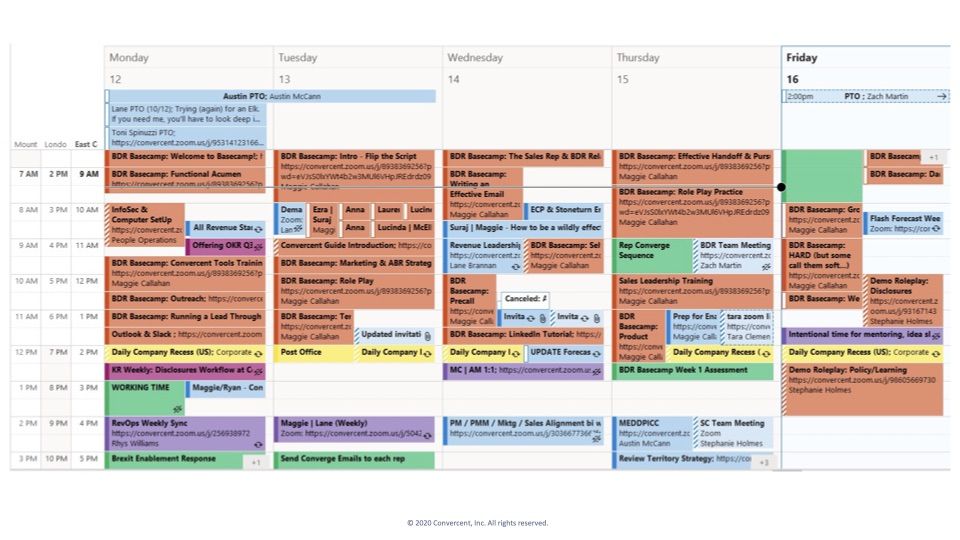
I know, it makes me anxious just looking at it! What you're probably thinking is:
I need to figure out, first and foremost, how to make sure I'm optimizing the meetings that I'm in because I don't have that much extra time.
Or maybe it's:
I tend to sit in meetings all week, and nothing happens. How can I make sure I'm effectively coaching as a sales leader, and ensuring something is actually coming out of the meetings I'm having?"
It's one of the most frustrating things for any of us in the trade.
The role of sales leaders
First and foremost, I'm going to highlight a quote from John Buchan, a Scottish politician in Canada, in 1935.
He said:
The task of leadership is not to put greatness into people, but to elicit it for greatness is there already.
I start every leadership coaching session with this quote, and actually get printouts of it, and put them in frames for all of the sales leaders I work with – because it is so easy to think that as sales leaders, it is our responsibility to inflict our greatness, our successes into our people.
Individual success doesn’t equal coaching prowess
We can sometimes go off the deep end thinking that just because we've been successful in sales or with a specific aspect of our careers, that we're going to be fantastic at coaching it too.
I'm here to ruin your dream of that, unfortunately. Just because we are fantastic individual contributors doesn't necessarily mean we have the skills to coach our teams effectively.
Lack of performance doesn’t equal lack of greatness
Another aspect is this: Just because one of your reps may not be performing to the degree you are expecting them to perform, doesn't mean they're not great – it might mean we're pushing them in a way that is not meant for them.
Their greatness is in there somewhere, and your responsibility as a coach and as a leader is to help them find it and help them soar to whatever level of success they want to accomplish and achieve.
 Greg Hall
The operating cadence
Defining operating cadence
When looking this up to help me define it, I found what I feel is a pretty solid definition from Dave Williams of the Chameleon Collective.
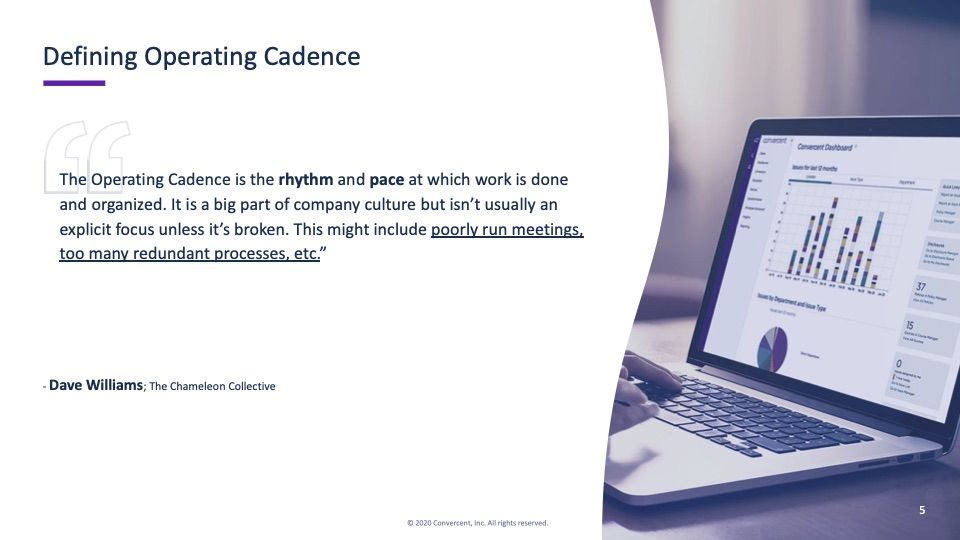
He says the operating cadence is first and foremost, the rhythm and the pace at which work is done and organized usually on your teams.
It's a big part of company culture and can either exude your company culture or become a detriment to your company culture.
But it isn't usually an explicit focus unless it is broken. What Dave is saying there is people don't necessarily talk about the operating cadence until they realize it's not being done well.
We tend to not be proactive about what we need from weekly sessions until we recognize they're not really having the outcome we want them to have.
When we define our operating cadence, we want to be hyper-focused on:
- How often are we meeting?
- What's the rhythm?
- Are we at the right pace?
- Is this how frequently we should be meeting?
- Does this topic of conversation require more frequent sessions? Less frequent sessions?
- Are we defining what the purpose and intention are?
Common sales cadence
If you're a leader of a sales team today, you're probably thinking to yourself:
Alright, I have a pretty good operating cadence!
And you probably include at least one of the following five sessions within your operating cadence.
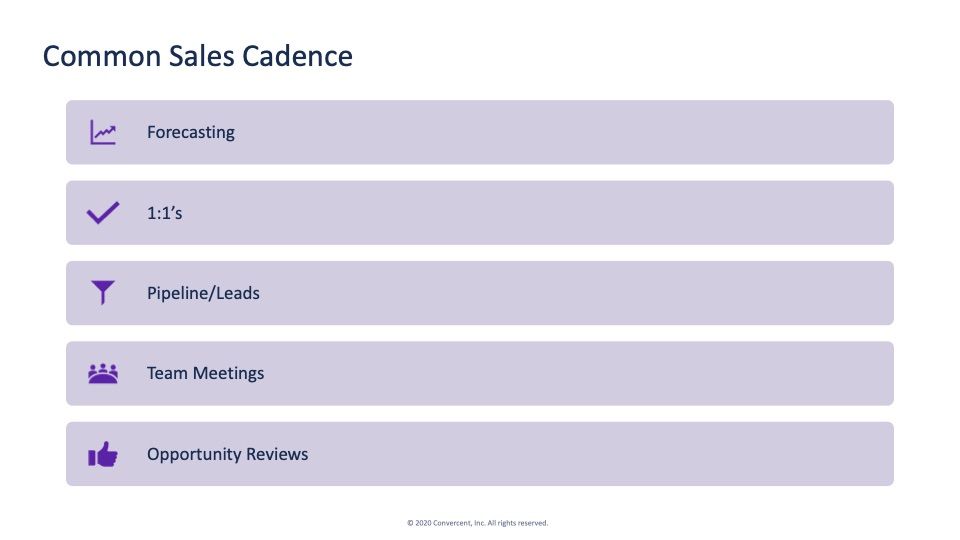
You may be looking at this list of five and thinking to yourself, "Yeah, we have all five of those!".
Great – are they going well? I want you to ask yourself that question first.
- Do you feel like in all five of your sessions you get out exactly what you want to get done?
- Your conversion percentages, your pipeline maintenance, your average sales price, your close rates, are continuously increasing or decreasing (depending on which direction is positive)?
That's the first question to ask.
The second piece is that some of you might be looking at this list of five and saying:
How in the world are any of those different from one another outside of maybe team meetings and one on ones? I do all of my forecasting, pipeline, leads, and opportunity reviews in my one on one"
That's really common – and I'm here to explain why it is so important to separate these out.
Not so you can add more operating cadence meetings to your calendar every week, but so you can accomplish whatever the largest priorities are for your sales organization right now.
 Rebecca Stewart
The four keys to effective operating & leadership cadence
Before anything else, make sure you're conscious of the four key areas that will make the largest difference for your sales coaching and leadership cadence – these are:
Opportunities
How many opportunities do you have? This is the lifeblood of your sales organization.
We all know this, I don't have to tell any of you this. The more opportunities you have, the more you have in the pipeline, the more opportunities you have to close. So:
- What is the composition of your opportunities?
- Are they high ARR, are they low ARR, and why might that be happening?
- How are you continuing to hit your pipeline targets?
- What pipeline target do you even have to hit based on your closed percentage? If you're closing only 25% of opportunities in your pipeline, you're going to need 4X pipeline.
- How are you thinking about the opportunities that are existent in your pipe?
Pace
- How are your opportunities moving through every single stage of your stage advancement criteria?
- How are your reps and your leaders spending their extra time during the week?
- What are you doing to ensure that the opportunities that are in pipeline are getting the attention they need?
- And that they are forecasted accurately?
- Are they in best case? Are they in pipeline? Are they in commit? Or whatever it is you put as your nomenclature vernacular on your stage advancement.
Deal strategy
- Are you currently leveraging a specific sales methodology?
- Are all of your people following that?
- If so, can they play back a deal strategy to you in relation to MEDDPICC, in relation to BANT, in relation to the challenger sale, in relation to SPIN Selling, in relation to value-based selling?
- Based on that, do they have multi-threaded opportunities?
- Are they speaking to enough people?
- Have they mapped out their buyer landscape, potentially?
- Have they identified effective next steps not only on their side of the house but on the customer side of the house? Is it mutual?
- Have they agreed upon paperwork?
Those aspects of your deal strategy are going to be really tangible in relation to whatever sales methodology your organization follows.
At scale
- Can they optimize all the opportunities they have and run similar plays or the plays they know they need to run at the right time, in the right opportunities, and ask for help in the right ways?
- Are they sharing with their team members best practices?
- Are there great stories of successes and failures so the larger organization gets to learn from one another?
Now, you may be looking at this list of four key effective operating or leadership cadences and thinking to yourself:
Well, where do I even start? Because I recognize I need to include all four of these aspects into my operating cadence. But I am having issues with everything from pipeline maintenance to negotiation tactics way later in an opportunity.
Where to start
Where in the funnel should you start with your coaching?
Here's my suggestion – a piece of advice from enablement to sales leaders – always look towards the areas that are going to have the most effect.
Think about the action that, if you pull that lever, everything else can begin to waterfall.
In a previous role, for me that was really:
- How do we manage our pipeline?
- How do we see what pipeline is coming in from our business development team?
- Are our sales reps prospecting on their own?
- Do we have 4x, 3x, 2x coverage?
- Are we handling our pipeline nurture?
- Do we have a pipeline nurture strategy?
Once we understood those elements, we had a better insight into what then moved or converted into stage one opportunities – which then allowed us track conversion percentages (should our conversion percentages have been low), and help us to then waterfall all of the rest of the aspects of our operating cadence in conjunction with that first lever we've pulled.
How might this look for you?
When we think about our operating cadence we want to think about it in two ways:
- What do we need to do independently, one on one with our team members?
- What do we want to do as a team, with more than just a one on one session, in team meetings?
Operating cadence 101
If we start to waterfall our opportunities, pace, deal strategy, and at scale into specific meetings, we start to actually cut it up and it starts to look bite-sized.
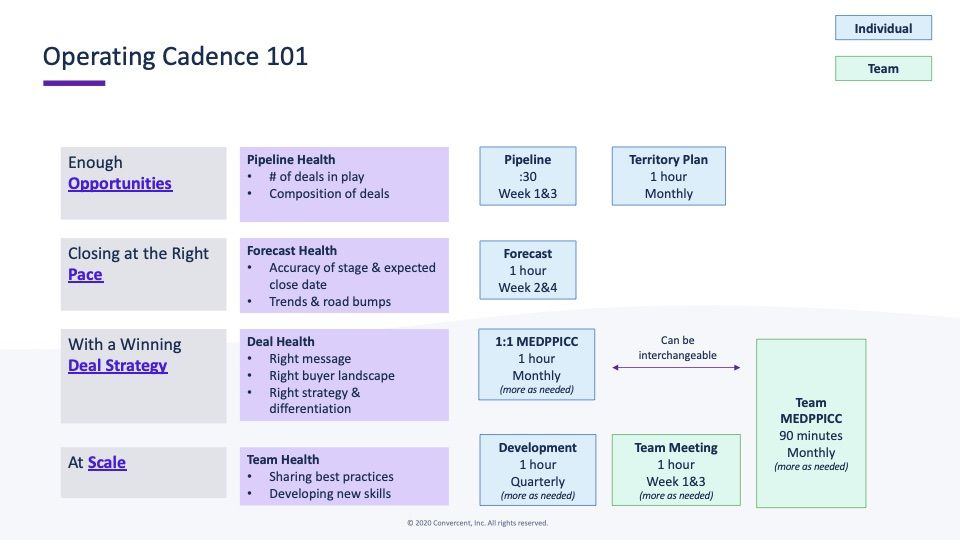
Opportunities
Do we have enough opportunities?
Pipeline health
Where this tends to play the largest role is in our pipeline health. When we define pipeline health, that usually is composed of two areas.
# of deals in play
First and foremost, do we have enough deals in play period?
- Are we getting enough at-bats from our business development team?
- Are they quality?
- Are they only quantity?
- How are we qualifying them once we are in pipeline? And,
- How are we moving them through?
Composition of deals
The second is what is the composition of these deals? I heard an amazing analogy that I love to use now around the composition of deals called whale, tuna, and guppy.
- Are you a rep that has a majority of guppies in your pipeline?
- Those deals that depending on your RR are less than $5,000?
- Do you have more of the tunas that are in between, say the $10-25,000 range?
- Or do you have the whales that are over $100,000?
- If you hit one of them, you could potentially hit your quota for the quarter?
- Where are you spending your time based on the composition of those opportunities?
This then waterfalls into the rest of the four key areas of our operating cadence strategy.
Pace
Forecast health
The second key area being pace - what's our forecast accuracy?
- Do we have good forecast health?
- Are we moving opportunities through their stage advancement criteria in the expected dates that we expect of our team just based on our general average sale cycle?
- And what are the trends we're seeing with forecast accuracy? Based on our commitments and best cases for our team.
- Do we have people that are sandbagging?
- Do we have people that are committing more than they know that they can get in because they're just trying to commit their number? That's really common as well.
Deal strategy
Deal health
With a deal strategy, we want to, of course, ensure that we have some type of one on one session with our team members to give them true independent coaching.
But then also, if you don't have the time to do that, incorporate this into a team meeting.
- How can your team members build off of one another and build strategies together based on all of their experiences?
- Are we sending the right message to our prospects?
- Are we identifying the right buyers as we're trying to multithread?
- Do we have the right differentiation for the competition that's involved in this opportunity?
- Are we identifying the decision criteria and decision process early on?
- Or are we forgetting?
- How are we pricing this deal strategy?
At scale
Team health
Then we go into team health which really helps us to identify not only best practices, but it offers a great opportunity to develop new skills around all of the other areas of the operating cadence.
When I bake this out, I bake it out in separate sessions that either occur once every other week or monthly. This will really help you to first of all cut back on unnecessary meetings you may be currently having weekly.
Secondarily, it helps you to really understand what you're going into your leadership forecast meetings or your leadership pipeline meetings with because they are happening frequently enough.
Frequency
In the previous diagram (Operating Cadence 101), you can see suggestions for how often you should be having pipeline meetings and how often should these be solely pipeline meetings.
Not pipeline and territory meetings, not pipeline and forecast meetings, not pipeline and deal strategy meetings, but true pipeline meetings, as opposed to forecast meetings.
Learning by osmosis
If you don't have the time because you’re strapped and you’re a small team, and you don't really have the access to coaching all the time for your team members, use your team members as assistants to help you coach.
Get learning by osmosis, do team forecasting, team pipeline sharing so you can continuously share best practices.
 Daniel O’Dowd
Coaching vs. not coaching
I mentioned that in a previous role started this all off with our pipeline health. We wanted to figure out how in the world we were going to ensure we had the right pipeline, and whether we were managing our pipeline effectively.
I'm going to bring us back around to our quote by John Buchan – we can't force greatness into anybody, but we can elicit greatness for it's already there.
Observing your seller in action vs. taking over the sale
As we go into how to lead these aspects of our operating cadence, we want to make sure we are checking ourselves as leaders and not micromanaging.
Don't take over the sale. Don't say: "I can help you with all of these specific areas".
Instead, observe your sales reps in action, and ensure they can play back a strategy for you.
Asking discovery questions vs. telling sellers what to do
What I see so frequently with sales leaders is they'll close meetings by saying:
Here's what I think you should go and do. Next time, come back to me and tell me that you did it.
Rather than saying:
Walk me through what we just spoke about, and tell me what you are going to do.
Mutually agreeing to expectations vs. setting sales targets
Asking discovery questions about the rep's preparation, what they're taking away from the meeting, and what they're agreeing to go and execute upon, is going to be significantly more impactful than telling them, taking over, setting targets that are really specific – it's better to mutually agree on behaviors.
Focusing on the future vs. focusing on the past
As we're starting to get to change management, we focus on the future rather than the past.
Instead of:
You've done these things wrong a million times.
It's better to focus on how they're going to change in the future. We allow the rep to play a huge role in deciding how they are going to move forward.
We're eliciting the greatness out of them, so we have to get buy-in from them.
 Thomas Cheriyan
Pipeline 101
Based on that, how do we even start to define a pipeline meeting? Firstly, you want to make sure that as you are defining these separate stages of your operating cadence, you do three things.
Purpose
Always make sure you have a purpose for why you are running this meeting.
If you don't have a good purpose statement or intention of what the outcomes are, I can promise you this meeting will get eaten up by something completely different – and you won't end up focusing on the largest areas of opportunity that will enable your team's success.
On top of that, if your sales reps don't have something to prepare for, or they don't understand what the purpose is for them, it can lead to what's called seller deficit disorder that Force Management talks about:
Hey, Mr. or Mrs. Leader, I don't know why you're asking me for all this information because you don't use it.
That is so negative for how your reps then view you as an effective coach or leader – we always want to make sure we're defining a purpose.
Here's an example of our purpose statement for pipeline:
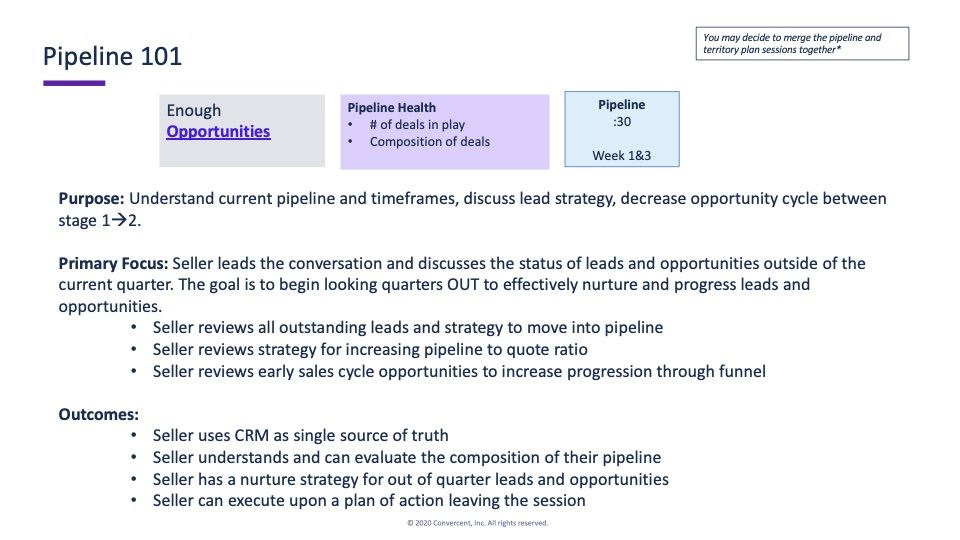
We want to:
- Understand the current pipeline and timeframes of pipeline.
- Discuss our lead strategy.
- Decrease our opportunity cycle between our stage one and stage two opportunities.
How can we get more into our lead funnel, and then into our early stages of our opportunities?
Primary focus
The second thing to do is ensure that you've organized your primary focus – who owns the meeting? What you expect of them owning the meeting?
For us, our pipeline meetings are run entirely by our sales reps. The reps:
- Lead the conversation
- Bring all of the relevant information in relation to outstanding leads and strategies to move it into pipeline
- Bring their increasing pipeline to quota ratio, their early sales cycle opportunities
- Explain how they plan on getting them through the funnel, their BDR strategies, etc.
They are responsible for bringing all of that to the table.
Outcomes
Finally, the third piece (which is extremely important as you're starting to define your operating cadence for specific meetings) is what are the outcomes you are expecting?
The outcomes we have been expecting, that we do expect are that our seller understands how they can evaluate the composition of their pipeline.
Can I look at my pipeline strategy and say:
Hey, I'm working on way too many guppies right now and it's taking up so much time. Do I have the permission (because that tends to happen often) to set aside these opportunities that may not be playing as large of a role in me hitting my quota, and therefore the team hitting our quota, and focus more on these tuna and these whale opportunities?"
Not only that, but the seller should always leave these meetings with a plan of action they can go and execute upon.
Let's talk about what this looks like when we break it down even further.
Setting expectations
We set the sales reps and sales leader expectations specifically, and we share this with them as if it is a sales meeting.
One great lesson I've learned about change management for all of you sales leaders out there who are struggling is this:
If you can relate whatever activity you're trying to change the behavior of to an activity your people already understand inherently (the sales motion, for example), you'll have a significantly higher likelihood of true change management and progression of whatever opportunity you're trying to face.
The sales rep
For example, for us, when we set the expectations of our sales reps coming prepared to the meeting – we look at it as the sales rep runs this meeting, and the leader is the actual customer. The leader is being sold to, essentially.
That means the sales rep better come with the collateral necessary for the sales leader to be educated on the process, and know their territory, their current pipeline numbers, the number of opportunities put in nurture, etc.
- What's happening to them once they've been in nurture for 60 days, and they need to fall out?
- How are they working with the BDR?
- How are they using other folks within the organization to help them get to their pipeline numbers?
The sales leader
The sales leader on the other hand, when we talk about coaching, has to have some different parameters – the sales leader is the customer in this meeting.
The more that we try to cut people off in the middle of these sessions (unless they're going down a rabbit hole that's not relevant to the meeting), the less they will believe this meeting is theirs – and the more they'll believe that you're trying to micromanage their pipeline.
As a sales leader, you have to be willing and ready to allow the sales rep to kick off these meetings, to patiently listen, and take diligent notes on whatever it is that they're saying.
Because when you close out this meeting, you want to make sure your sales rep has something to go and act upon.
Finally, be sure to begin every single meeting you have in your operating cadence by recapping the areas of opportunity from previous sessions.
 Rebecca Stewart
For example, if our pipeline meetings are every first and third week of the month, at the end of my first pipeline meeting, I am asking my rep:
All right, Maggie, walk me through the areas you are going to focus on for your pipeline health before week three.
I'm going to ask Maggie to run me through a mutual action plan of what she's expecting to do and what she needs help with.
I'm then going to kick off the meeting in week three with:
All right, Maggie, you told me you were going to go and execute upon this number of areas of opportunity within your pipeline. Talk to me about how it's going, and then let's get into the numbers.
Everything has to come back around to whatever it is you spoke about before, or else the sales rep will believe you are not doing anything with the information from these meetings.
Getting seller buy-in
It's super important to not fall into the aforementioned sales leader deficit disorder here.
Ensure you're getting sales rep buy-in in doing this, because we all know that when we have buy-in from our team members, they're so much more likely to participate and make it their own.
Meeting process
Acknowledge
Acknowledge the current process that they run through, just to listen to it.
Ask
Ask them for gaps they see or areas of opportunity they see within their current process. Get their perspective on literally what they believe they could be doing better at and where they need help.
Agree
Agree with them upon how you plan to modify this new process into your stage advancement criteria, sales methodology, or whatever it is you're trying to make a change in.
For example, for pipeline health, we're leaving a meeting, in our first meeting where we're getting buy-in – I'm saying to my rep:
All right, Maggie, do we agree that our area of focus is going to be getting opportunities from our lead stage into our S1 stage faster?"
"Yes, I agree".
We always want to make sure we're leaving in agreement.
Involve
The second to last piece would be to involve others. Get your team together after you've had your one on ones around specific meetings in your operating cadence and talk through what's working and what's not.
Set up
Then set up a true action plan. Another way to actually involve others would be to say:
Maggie, talk me through how you're leveraging your business development representative to help you with developing pipeline and ensuring you're getting quality leads that are qualified
We, of course, want to make sure our reps are bought into the strategy and the progress of our sessions.
 Sales Enablement Collective
How can we effectively coach?
One of the most impactful ways I've learned to effectively coach is by using the Socratic method:
The Socratic method
The concept at the heart of the Socratic method is that we're not necessarily looking for a right or wrong answer.
When we ask questions in any one of these meetings within our operating cadence, we're not asking for our reps to say yes or no to any of the questions we ask.
Sticking with the pipeline meeting example – what we're trying to probe out is how do they think about it? What's their perspective on the world of pipeline? And how do they act upon the ways they believe?
This will give us a few things:
- First, it helps our reps to actually work through whatever their perspective is, rather than coming to you consistently and asking you what are the right or wrong ways to do things. It's truly helping them go through the learning process within their own mind.
- Secondly, it helps us identify our areas of gap that we can then go and coach to. Maybe it is "I think about pursuit nurture in this specific way and I think pursuit nurtures can sit in that stage for a whole year". Maybe that's not your process. Maybe you only want pursuit nurtures to sit in that stage for 60 days. How are you going to start to maneuver and express to your sales rep why their plan might not be as successful?
- Thirdly, it allows you to leverage your sales enablement team for areas of opportunity you might be able to tune in on. Always use your sales enablement team, if that's of access to you, to help with leading these types of coaching sessions.
Whenever we're asking these Socratic questions, we want to be asking them in a broad and generic way. Ultimately, we're trying to understand how our people think and, therefore, how they act.
The Socratic method in action
The whole point of the Socratic method is to force you to listen actively and follow your line of questions while doing so.
Example 1:
For example, if I'm sitting with Maggie in a pipeline session, and I ask her:
Where is most of your pipeline currently coming from?
And she says:
I don't know.
Then I follow up with something like:
Maggie, can you talk to me about why you don't know? Can you talk to me about the specific reports you use to track your pipeline? Can you walk me through your relationship with your business development representative, so I can understand a little bit better why this might be a disconnect?
Example 2:
Similarly, if I ask Maggie the question:
Talk to me about the composition of your pipeline, what types of opportunities tend to fill it?"
And she replies with:
Well, a majority of my pipeline are deals like XYZ company and usually, I'm really struggling with those because they only have a $5,000 ARR
Then I'm probably talking to Maggie about:
- Who is she going after in her own prospecting time?
- What her strategy is with her BDR to ensure she's getting quality pipeline from larger organizations that will have bigger average deal sizes associated
Continuing the conversation
The real point of this section is to give you some examples of great questions you can use in these sessions – allowing you to then follow up with this:
Okay, now that you've walked me through areas of opportunity you clearly have, I want you to talk to me about areas you're going to hone in on and execute upon before our next session in a couple of weeks.
This is not to say that in using the Socratic method, you can't also give advice or coaching tips.
For example:
Hey, Maggie, I might suggest you sit with your BDR and walk through a strategy of who it is you're targeting and understand whether these are real ideal customer profile accounts? Or are they lower grade, and maybe not as good for your continued pipeline maintenance?
Next steps
In this guide, I've talked through a lot to do with operating cadence. When you start getting into conversations around the operating cadence, it can seem like this massive ocean to boil.
But in reality, what you need to do is get focused, prioritize, and make sure you have a purpose and intention set – so that you can impactfully and effectively coach our team members!
This article is based on Maggie's presentation at our Sales Enablement Festival.



Sales enablement insider
Thank you for subscribing
Level up your sales enablement career & network with sales enablement experts
An email has been successfully sent to confirm your subscription.
 Follow us on LinkedIn
Sales enablement insider
Thank you for subscribing
Level up your sales enablement career & network with sales enablement experts
An email has been successfully sent to confirm your subscription.



.svg)
