


Let me start with a confession.
We in enablement? We're good at making things more complicated than they need to be. It's our superpower. But when you strip away all the certifications, programs, and classes around change management, what you're left with is pretty simple: we have a current state, we have a desired future state, and there's this gap in the middle.
The real question is how do we get people to move across that gap?
I've been thinking about this a lot lately, especially after developing our social selling certification program at SAS. And here's what I've learned: until someone in the field takes action, you haven't enabled them.
Making the abstract concrete
There's this word I learned in college that's been rattling around in my brain lately: reify. It means to consider or represent something abstract as material, concrete, or definite in form. And honestly, this is what we have to do for our field every single day.
Think about it. Most of what we teach people is actually really abstract.
Prospecting, coaching, onboarding, negotiation, discovery, what are those actually? We live and breathe this stuff every day so it makes sense to us.
If I said to you, "Hey, we need to develop an onboarding program to help make sure that our team in 30, 60, and 90 is prospecting with the qualified ICP," that makes perfect sense to you.
But to the field? They're thinking, "Yeah, but it's Tuesday at 2 o'clock, what do I do?"
This disconnect between our strategic thinking and their tactical needs is where certifications come in. And before you roll your eyes thinking this is just about social selling, stick with me. This has nothing to do with social selling specifically.
Anything you want to do can be a certification program. Don't even call it a certification if you don't want to. Call it a badge, a club, or whatever works for your culture. Some of your sellers are probably trying to achieve President's Club every year, and what is that really? It's just a special group of people who've proven they're on the inside.
Three benefits of internal certification programs
When we created our social selling certification at SAS, we discovered three major benefits that apply to any certification program you might create.
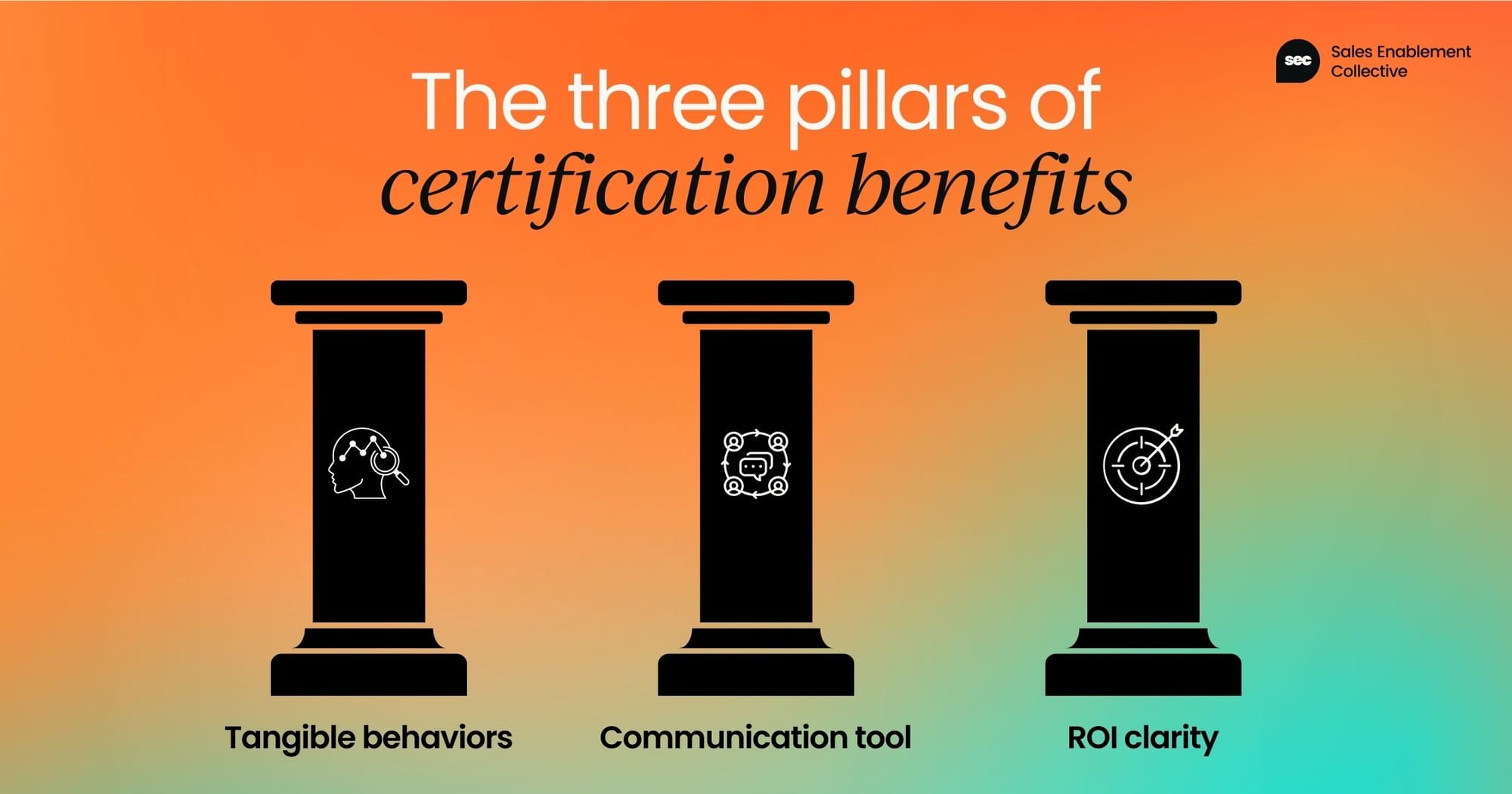
1. Making new behaviors tangible
The biggest thing a certification does is make what you're asking of your team tangible. They know what to do. Take prospecting as an example. "Hey, we want to help you get better at prospecting." What does that even mean? Let the word "better" be a big red flag because you can't track better.
Instead, imagine saying, "We're going to help you with prospecting. We're going to give you the tools that you can use to identify and qualify the customers you should be contacting. We're going to give you a playbook that outlines what the approaches are, the scripts you should be using, whether it's a phone call or email or social. And we want to talk about what is expected as far as the activity numbers and then give you a path to help do that."
Now that becomes tangible. That person on Tuesday at 2 o'clock knows exactly what to do: "I should be making these 10 phone calls I was supposed to make using this script to this specific type of customer."
2. Creating a communication tool
This might actually be one of the biggest benefits. A certification program gives you a communication tool for two very specific stakeholders.
First, it's for the person you're trying to get to do something – that seller in the field, the customer success person, your technical enablement team, whoever it is. It lets you communicate clearly: here's what I expect you to do.
But even more importantly, it gives you a way to communicate with your leadership. Since we've developed our certification program, I don't get nervous when my boss, and my boss's boss, and my boss's boss call me and say, "I'm going to talk to the SVP of sales in this region. What have you done for them?"
Now I can look at a spreadsheet and say, "Well, they've got four sales teams. We've put three of them through their training. By the way, the fourth one, the sales manager is being difficult and isn't giving us the time. And by the way, those three teams, here's the impact we've had on them. The team that hasn't gone through the training? Here's how they're doing."
That conversation takes us about five minutes to figure out. But it's only possible because we've reified the abstract program into something specific.
3. Simplifying ROI measurement
Think about a lot of the programs you develop. When they're kind of loosey-goosey, it's difficult to measure impact. You end up saying things like, "I think we put them through this AI role-playing, and it's available to them. We're not sure how much they did it, and we think it helps."
Compare that to: "We have a role-playing certification. If you've done 10 role plays and you've passed the test and the AI said you did a good job, you get this badge. And by the way, when people have that badge, we track their pipeline development. We track their sales conversion and it's 16 points higher."
Boom. The ROI becomes much clearer.
There's also something else that certifications do, depending on how you present them. They make things cool. I have a good friend Andy Crestodina who once said, "If you draw a circle in the sand and get in it, other people will want to join you." There's truth to that. It's about saying, "Here are the people who are certified. Why aren't you?" It makes the communication a little easier.
Our social selling certification results
I know most of you aren't involved in social selling specifically, but let me share what this approach has done for us. We developed three levels of certification.
One is an on-demand training program. One is a live training process where they work with our team. And then the mastery level, that's for people who really want to get involved. They get one-on-one help, we do some auditing, and we're tracking specific activities. It allows people to opt in where they want.
Today we have 586 certificate holders. Our goal is 600 by the end of the year, so I'm checking it every morning. We've gotten almost 600 individuals certified in the first 18 months of the program.
But it doesn't stop there. The certification has given us the ability to continue talking to people and having a reason to engage. We run follow-up trainings for the various levels every other month, at least every quarter. Two weeks ago we had 67 people in a training. Completely optional. Their sales managers aren't making them do it, but 67 people spent an hour with us just to learn more about how to use some of the new tools that are available.
We also send out quarterly emails to all our certificate holders. I know, I know – nobody reads emails. But just having an excuse to show up and make it interesting, share some successes that we've had and that others have had gives us a great opportunity to keep the conversation going.
The impact? Just this year alone, if social selling is involved in a deal, those deals are 51% bigger. So when we want to talk about impact, this allows us to go to other parts of the organization and ask, "Do you want this?"
Setting the stage for your certification
If you want to put together any sort of internal certification, there are three things you need to do to till the fields before you even plant the seeds.
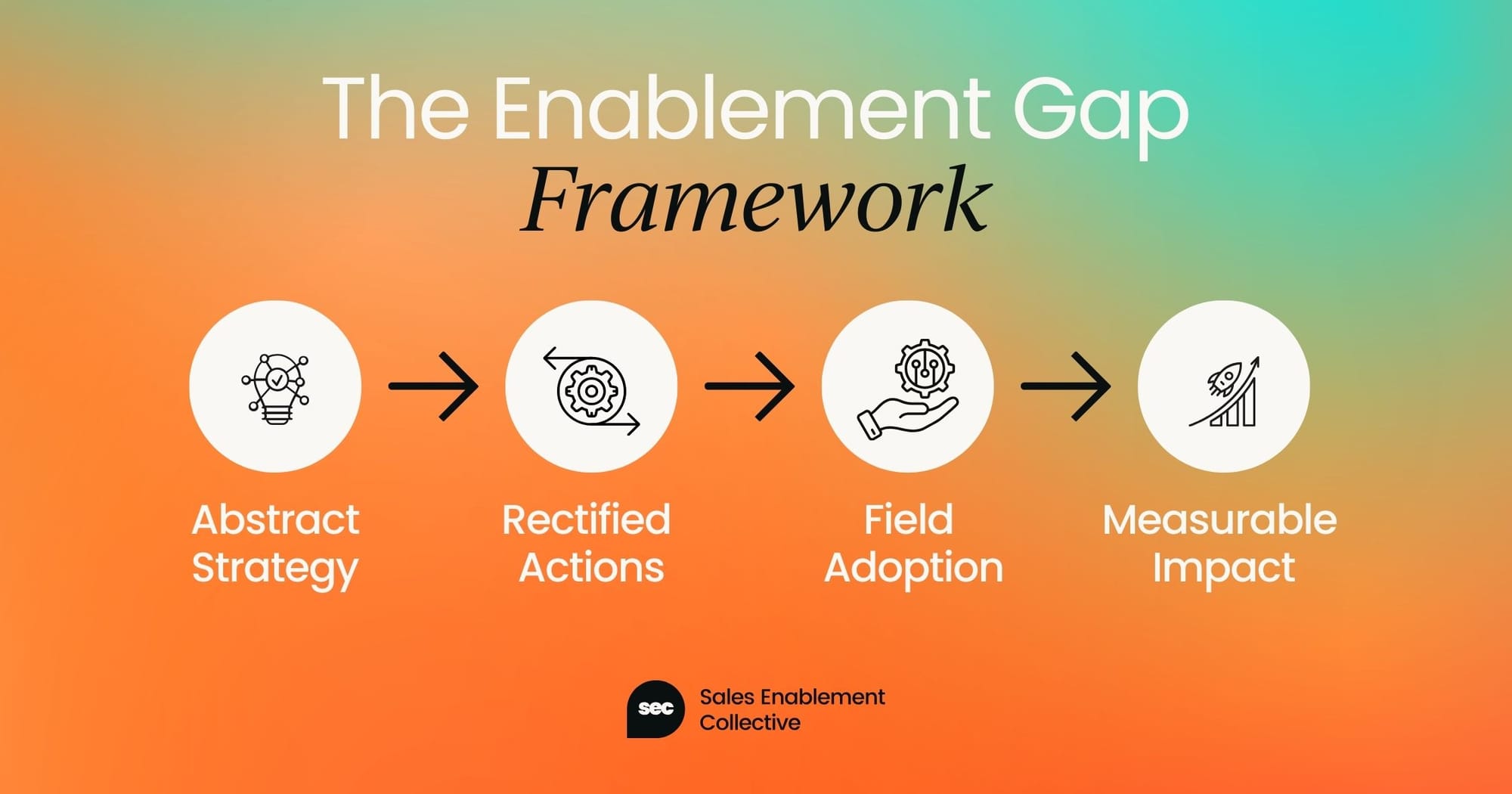
1. Build cross-functional relationships
That's a fancy way of saying you need to know all the different stakeholders who would touch this. I think it's important to know two groups specifically.
First, the people who can be allies. Is it marketing? Is it ops? Are there specific groups you need to get tied together with? For example, if you wanted to create a certification around a specific tool – I was speaking with somebody who's trying to roll HubSpot out to their organization – maybe it's working with ops and saying, "Hey, we need to partner together so we're working in lockstep."
The second group is the people who will be upset when they hear about your certification and you didn't talk to them. You know who they are in your organization. It's that person who's like, "Well, we're involved with that, why weren't we told about it?"
For our program, I'm responsible for social selling. We also have, in our marketing department, the employee advocacy team and the people who run the official company social media accounts. You're darn right I got to know those people really well. So they didn't go, "What is this? Shouldn't we have been doing that?" I started making relationships with them way before we ever did this. I didn't always ask them permission, but they at least had a way to call me and find out if something was up.
2. Define clear activities
Think about what you actually want people to do because they've gone through your program. Not what they know – what they do. You have to have clearly defined activities.
Here's the way to test if you have a clearly defined goal: can it be answered with a yes or a no? If you cannot take that metric, whatever that parameter is, and answer with a yes or no, you have not clearly defined it. "Better" is a red flag. We don't want better. We want: they did this many times. They did it this way. They used this tool this many times.
I can look at a report and know how often our people use Sales Navigator, how often they log into it. I have goals around that. How many times they've saved a lead in the platform. That's what we're looking for – those specific numbers.
3. Find a leadership sponsor
You don't always need somebody in the C-suite to sponsor this, and that's fine. You don't need an active sponsor. What you need is air cover. You just need someone who can say, "Well, this is something that's important to this individual."
Look at whatever program you want to create the certification for. Where does it align with organizational goals? Who does it connect with? That might be some of your sales leadership or your CRO. It might be someone in marketing or operations. Figure out who can give you that air cover.
When I started our certification program, it literally began because it was on a roadmap. Not even the main roadmap – it was in the "here's some ideas we have" section. Our senior director was in a meeting with the chief sales officer, who asked, "What's that?" I got an email the next day, and suddenly that certification program became "We are going to do that."
What that meant is our chief sales officer wanted it. That allowed us to get the resources and the permission to do it. You don't need them to say, "Yes, I'm going to give you a budget." But having that person who thinks what you're doing is a good idea helps a lot.
Let's get the objections right on the table.
"I don't have permission"
Here's the secret: you don't need it. Every certification, every badge, every club, and every group is completely invented. That's a dirty little secret.
Now, some certifications are good inventions that we all agree with. I'm glad my doctor is certified. If I'm calling a lawyer, I want them to have passed the bar. But eventually, everything is just a shared invention. You don't need permission to do any of this. Do you know who I asked for permission to do a social selling certification? Nobody. I just said, "All right, we're going to do it."
If you do want to create a certification around a specific tool, then maybe talk to your vendor to make sure you're not stepping on any toes. We have a social selling certification, not a Sales Navigator or LinkedIn certification. We don't say that's what it is. And definitely go talk to your vendors – maybe they have some tools you can use to help.
Similarly, if you're using an established sales training process, and there are lots of them out there, if you want to get that certification, fantastic. I'm not telling you to take Challenger Sale and then just not pay them for it. But if you really think about what we're asking our people to do, you don't need a trademark on it. You're asking them to do some pretty basic activities.
"I don't have the resources"
Of course you don't have the resources. Who in here is over-resourced in their organization? None of us are bleeding budget.
Here's the thing: you actually don't need more resources. Just repurpose what you have. In our journey with the social selling certification, we added exactly zero things to what we were already doing. We were already running training. We already had the on-demand programs. Yeah, we do some audits now for the people who are really rock stars, but you know how much it costs us? Zero. It literally cost us the price of making those stickers, and our printing team did that.
Instead of thinking, "I've got to now do additional work," look backwards. What have you been creating this year? What can you take and package in a way that is much more easily communicated with the field? What can you take and put a framework around and say, "This is what we've actually been doing"?
We had been doing these trainings already, but people would ask, "Is this team enabled on social selling?" And I'd have to say, "I think we went through the training, but actually we did the training like six months ago, and I know there's a bunch of turnover and we reorganized, so I think some of them..."
Now, my colleague Becky Brown, who's way more organized than I am, has an amazing spreadsheet. I call her and say, "Okay, we need to know," and boom – she gives me this list. It makes everything so much easier.
"I don't have the bandwidth"
Again, of course you don't. You're being asked to do so many things. We talk about the need to be proactive versus reactive, and it's great because we should be super proactive. But we all know we're going to go back to the office tomorrow or Monday, or let's be honest, we're going to check our email later today, and there's going to be three things we're being asked to do.
There's always this pressure on our bandwidth. You're never just going to have a day when you think, "I have got nothing to do today, let's work on a certification."
Start small. You don't have to roll out an entire process quickly.
Launching your certification
Once you've got your program ready, you have to get it out into the world. I've written a number of books, and what I learned very early on is that writing books is easy. Getting people to buy your book is really hard. That's why you'll see people in your networks talking about their launch days or why movies have premiere days and make it a big deal. It's all about getting people's attention. Do the same thing for your program.
Pre-launch with pilots
There are pilots to try stuff out, and then there are pilots who are like, "We're going to do this, we're going to get some momentum first." We had a few sales teams that we piloted in our certification program. We knew this was good. We knew it was going to stick because what that allowed us to do is start day one and not say, "Hey, would somebody like to get certified?" Instead, it was, "You should get certified. Forty-three of your peers are already certified." That change in communication was so valuable.
Make it an event
Again, it's all invented. Pick a day – launch day. Even if it's something you've been doing for a while. "January 2nd, 2026, is the launch of the new onboarding certification." Talk to your sales leaders who you've got in a coaching program. "March 6th is the beginning of our new certification, and we want you to be involved in that." Pick a day.
 Sales Enablement Collective
Identify your champions
Think about who the people are that are super excited. You all know who they are. There's that salesperson, that sales leader who will actually talk to you all the time, sometimes too much, who's really engaged. Great, that's your champion. "We're starting a new certification program. We want you to be leading it. I want you to be in the first cohort."
Find the people who are respected by their peers. If there's a sales team, there's somebody who's a rock star that other people listen to. Get that person to be your champion if they're up for it.
Over-communicate
This is probably one of the biggest mistakes we make in enablement – we think people have heard us. We all joke, "Yeah, nobody reads their email." I don't mind what platform you use – Slack, Viva Engage, pick your platform – they're not paying attention.
What's really happening is they are paying attention when they have time and when they're not worried about getting in front of a prospect or getting an email from their sales leader, hitting quota, or all the stresses that our salespeople have. So just keep talking about it. I've written books before where literally six months in, somebody's like, "Oh, I heard you wrote a book." I've been telling you every day for the last six months!
If you ever get to the point where you feel you've discussed your program too much, you are starting to get through.
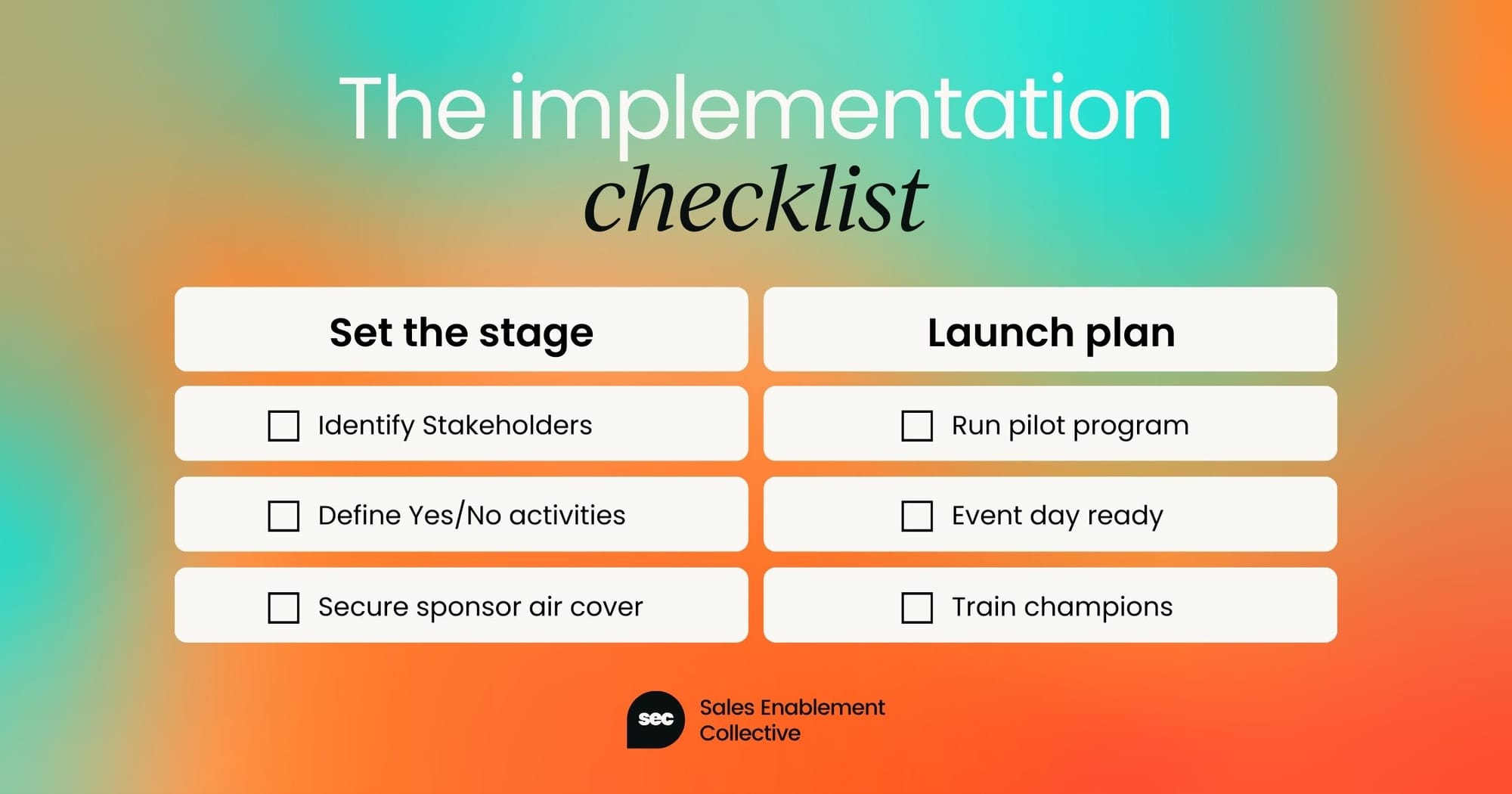
Keeping the momentum going
You draw the circle, you get inside and say this is cool. You can't do that once. You have to keep talking about how cool this is. How cool this circle is. Don't you want to be in the circle? Don't you want to have that badge? Don't you want to be certified? Don't you want to be in the club?
We're 18 months in, and we talk about it just like it started. Those stickers we made? We just had that idea about a month ago. It was an excuse to talk about it again. It was an excuse to send those to all of our people who were certified.
You still do all the things that you would if this was just one of your programs. We track it, report it, all of that. Nothing changes. But add in celebration. This gives you an opportunity to celebrate and elevate the people who are certified. Talk about them – they're champions. Make them feel good. Make other people want to feel good just like them.
When you do that, it gets exciting. We have a social selling program, so of course people are going to talk about it on LinkedIn. But when we sent these stickers out, people started taking pictures of them and sharing them. We didn't ask them to. Some posts got 18 likes, others 24, and one got 84 likes. My senior director posted hers – you want to talk about getting support? She was into it, and then she posted it, and then a bunch of people said that's great. It's called job security.
One of our sales managers in Germany shared it too. They're actually sharing within their circles of influence how cool this is. Think about where there's a place for you to really frame up your program.
The challenge for you
Change how you look at your programs, and that allows the field to change how they look at them. Most importantly, it allows them to start. You're on a starting line – you've got to do something.
So here's my challenge for you: when you go back home, back to the office, think about where you can frame something up. Where's a circle you can draw around something you're already doing? Just make it a little more compelling. Make it so that you can easily communicate to the field so they know when they've done what you asked them to do.
Because at that point, then you've enabled them.
The beauty of this approach is its simplicity. We spend so much time thinking about complex change management frameworks and methodologies, but sometimes the answer is just making things tangible for people. Give them a clear path, a way to measure progress, and recognition when they achieve it. That's what certifications do – they take all those abstract concepts we deal with every day and turn them into something people can actually grasp and act on.
Remember, until someone takes action, you haven't enabled them. A certification program, or whatever you want to call it, is just a tool to drive that action. It's about creating clarity in a world full of abstract concepts and competing priorities. It's about giving people a reason to engage with your programs not just once, but continuously. And it's about making your impact measurable and communicable to everyone who matters.
So go ahead, draw your circle in the sand. Get in it. And watch as others start wanting to join you.


Sales enablement insider
Thank you for subscribing
Level up your sales enablement career & network with sales enablement experts
An email has been successfully sent to confirm your subscription.
 Follow us on LinkedIn
Sales enablement insider
Thank you for subscribing
Level up your sales enablement career & network with sales enablement experts
An email has been successfully sent to confirm your subscription.


.svg)
