


Here's something my dad used to tell me all the time: “The time to fix the roof is when the sun is shining.” (Turns out JFK said it too, which gives it slightly more merit than just dad wisdom.) But here's why this matters for enablement...
We all know enablement is born during good times. The sun's shining, revenue's flowing, and a smart CRO thinks, “Hey, we're doing well – how can we do better?” That's when they bring you in to build or grow the enablement team.
But what happens when those clouds roll in? Maybe you hit a rough quarter or two. That CRO who championed you? Gone. New leadership walks in, looks around, and asks the dreaded question: “What exactly are you doing here?”
I've been there. More than once, actually. And if you're nodding along right now, you know exactly what I'm talking about.
From “gift” to linchpin: Why being nice isn't enough
Here's something that might sound familiar: “You are such a gift. We're so lucky to have you.”
First off, they are lucky to have you. But when leadership calls you a “gift,” what they're really saying is you're nice to have. Not need to have. There's a massive difference.
Gifts are optional. They're lovely surprises. But you want to be crucial. So how do you make that shift? After building enablement functions from scratch at two hyper-growth startups, I've developed a framework that works.
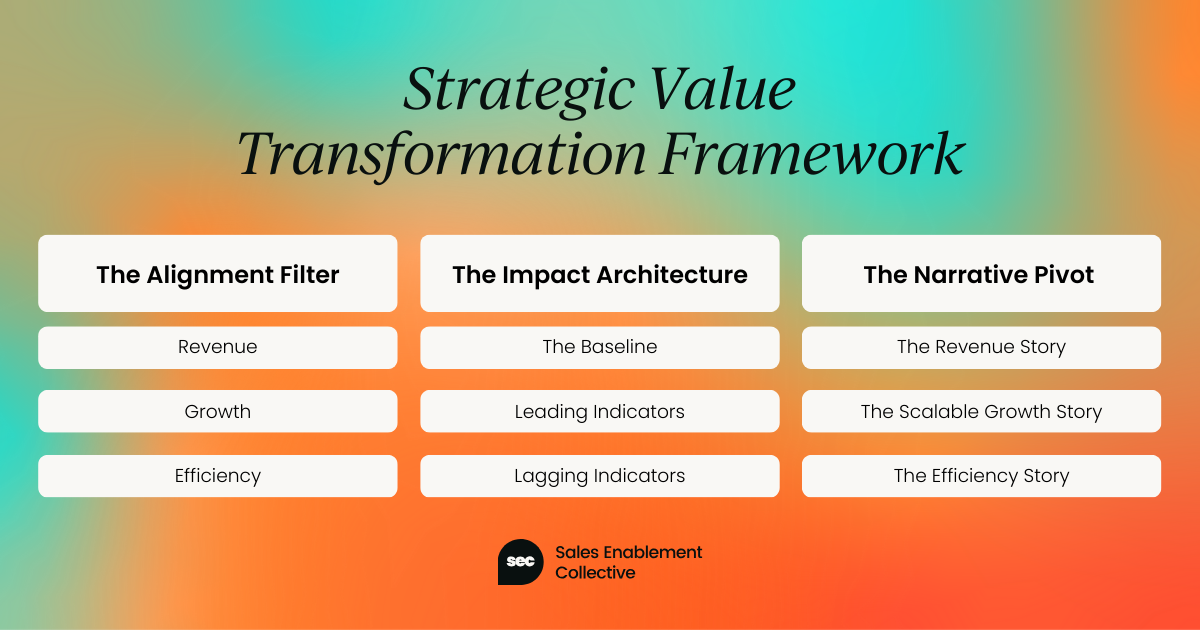
It comes down to three key things:
- Change how you speak to leadership
- Stay strategically outcome and data-focused
- Use storytelling to shape your impact
Let me break each of these down.
Part 1) Speaking the language of leadership
- Revenue (shocking, I know). They report to boards and investors who expect that number to climb every single year.
- Growth. They want to expand into new markets, increase market share, open new regions. They're constantly thinking about how to grow the pie.
- Efficiency. Every year, they're asked to do more with less. And with AI becoming more prominent, that pressure's only intensifying.
So where does enablement fit into these outcomes?
We're not direct sales. I'm never going to sign an IO. But we absolutely impact revenue. We drive scalability, which directly supports growth. And we save time, which translates to efficiency and productivity gains.
What leadership doesn't care about
This might sting a bit, but leadership doesn't care about:
- The number of workshops you delivered
- Your completion rates
- How many learners you enrolled
- The number of resources you created
These metrics never come up in boardroom conversations. So don't lead with them when you talk to executives!
Part 2) Begin with the end in mind
Close your eyes for a moment. Picture yourself at the end of the year. What stories do you want to tell your leadership team?
I recommend having three ready:
- A revenue impact story that connects your initiatives to metrics like increased deal size or improved win rates
- A scalable growth story that shows how you helped the organization expand efficiently
- An efficiency story that quantifies the time and productivity gains you delivered
Now, I'm going to give you the actual recipes for crafting each of these stories.
The three essential ingredients
Before we dive into the recipes, you need three key ingredients. Think of these as your high-quality olive oil, flaky sea salt, and freshly cracked pepper – the must-haves for any savory dish.
1. Your baseline
This seems simple, but it's where most people trip up. Any recovering people pleasers in the room? Yeah, I see those hands.
When you're a natural people pleaser (and on a work visa like me, it's a double whammy), you hate saying no. Someone asks for something, and you promise to deliver it tomorrow. You move so fast that you forget to capture where things stood before you started.
But without a baseline, you can't quantify impact.
2. Leading indicators
These tell you whether you need to adjust course. Are people adopting the new process? Is confidence improving? These metrics help you spot issues before they show up in the numbers.
3. Lagging indicators
These are your outcome metrics – the ones that actually move the needle for leadership.
Recipe #1: The efficiency story
The key metric for efficiency? Time saved.
Whenever someone asks me to create a resource – a playbook, template, whatever – I ask three questions:
- Has anything like this existed before? You'd be amazed how often the answer is yes, and no one used it. That's valuable data about why it failed.
- How much time is this currently costing the team? If you can't measure the time cost, you can't measure time saved.
- What challenge is this solving? The number of people who can't answer this question would surprise you. “We want it” isn't a challenge – it's a preference.
Real-world example: The QBR template
Agency leads were spending three hours prepping for quarterly business reviews. The storytelling was inconsistent. Data lived in a dozen different places. It was chaos.
We created a standardized template with a powerful narrative and centralized data sources. The results:
- 90% adoption rate
- Prep time reduced from 3 hours to 1 hour
- Described as a “game changer” by the team
“Agency leads were spending three hours preparing inconsistent QBRs with data scattered across multiple sources. We created a standardized template that reduced prep time to one hour.
“With 40 agency leads running 4 QBRs annually, that's 320 hours saved per year. At a conservative $150 fully loaded hourly rate, that's $48,000 in annual productivity value.”
See the difference? That's way more powerful than “They wanted it, and have you seen the template? She's gorgeous.”
Recipe #2: The scalability story
Scale can mean many things. Tool adoption across regions, process standardization, consistent onboarding. The key is showing how you helped the organization grow efficiently.
Real-world example: New hire onboarding
Time to first deal for new reps? 100 days. Not ideal.
Our analysis showed why:
- Inconsistent onboarding
- No single source of truth
- Unclear competencies
We fixed all of that with a structured program including milestone tracking, role-play practice, and centralized resources.
Result: Time to first deal dropped to 60 days.
“New reps were taking 100 days to close their first deal due to inconsistent onboarding. Our new program with structured milestones and centralized resources reduced this to 60 days.
“With 20 new hires annually, that's 800 days of productivity gained. At a conservative $40,000 productivity value rate, that equals $800,000 in potential revenue impact.”
Recipe #3: The revenue story
This is the most important story you can tell. And it starts with truly understanding your numbers.
You need to know:
- Current revenue gaps
- Win rates
- Average deal sizes
- Deal velocity
Once you understand where leadership wants to move these metrics, you can align your initiatives accordingly.
Real-world example: Discovery program
Remember that negotiation training request? We created a discovery program focused on value articulation instead.
Baseline: $40,000 average deal size
Result: $50,000 average deal size
“Average deal size was stuck at $40,000 due to inconsistent discovery and poor value articulation. Our new discovery program with standardized messaging and manager-led coaching helped increase average deal size to $50,000.
“With 1,000 opportunities annually, this uplift could equal $10 million in additional revenue.”
We're never solely responsible for these outcomes. But with solid data analysis and agreed-upon hypotheses, the story becomes clear – we contributed meaningfully to that improvement.
Part 3) The power of data-driven storytelling
Without data, you're just guessing. With data, you're building compelling narratives that resonate with leadership.
Every story should follow this structure:
- The challenge: What problem existed before?
- Your impact: What did you create or implement?
- The quantified result: What measurable outcome did you influence?
Making the shift from activity to impact
If you remember nothing else, remember this: Stay completely outcome-focused on revenue, growth, and efficiency. If an initiative doesn't tie back to one of these, it's not worth your time.
Lead with data. You can't drive outcomes without understanding the numbers. Partner with sales ops, finance, whoever you need to get ironclad metrics.
Finally, tell powerful stories. Begin with the challenge, describe your impact, and quantify the results. Make it impossible for leadership to see you as anything other than essential.
Your action plan
As you think about your enablement strategy, ask yourself:
- What three stories do I want to tell come my next progression cycle?
- What baselines do I need to capture now?
- How can I shift my current initiatives to focus on outcomes instead of activities?
The sun might be shining now, but clouds always roll in eventually. When new leadership asks what you're doing there, you'll be ready with data-driven stories that prove your impact on revenue, growth, and efficiency.
You won't be a gift anymore. You'll be the linchpin that makes everything else work.
And that's exactly where enablement belongs: right at the center of your revenue organization's success.


Sales enablement insider
Thank you for subscribing
Level up your sales enablement career & network with sales enablement experts
An email has been successfully sent to confirm your subscription.
 Follow us on LinkedIn
Sales enablement insider
Thank you for subscribing
Level up your sales enablement career & network with sales enablement experts
An email has been successfully sent to confirm your subscription.


.svg)
