


What is an SDR?
SDR stands for Sales Development Representative. These sales professionals focus on qualifying inbound leads generated through marketing efforts like content downloads, webinar registrations, and website inquiries.
SDRs typically report to the marketing department and act as the bridge between marketing-generated interest and the sales team. They're responsible for determining whether incoming leads match your ideal customer profile and have genuine buying potential.
In essence, SDRs are turning cold leads into warm ones by working with prospects who've already engaged with your company in some way. They focus on top-of-the-funnel lead generation, feeding those inbound leads who are already engaged through to account executives.
What is a BDR?
BDR stands for Business Development Representative. Unlike SDRs who handle incoming interest, BDRs proactively hunt for new business opportunities through cold outreach.
BDRs typically report to the sales organization and focus on outbound prospecting. They research target accounts, identify potential buyers, and initiate contact through cold calls, emails, and LinkedIn messages. Their goal? Creating sales opportunities where none existed before - it's all about identifying early stage business opportunities.
But here's where it gets interesting. If you asked ten organizations how they actually define these roles, you'd probably get ten different answers (and maybe more). Gail Behun, Senior Director of Revenue Enablement at Juniper Square, describes her experience with this distinction (or lack thereof):
There's a lot of interesting discussions between BDRs and SDRs, because a lot of companies don't separate them at all.
The company I'm at doesn't separate them. We have inbound SDRs and outbound SDRs, and when I came aboard I said 'well, aren't the inbound SDRs really BDRs?'
The key distinction? While SDRs qualify leads who've already shown interest, BDRs generate interest from scratch. With this in mind, the difference between a BDR and SDR isn't all that great, and varies company by company. It's more important to consider whether that sales rep deals with inbound or outbound leads.
What is an AE?
Usually, AEs are more senior than BDRs and SDRs, operating further into the customer journey. AEs tend to focus on active, qualified opportunities, and on moving the client through the sales funnel, turning them from a lead into a (hopefully long-term) customer.
As organizations operate in different ways, the distinction between the varied roles, skills, and talents of BDRs, SDRs, and AEs can be confusing. We’re here to help you understand the differences, some subtle and some less so.
SDR responsibilities and skills
Daily responsibilities
SDRs handle the crucial first touchpoint with inbound leads—those prospects who've already shown interest in your company. As Gail describes it, you're "catching the fish as they're coming into the net."
Your typical day involves responding to marketing qualified leads within minutes of form submissions, conducting discovery calls to understand prospect needs, and making quick qualification decisions. You'll spend time updating CRM records, scheduling meetings between qualified prospects and account executives, and following up with leads who aren't ready to buy yet.
Think about the workload: the SEC Gold Standard Prospecting 2022 Report shows 58% of SDRs juggle more than 75 accounts every quarter. No wonder speed and efficiency aren’t just nice-to-haves—they’re mission-critical for keeping your pipeline healthy.
Essential SDR skills
At the heart of SDR responsibilities is lead qualification. You need to master asking the right questions at the right time to ensure inbound leads are the right fit before passing them to an AE.
Lead qualification mastery comes first. You'll need to go through initial qualification phases effectively—otherwise you risk passing bad leads further along and wasting an AE's time. This involves knowing what questions to ask and, just as importantly, when to ask them.
Product knowledge builds naturally as you progress. An SDR learns to give product overviews and understand the ideal customer profile (ICP). However, as Gail explains, the role has its limits:
You learn your ICP and all of the qualification questions, and then you say 'yes, Chloe, you sound like a great fit. I'm going to set you up with a call with Joe (who is an AE). Joe, he's going to walk you through the product'
Time management becomes crucial when handling high lead volumes. You need to efficiently prioritize outreach based on lead scoring and engagement signals.
While being an SDR has its challenges and learning curve, it's typically the first step in your sales career progression. The next step usually involves moving to outbound prospecting, which Gail thinks 'is harder because you have to know where to target'. In comparison, inbound leads have already had some contact with your organization—whether filling out a form, downloading content, or calling your sales team directly.
BDR responsibilities and skills
Daily responsibilities
BDRs are hunters who create opportunities from scratch. Unlike inbound reps who 'catch the fish as they're coming into the net', BDRs actively search for leads who aren't necessarily aware of your product or service.
Their daily activities include:
- Researching target accounts and building prospect lists
- Crafting personalized cold emails and LinkedIn messages
- Making cold calls to prospects who've never heard of your company
- Identifying trigger events and buying signals through research
- Booking meetings for account executives with qualified prospects
- Maintaining multi-touch cadences across various channels
Jonathan Tavella, Sales Enablement and Operations Analyst, EMEA at Wasabi Technologies, says:
"Outbound reps are most effectively deployed in accounts where you don't have existing relationships. That's because creating conversations where there are none is the hardest and most time consuming part of the sales process, and requires a significant continued effort - which AEs are not always in the position to put in."
Essential BDR skills
BDRs need all the lead qualification skills, ICP knowledge, and product overview knowledge that inbound reps possess, but with additional outbound expertise to seek out potential leads based on criteria such as region, company size, or sector.
Research proficiency: Before reaching out, BDRs must understand the prospect's business, challenges, and potential fit. This means leveraging tools like LinkedIn Sales Navigator, ZoomInfo, and company websites to build targeted prospect lists.
Rejection resilience: With cold outreach, you'll hear "no" far more than "yes." Like an inbound rep, those going outbound need strong product knowledge and an ability to qualify leads, but they carry the additional weight of dealing with objections and rejections from potential leads who have no interest in being reached out to.
Creative messaging: Standing out in crowded inboxes requires compelling subject lines and personalized value propositions. According to Gail: "They have to learn to go outbound. So they have to learn to say 'our target customer is companies with 500 and fewer employees within the educational tech sector within these countries. Okay, go!'
"They're going out and they're calling people that have never heard of us and saying, 'Hey, have you heard of us? This is what we can do for you'. Then they go through the same qualifying steps."
Multi-channel orchestration: Modern BDRs coordinate outreach across email, phone, LinkedIn, and sometimes even direct mail to maximize response rates and create multiple touchpoints with prospects.
 Ella Harrison
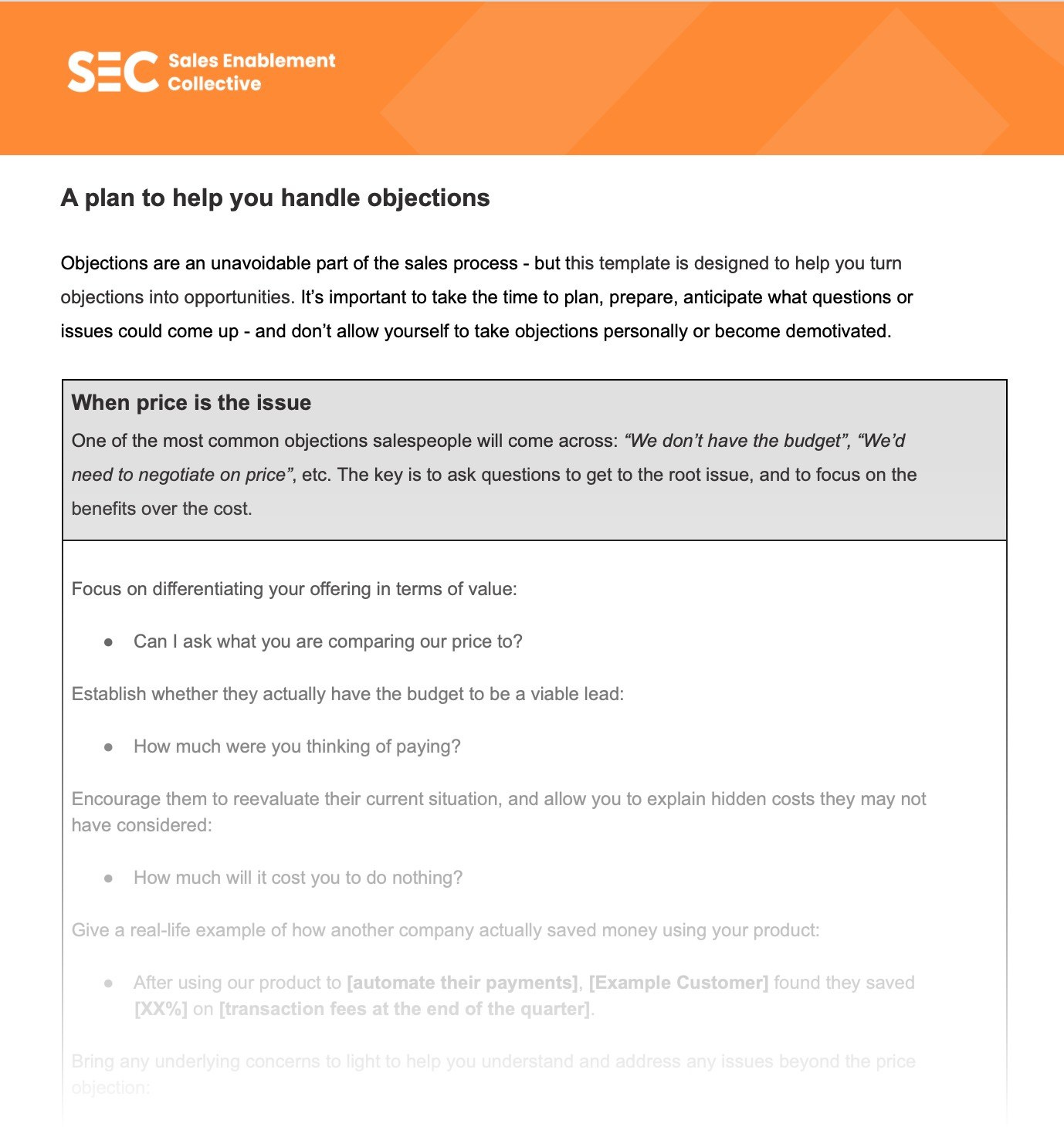
With an SEC membership plan, you get instant access to this checklist designed to help your sales teams handle objections as they work their way through the sales process. Sign up now and explore this checklist and lots more!
Jonathan explains that “[outbound reps] need to open new doors. At a high level that requires a good understanding of the problem they solve, of who their product is and is not for, and the ability to explain the value proposition clearly and simply”.
Tying all those skills together allows you to effectively identify leads with specific characteristics such as size, region, and industry - then reach them through strategic cold outreach that creates genuine business development opportunities.
Gail says that being a BDR or an SDR, “whatever you call it, is the first step before you're an account executive. You learn how to take new leads, either coming in or going out, and then somebody else has to develop and close them. Then you learn the develop and close part [later on]”.
Account executive role and skills
Role
While there may be some similarities between a BDR and SDR depending on the organization, an AE’s sales role is usually more clearly defined.
Account executives (sometimes called sales executives) focus on active, qualified opportunities, and on moving the client through the sales funnel, turning them from a lead into a customer.
Typically, an AE will have leads passed to them from BDRs or SDRs, and use the information gathered by the rep who qualified the lead to perform a more in-depth discovery call, conduct demos, run follow-ups and eventually work towards closing the sale.
Gail built on her earlier example, saying: “Joe (the AE from earlier) is going to be able to catch either side; he can catch the ones a BDR or an SDR brings in, it doesn't matter.”
[The AE] is catching those and saying ‘hey, I'm really glad to meet you, I see that you're interested in the product, it feels like we're a fit. Let me give you the demo’ and they take that all the way from demo to close.
Skills
Although many AEs start out as BDRs/SDRs, as they work with already qualified leads, they require a more nuanced skill set.
AEs work on high-opportunity deals, and focus on uncovering a lead’s needs. They’re always trying to find ways to maximize the value of deals. This means they need excellent active/deep listening skills and nurturing skills in order to really understand potential customers’ concerns and business needs.
AEs require a higher level of product knowledge and an eye for hidden opportunities for up and cross-selling. They have to be able to recognize and take advantage of those opportunities if they appear during discovery.
In essence, they should perform as product consultants, rather than just delivering sales pitches.
Jonathan says that while a BDR/SDR’s pitch is more high-level and based around generating interest, “AEs should be trained to run very good discovery calls and then to deliver effective pitches to match the pain points they uncover”.
Simply put, AEs need to have the ability to undergo a deeper discovery process, especially compared to BDRs/SDRs.
Is there any overlap?
Yes, there's significant overlap between SDR and BDR roles. Both positions focus on prospecting, qualifying leads, and setting appointments for account executives. They use similar tools, follow comparable processes, and require many of the same skills.
The main difference lies in their lead sources and approach. SDRs work with warm leads who've already shown interest, while BDRs create opportunities from scratch through cold outreach.
Many companies blur these lines intentionally. Some organizations have their SDRs handle both inbound responses and outbound prospecting during slower periods. Others train their BDRs to jump on hot inbound leads when needed.
The overlap becomes even more pronounced in smaller companies where one person might wear both hats out of necessity.
According to Jonathan:
There is some overlap in the sense that in many organizations AEs still need to build their own pipeline. They can’t just rely on their BDRs to find new opportunities for them.
That means that an AE and a BDR could be prospecting on the same account at the same time. That requires a tight collaboration, and good AEs will often take the time to coach their BDR and to explain their account plan to them.
When to hire SDRs vs BDRs
The decision between hiring SDRs or BDRs depends on your company's growth stage and go-to-market strategy.
Hire SDRs first when:
- You have consistent inbound lead flow from marketing
- Your marketing generates more leads than AEs can handle
- You need to improve lead response times
- Your AEs waste time on unqualified prospects
Hire BDRs first when:
- You're entering new markets or verticals
- Your inbound lead flow is inconsistent
- You have a clearly defined ideal customer profile
- Your average deal size justifies outbound investment
For early-stage companies: Most startups under $5M ARR combine both functions into a single role. As one founder put it: "Our first sales hire was an 'SDR/BDR hybrid' who handled both inbound and outbound until we hit enough volume to specialize."
For scaling companies: Once you reach 10+ salespeople, specialization typically improves efficiency. Companies often maintain a 2:1 ratio of SDRs to BDRs, adjusting based on lead flow and market dynamics.
The key differences summarized
| Role and skills 🛠️ | Inbound rep 📩 | Outbound rep 📞 | Account exec 🤝 |
|---|---|---|---|
| Works with warmer leads? | Yes | No | Yes |
| Interacts with unaware prospects? | No | Yes | No |
| Conducts top-of-the-funnel lead qualification? | Yes | Yes | No |
| Has a good level of product knowledge? | Yes | Yes | Yes |
| Conducts demos and deep discovery? | No | No | Yes |
| Converts leads and closes deals? | No | No | Yes |
If you're responsible for a team made up of BDRs, SDRs, and AEs, Jonathan has some advice:
"An area that is oftentimes overlooked is how to lay a path forward for BDRs/SDRs to become AEs. The best companies have the whole process clearly laid out, so new BDRs/SDRs know what they need to do and what they need to show to become AEs. Many BDRs/SDRs want to become AEs and it is not very clear to them how to do so.”
Hopefully, with this information you can now answer any questions you get about comparing BDR v SDR, SDR v BDR, or what AE in sales means!
Ready to accelerate your sales career?
Whether you're an SDR looking to move into a BDR role, or a BDR aiming to become an Account Executive, having the right skills and certifications can fast-track your progression.
With Sales Enablement Collective's Pro+ Membership, you'll get:
- 12+ industry-recognized certifications to showcase your expertise and stand out to employers
- Expert-led training programs covering everything from lead qualification to advanced sales techniques
- Proven templates and frameworks used by top performers at companies like Google, LinkedIn, and Salesforce
- Mentorship opportunities to get 1-on-1 guidance from seasoned sales professionals
- Access to an exclusive community of 30,000+ sales enablement professionals sharing best practices
Don't let your career stagnate. Join thousands of sales professionals who've used our resources to level up their skills and land their dream roles.
Become a Pro+ member today and take the first step toward your next promotion. 🚀


Sales enablement insider
Thank you for subscribing
Level up your sales enablement career & network with sales enablement experts
An email has been successfully sent to confirm your subscription.
 Follow us on LinkedIn
Sales enablement insider
Thank you for subscribing
Level up your sales enablement career & network with sales enablement experts
An email has been successfully sent to confirm your subscription.



.svg)
