


Let me paint you a picture. You're sitting at your desk, drowning in Slack messages. Your sales director needs negotiation training by Friday. Marketing wants you to review their new pitch deck. RevOps is asking about that onboarding metrics report...
And somewhere in the back of your mind, you know you should be working on that strategic initiative that could actually move the needle for your entire sales org.
Sound familiar?
Whether you're flying solo or part of a small team, the challenges I'm about to share will hit close to home.
The reality check nobody talks about
I've been the one-person enablement army three times over. At Amazon Ads, I supported 300 account managers. Just me. At Ricoh, 25 global account directors looked to me for enablement. Again, just me. And at Deel? Try 250 SDRs scattered across the globe, all with different managers who had wildly different ideas about what success looked like.
Here's what nobody tells you about being a solo enabler: the biggest risk isn't burnout (though that's real). The biggest risk is becoming so reactive and tactical that you lose sight of why enablement exists in the first place.
The trap that catches us all
You know that feeling when you're constantly putting out fires? That's what happens when you're not intentional about your role. You get stuck in what I call the "urgent but tactical" zone. You're solving problems at the river's mouth, instead of going upstream to figure out why the problems exist in the first place.
This analogy has become my north star. Picture yourself standing at the end of a massive river, trying to fix all the issues flowing past you. The sales team's struggling with objections. Deals are stalling in the pipeline. New hires aren't ramping fast enough. You're there with your little net, trying to catch every problem as it rushes by.
But those problems? They started way upstream. Maybe in how leads are qualified. Maybe in the hiring process. Maybe in the tools your team uses. If you're always working at the estuary, you'll never solve the root causes.
Without economies of scale, you end up doing everything manually. Creating the same training deck for the fifteenth time. Running the same objection handling session every quarter. You're not building systems – you're just doing tasks. And tasks don't scale.
The quadrant that changed everything
At Amazon, we had this principle: work backwards. Start with the outcome you want and figure out how to get there. I took that thinking and created what I call the enablement quadrant. It's simple, but it's been my guide through every role since.
Picture a standard quadrant. On the vertical axis, you've got strategic at the top and tactical at the bottom. On the horizontal axis, reactive on one side and proactive on the other. Your goal? Live in that top-right corner—strategic and proactive.
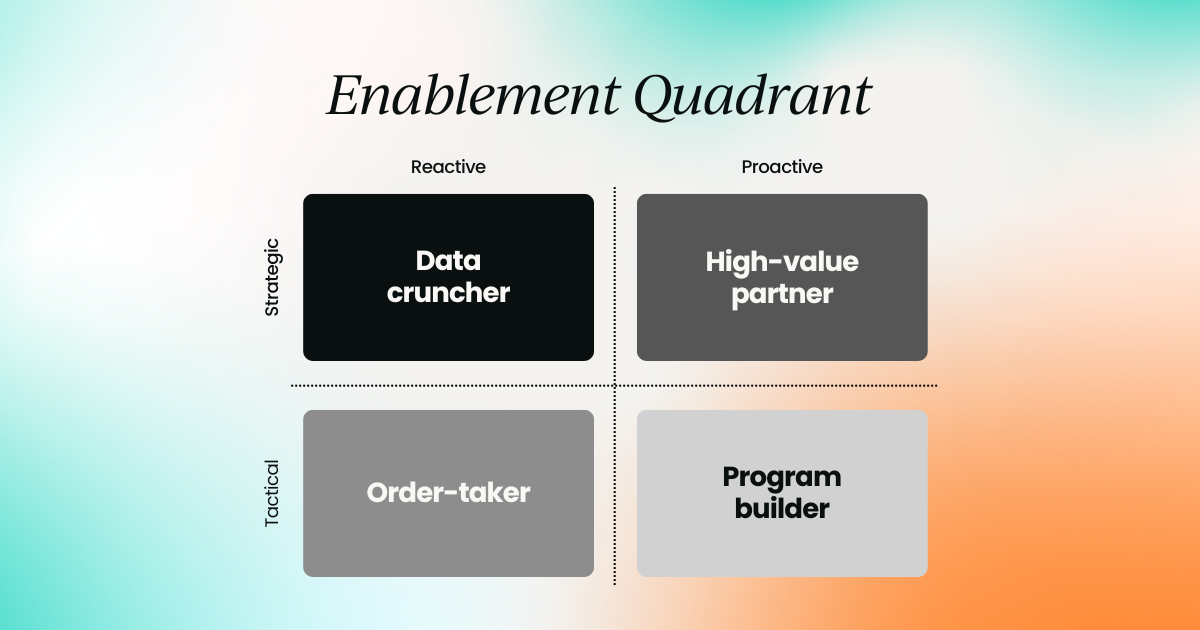
Let me break down what each quadrant looks like in real life:
Reactive and Tactical: This is where most of us start. Your sales manager asks for negotiation training, you deliver negotiation training. No questions asked. You're basically an order-taker, and while the work might feel important in the moment, it rarely moves the needle on actual sales performance.
Proactive and Tactical: A step up. You're building programs and playbooks on your own initiative. You've got structure around onboarding, maybe some sales materials. It's good work, but it's still tactical. You're doing things, but are they the right things?
Strategic and Reactive: Now you're getting somewhere. You're digging into data, understanding buyer journeys, partnering with performance analytics to spot trends. You're asking why deals take longer to close or why win rates fluctuate. You're reactive because you're responding to problems, but at least you're thinking strategically about root causes.
Strategic and Proactive: This is the promised land. You're thinking ahead of the sales organization. You're partnering with RevOps (and if you're not talking to your RevOps team, please, as soon as you finish reading this, go find them). You're implementing sales methodologies based on data, not hunches. You're preventing problems before they start.
 Brianna Lewke
The Deel story that changed my perspective
Want to know how this plays out in real life? When I joined Deel, one of the directors immediately asked me to run objection handling training for his team. Classic reactive and tactical request, right?
Instead of saying yes, I asked to meet with him and his managers. "Walk me through your team's workflow," I said. "From the moment they wake up to the moment they log off. Every step."
They looked at me like I'd grown a second head. But we did it. And you know what I discovered? They had no workflow. No structure. No consistent approach to managing prospects through the sales cycle.
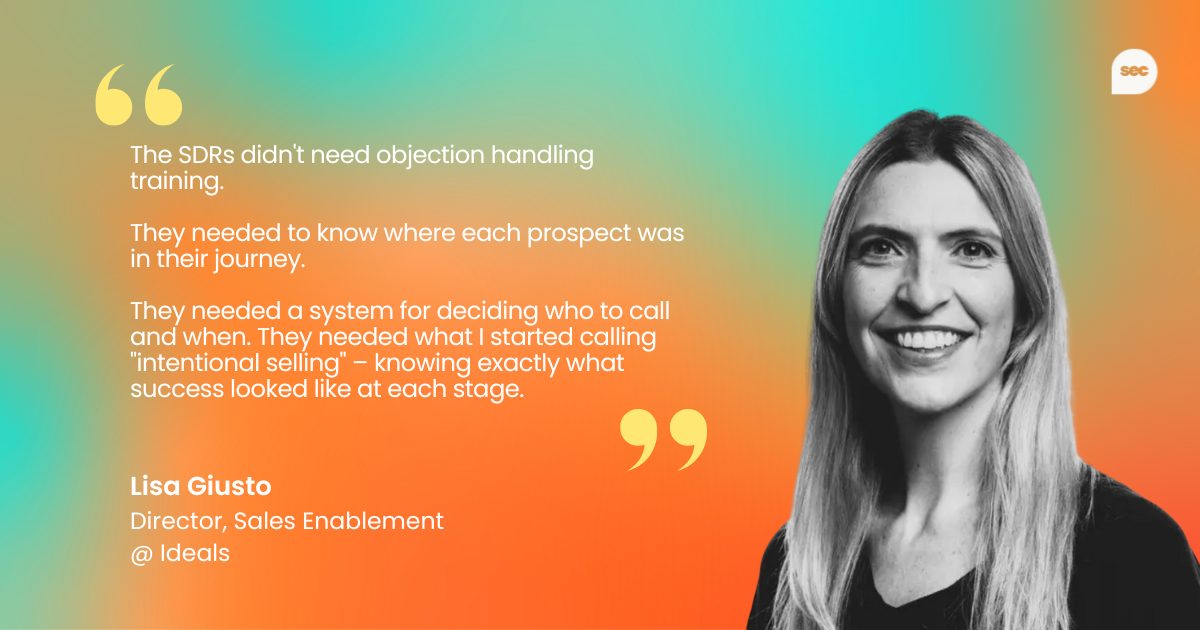
The SDRs didn't need objection handling training. They needed to know where each prospect was in their journey. They needed a system for deciding who to call and when. They needed what I started calling "intentional selling" – knowing exactly what success looked like at each stage.
I noticed this about our customers and it changed everything...
So I started listening to their calls. Hundreds of them. But I wasn't listening to the SDRs' techniques (though some were great and others... had room for improvement). I was listening to the customers. What were their actual problems? What did they understand about our solution? What made them hesitate?
After all those calls, I noticed something fascinating. Every customer problem fell into one of five buckets. Five core pain points that came up again and again. So I created a simple framework: five buckets, each with specific positioning and solutions.
I ran sessions where SDRs would listen to calls together and identify which bucket each customer fell into. Within weeks, they had a common language. They knew within the first few questions where a prospect fit and how to position our solution.
The director who wanted objection handling? He came back to me and said, "I absolutely love this. My team finally has a common language. Can we make these sessions mandatory?"
That's the power of saying no to the tactical and yes to the strategic.
The brutal truth about where we spend our time
Research shows that most enablers spend only 5% of their time being strategic. Five percent! The rest is tactical execution, and while some of that's necessary, it's not sustainable if you want to drive real impact.
Your superpower as an enabler (especially one flying solo) is prioritization. It's not about doing more. It's about doing what matters.
Here's my prioritization framework:
Work backwards from the outcome you want: What's the actual outcome you're trying to achieve? More revenue? Faster ramp time? Higher win rates? Start there and work backwards to figure out what activities will actually impact those metrics.
Get the data: You can't prioritize without data. And if your RevOps team isn't giving you clean data, learn to pull it yourself. When I was at Deel, I became a Salesforce wizard out of necessity. I needed to understand how deals moved through our pipeline, where they got stuck, and why. HubSpot isn't as easy, but it's still doable if you're willing to dig.
Focus on one strategic initiative at a time: This is hard. Alexandra, who works on my team now, and I have what we call our "sheet of chaos" – an endless list of things we could be doing. But we force ourselves to focus on just a few critical initiatives at a time. Because here's the truth: you can't boil the ocean. Especially not by yourself.
Balance the reactive with the strategic: You'll always have some tactical work. Product launches need enablement. Pricing changes need communication. But ask yourself every day: "How much time am I spending on work that actually moves the needle? And how can I carve out more time for strategic initiatives?"
 James Shaw
The questions that cut through the noise
When someone comes to you with a request, don't just say yes or no. Ask questions:
- What problem are we actually solving?
- Why do we have this problem in the first place?
- What's the root cause? (And then go find the data to verify it)
- Is this a process problem? Do we lack clear, documented SOPs?
- Is this a tools issue? Too many tools? Not enough? The wrong ones?
- Is this a skills issue? Do people actually not know how to do something?
- Who cares about this issue and why?
- How will we measure success if we fix it?
- What's the cost of not fixing it?
- What am I deprioritizing to work on this?
That last question is crucial. Your time is finite. Every yes is a no to something else.
Building without budget (yes, it's possible)
Let's talk about the elephant in the room. What if you have no budget? What if an LMS is a pipe dream and hiring help isn't happening anytime soon?
First, breathe. I operated at Deel without an LMS and was perfectly happy. When I finally got one, I actually hated it. You don't need fancy tools to be effective.
Here's what you do need:
- SOPs and documentation: Create clear, scalable processes. Use Notion, Confluence, Google Docs – heck, use Word if that's what you've got. The tool doesn't matter. What matters is that you document everything so it can scale without you.
- Clear call structures and discovery guides: Give your team frameworks for success. That five-bucket system I created at Deel? It lived in a simple document, but it transformed how 250 SDRs approached their calls.
- Documented onboarding with exit criteria: Define what success looks like at the end of onboarding. What should new hires know? What should they be able to do? Make it crystal clear, and make it scalable.
My first onboarding program at Deel was built in Notion. Tons of emojis, super simple, and the SDRs loved it. We later moved to Google Sites (seriously, if you need to create a learning journey without an LMS, Google Sites is your best friend). Quick to build, easy to update, and it did the job beautifully.
- Peer learning: Remember those sessions where SDRs listened to calls together? Cost: zero. Impact: massive. Sometimes the best enablement happens when you get your team teaching each other.
From solo to scaled: building a team
With my current employer, we built the enablement team I lead from scratch, and I've structured it completely differently from any enablement team I've seen before.
Most enablement teams are full of generalists – program managers who do a bit of everything. One day you're working on onboarding, the next day there's a product launch, the day after that someone needs negotiation training. You know what happens? Everyone stays tactical and reactive by default.
At Ideals, I created what I call verticals. I have experts, not generalists:
- Someone owns product enablement
- Someone owns process and tools enablement
- Someone owns the digital experience
- Someone owns onboarding
- Someone owns performance analytics and insights
- And I'm hiring someone to own sales techniques and manager coaching
This structure means we're always aligned with business priorities. We have clear ownership and accountability. And after two years with this model, I wouldn't go back. When you have experts who own their domains end-to-end, you get strategic thinking and execution, not just task completion.
The mindset shift that changes everything
But that starts with being intentional. It starts with saying no to the tactical requests that don't move the needle. It starts with going upstream to solve root causes instead of symptoms.
Whether you're a team of one or twenty, the principles are the same:
- Know your needles (what metrics actually matter)
- Work backwards from outcomes
- Focus on one strategic initiative at a time
- Partner with RevOps like your life depends on it
- Build scalable systems, not one-off solutions
- Measure everything
Being a solo enabler taught me to be ruthlessly focused on impact. Now, with a team, I still apply those same lessons. Because at the end of the day, whether you're alone or part of a larger group, your job is the same: help sales sell better, faster, and more.
Your sales team is counting on you to be more than just a trainer or a content creator. They need you to be a strategic partner who understands the business, sees around corners, and builds the systems that help them succeed.
That's what great enablement looks like. And yes, you can do it. Even if you're doing it alone.


Sales enablement insider
Thank you for subscribing
Level up your sales enablement career & network with sales enablement experts
An email has been successfully sent to confirm your subscription.
 Follow us on LinkedIn
Sales enablement insider
Thank you for subscribing
Level up your sales enablement career & network with sales enablement experts
An email has been successfully sent to confirm your subscription.


.svg)
