


First, a confession
When I say the word “change,” I get a little anxious. And I'm willing to bet you do too.
After 15 years in enablement, I've learned something crucial: most of us are terrible at managing change. In fact, McKinsey tells us that 70% of organizational change programs fail. Seven out of ten! That's not just sad – it's expensive.
But enablement professionals hold the key to flipping those odds...
The psychology behind our fear of change
When we face change, we're peering into an uncertain future. That uncertainty triggers our fight-or-flight response. Now compound this with the fact that we're living through the fourth industrial revolution with AI. The pace of change is absolutely bonkers. But it's the world we're trying to prepare our teams for.
How fear shows up in your organization
So how does this fear manifest in our sales teams?
At the individual level, your sales reps are terrified of looking incompetent. Imagine handing them a new, highly technical product to sell. They're thinking, “What if I can't explain this? What if I fail in front of a customer? What if I lose my job?”
Meanwhile, their managers are dealing with their own fear multiplied by eight (or however many reps they manage). They're practicing what I call the “pocket veto” – nodding yes in meetings while planning to do absolutely nothing.
And here's the triple whammy: your customers don't want to change, either. Remember the old saying, “Nobody got fired for buying IBM”? That was about making the safe choice. Today, about 60% of deals are lost not to competitors, but to customers deciding not to make any decision at all.
The change curve: why people resist
You've probably seen the Kübler-Ross change curve before. Elizabeth Kübler-Ross originally developed it in the 1960s while writing about death and dying, which tells you something about how dramatic change feels to us.
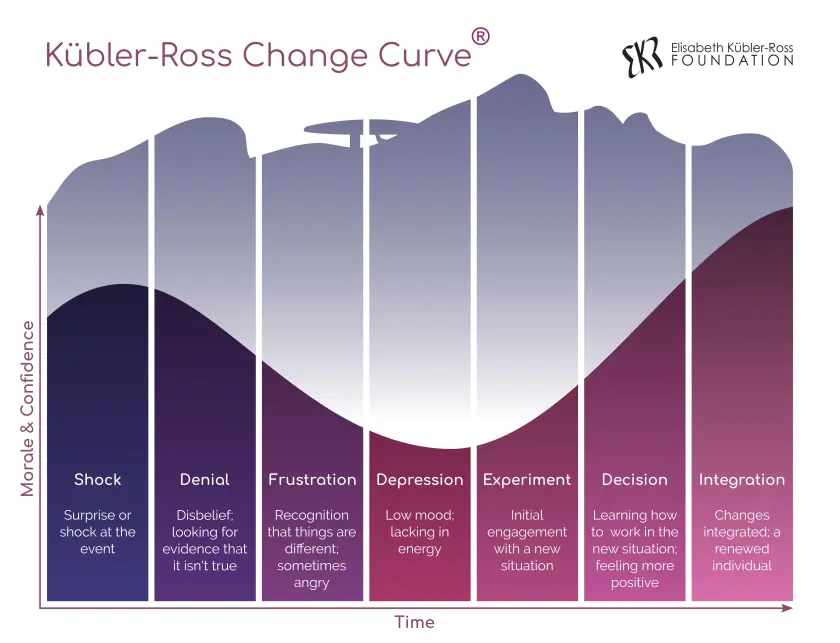
Here's how it works: When change hits, we deny it first (hello, pocket veto). Then our emotions plummet as we realize change is happening with or without us. We hit rock bottom – that point of depression. Then, and only then, do we start experimenting with new ways of working, eventually integrating them into our routine.
Every single person goes through this curve. Your managers need to navigate it before they can help their teams through it. There's no shortcut.
Enter ADKAR: your change management secret weapon
About three years ago, I discovered the ADKAR framework. You can spend thousands getting certified, or you can buy the book for ten pounds on Amazon. (Guess which route I recommend?)
ADKAR is an acronym:
- Awareness
- Desire
- Knowledge
- Ability
- Reinforcement
I run every single enablement initiative through this framework. Here's how it works:
Awareness: the story of change
First, you need to announce the change and explain why it's necessary. But here's the catch: you can't use the same message for everyone.
What motivates a salesperson (“This new product will help you hit quota”) is different from what motivates a CSM (“Your customers have been asking for this capability”).
This is communications work, pure and simple. If you don't have this capability on your enablement team, hire someone who does.
Desire: making them want it
Next, you need to create genuine desire for the change. This means articulating “what's in it for me” for each audience.
And please, don't tell people the company will make more money. That's too abstract. Make it personal. Use champions who've piloted the change to share their success stories. Nothing creates desire like hearing a peer say, “I tried this and my customer loved it.”
Knowledge: where most enablement stops
This is our comfort zone – training, resources, knowledge checks. We're great at this part. But here's the sobering truth: Hermann Ebbinghaus proved 150 years ago that we forget 75% of what we learn within 24 hours. After 30 days? Almost nothing’s left.
Knowledge is never enough. I don't know how to drive because I read my car's manual. I learned by practicing (and nearly crashing with my dad in the passenger seat).
Ability: the missing link
This is where the rubber meets the road. Can your team actually DO what you've taught them? This means role-playing, coaching, using conversation intelligence tools to listen at scale and test that ability does exist.
Don't just check their knowledge – verify their ability. And always include a call to action. Give them a sales play, a specific customer to target, something concrete to do with their new skills.
Reinforcement: making it stick
Finally, provide ongoing support. Celebrate wins, share best practices, re-enable when needed. This is how you move people from conscious competence (“I can do this if I think really hard”) to unconscious competence (“I do this without thinking about it”).

A real-world example
Let me share how we recently used ADKAR at my company to launch a new product called Voice:
- Awareness: Announced at our all-hands meeting
- Desire: Regional sessions to discuss “what's in it for me” by role
- Knowledge: Mandatory self-paced training in our LMS
- Ability: Manager-led role-play packages and conversation intelligence scorecards
- Reinforcement: Follow-up at our upcoming sales kickoff
Simple, sequential, effective.
Using ADKAR with customers
Here's where it gets really interesting. You can ADKAR your customers' buying experience too:
- Awareness: Impactful marketing messages about value
- Desire: Demos that clearly address their use cases and pain points
- Knowledge: Help all 13 members of the buying committee understand value through their lens
- Ability: Enable them to buy AND successfully onboard
- Reinforcement: Demonstrate value realization in QBRs, making renewals a non-event
Key principles to remember
- One size doesn't fit all: Different audiences experience change differently. You need multiple plans.
- Don't rush: ADKAR is a sequence. You can't bundle steps together and check boxes.
- Diagnose failures: When change doesn't stick, it's usually because we rushed past desire or ability.
- Start with impact assessment: List all audiences, understand their current state, and define clear outcomes—real business outcomes, not just “complete training.”
- Learn and iterate: Always retrospect. What worked? What didn't? What will you do differently next time?
The bottom line
I think about ADKAR constantly (maybe more than is healthy to admit publicly). But here's why: this framework can put your enablement efforts on steroids.
We're not just trainers. We're change agents. And in a world where 70% of change programs fail, mastering change management isn't just nice to have, it's essential.
So the next time you're launching a new product, process, or initiative, don't just create training. Create change. Your teams (and your success metrics) will thank you.
Looking for next steps?
10,000+ sales enablers from all over the world trust SEC to be the go-to resource for their learning and development. Benefit from our community-led resources through the insider plan, for free!
- Templates and frameworks: Save time with battle-tested and ready-to-use templates. 📖
- SEC-GPT: Solve challenges with the cumulative knowledge of our community. 🤖
- Real-world case studies: Hours of insights from leaders at Uber, Oracle, Adobe, and more. 🗣️
- Industry insights: Ungated access to first-hand research from thousands of sales enablers in our annual Salary and Landscape Report. 📈
- Supportive community: Join our global community of sales enablers whom you can bounce ideas around with and get support from other like-minded professionals. 🤝
Accelerate your career without spending a dime.
Become an SEC insider now. 👇
This article was adapted from Rebecca's talk at our Sales Enablement Summit in London, England.
Want to check out events near you so you can be the first to catch insights like these?


Sales enablement insider
Thank you for subscribing
Level up your sales enablement career & network with sales enablement experts
An email has been successfully sent to confirm your subscription.
 Follow us on LinkedIn
Sales enablement insider
Thank you for subscribing
Level up your sales enablement career & network with sales enablement experts
An email has been successfully sent to confirm your subscription.


.svg)
