









Enablement has never been more visible. Nearly every sales organization now has programs, playbooks, and training in place. But according to the latest industry research by Flowla – Enablement Beyond Content: 2025 Benchmark Report and Future Outlook, visibility hasn’t translated into velocity.
Teams are broader in scope: 64% now span multiple revenue functions, yet only 20.8% describe themselves as truly unified, AI-powered, and signal-led. Enablement has grown wider, but not deeper. It’s still stuck in “content and training” mode while today’s revenue reality demands speed, clarity, and automation.
We’re standing at the inflection point between traditional enablement and Enablement 2.0, a model built not on assets or training sessions, but on systems that drive motion across the entire revenue journey.
The cracks in the traditional enablement model
Ask any enablement leader how their quarter’s going, and the answers start to sound familiar:
“We just rolled out another playbook… but adoption’s already slipping.”
“Our reps are drowning in tools.”
“We’re still chasing metrics that don’t move the needle.”
Enablement 1.0 was built for a different era, when deals were linear, decision-makers were predictable, and “readiness” meant completing a course or knowing the pitch deck by heart. It worked when reps controlled the buying process. But in 2025, buyers control the pace, the process, and the information. And enablement hasn’t caught up.
Despite years of progress, the function is still fighting uphill battles on three fronts:
1. Low adoption, low impact
Despite better tools and content, more than 60% of enablement leaders still point to low playbook adoption and inconsistent rep behavior as their biggest challenge. They’re shipping content, running enablement sessions, and holding managers accountable, but playbooks are ignored or forgotten the moment a deal heats up.
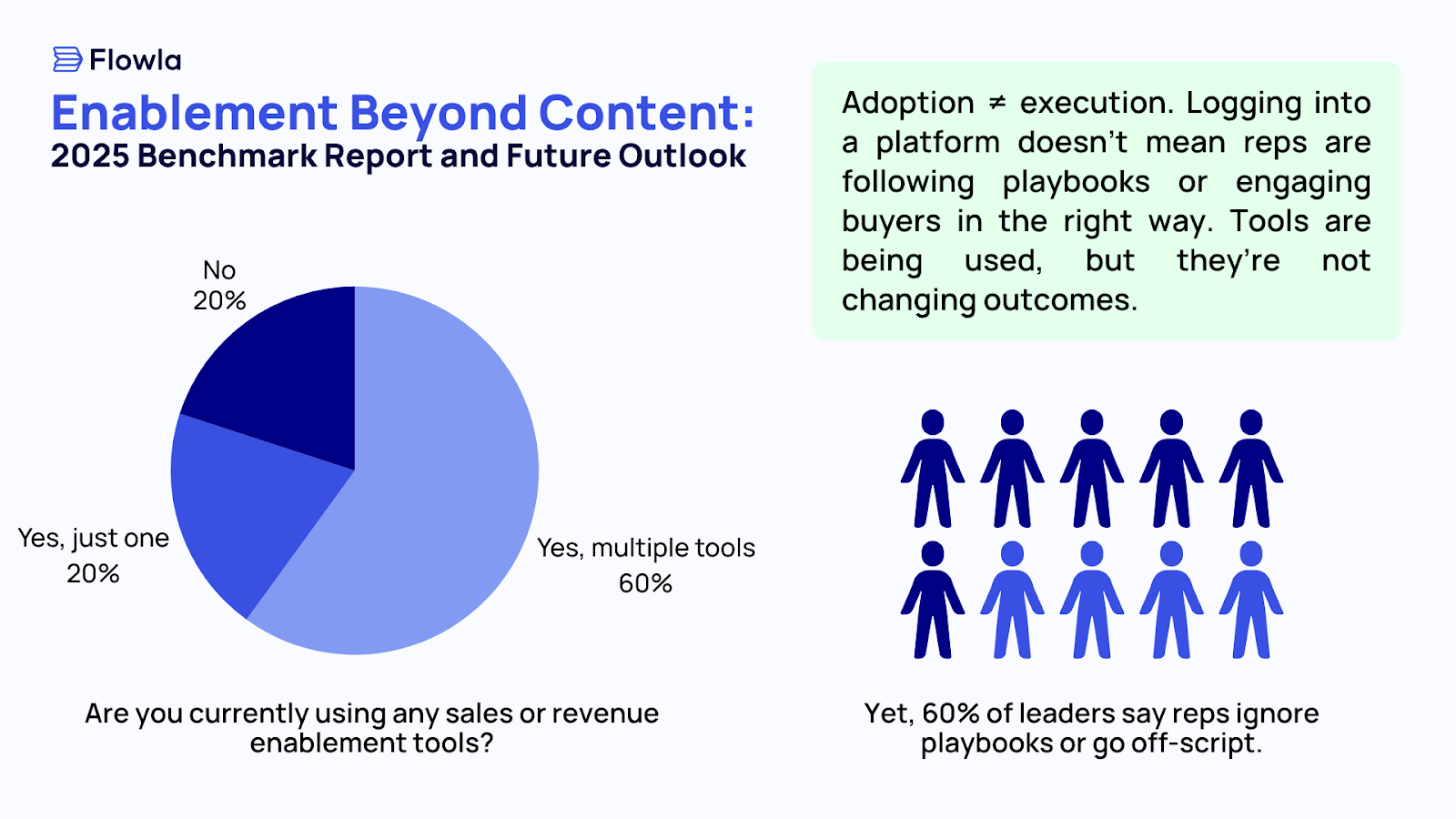
It’s not that playbooks aren’t useful – it’s that they’re static. In fast-moving deals, reps default to what’s easiest or familiar. Without automation or real-time triggers, enablement remains a “push” effort, not a living system.
2. Tool chaos, not alignment
Enablement stacks are bigger than ever. Sixty percent of the surveyed organizations use multiple enablement tools, layering popular platforms like Seismic, Highspot, Gong, and Clari. Yet, most of them are not happy and won’t recommend the tools as they are redundant or not working well for them.
And even among those with robust systems, automation maturity averages only 5–6 out of 10. That means hours lost to manual updates, duplicate data entry, and toggling between platforms just to move a deal forward. The irony: the more tools teams add, the less connected their workflows become.
 Alex Walton
3. Signals everywhere, action nowhere
If there’s one area where modern enablement looks sophisticated on paper, it’s data. Almost every team now tracks buyer and deal signals, from overall deal progression to meeting activity or email engagement. Dashboards have never looked better. But the real question is: What happens next?
When asked how well they actually act on those signals, confidence collapses. Only 28% of leaders rated themselves a 6 out of 10. Just 24% felt good enough to score an 8. The rest quietly admitted that most signals don’t translate into motion. Engagement data sits in dashboards, disconnected from execution. Deals die not for lack of insight — but for lack of motion.
4. Activity over outcomes
Enablement functions are producing more than ever – more onboarding sessions, more assets, more certifications – but it’s not translating into motion. Half of leaders say their revenue process stalls most often in the mid-funnel, not at the top or renewal stage.
In other words, even after enablement does its part – building content, running training, aligning playbooks – deals still stall where momentum should peak.
The pattern is clear. Traditional enablement solved for readiness, not for reality. It gave teams structure and shared language, but not the systems to keep pace with today’s buying process. Reps are still drowning in admin, chasing stakeholders, and struggling to maintain consistency.
Enablement has never had more visibility – yet it’s never felt less in control. The data makes it clear: the function has expanded in scope but plateaued in impact. More tools, more content, and more training can’t fix the friction baked into how revenue teams actually operate.
That’s the breaking point between traditional enablement and enablement 2.0. The old model can’t scale with today’s buying reality. To move forward, enablement has to stop trying to manage activity and start designing systems that create movement.
The shift toward Enablement 2.0
If the traditional enablement model was about readiness, Revenue Enablement 2.0 is about revenue motion.
The old model equipped reps with knowledge; the new one guides them through action. It’s not about running more sessions or uploading more decks – it’s about building connected systems that make progress automatic.
According to our research, fewer than one in four enablement teams (20.8%) say they’ve reached this level of maturity – unified, AI-powered, and signal-led. The rest are still running on manual updates, tribal knowledge, and endless follow-ups. But the gap between those two groups is widening fast.
Enablement 2.0 is emerging as a new kind of operating system for revenue, built on four key pillars.
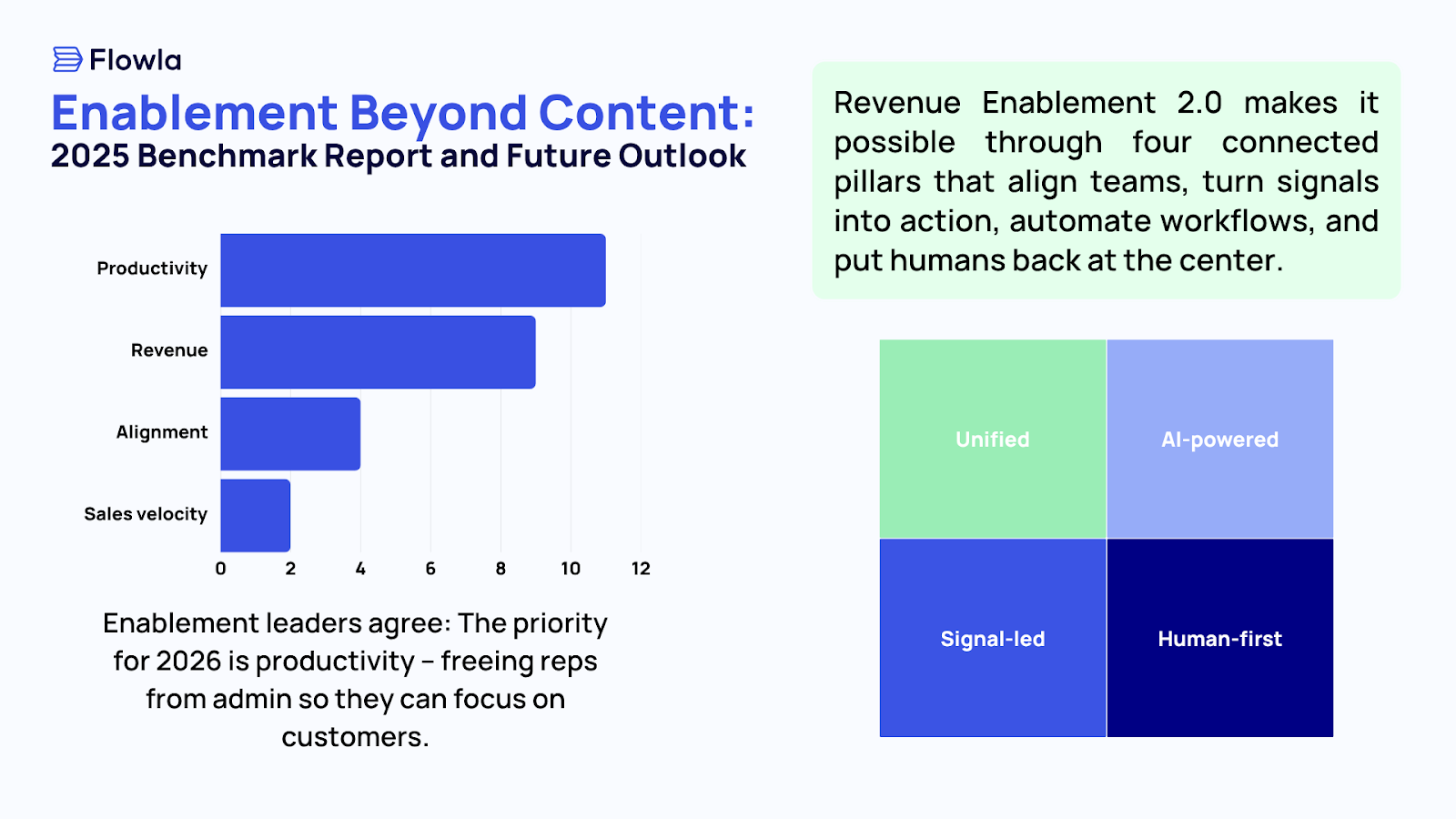
1. Unified journeys
Deals no longer end at closed-won. The best-performing organizations treat Sales, CS, and post-sale enablement as one connected journey. Mutual action plans carry over into onboarding. Handoff notes are auto-generated instead of rewritten. Customer usage data flows back into Sales, informing renewal and expansion plays.
This creates one continuous experience – not just for teams, but for buyers.
2. Signal-led execution
Where Enablement 1.0 tracked engagement, Enablement 2.0 acts on it. Every buyer signal – a viewed proposal, a missed meeting, a quiet account – automatically triggers a contextual response. The systems are designed to eliminate lag, so reps never lose momentum waiting for someone to notice.
When signals guide the motion, enablement stops being a reporting function and becomes a driver of execution.
3. AI-powered workflows
AI isn’t replacing enablement; it’s freeing it. Leaders in the study made it clear: 54% want AI to help with deal coaching and insights, not to churn out templated follow-ups. They’re asking for intelligence that helps prioritize, sequence, and suggest, not just increase speed.
Enablement 2.0 uses AI to reduce administrative drag: Call notes summarize automatically, handoff docs generate themselves, and next-step suggestions appear in the flow of work. It’s quiet efficiency that compounds across every rep, every week.
4. Human-first design
At its core, enablement has always been about people. Technology should amplify their judgment, not replace it. By stripping away admin and cognitive load, Enablement 2.0 gives reps and managers more time for what actually drives revenue: Meaningful buyer conversations, stronger coaching, and relationship building.
This is the paradox of automation done right: The more efficient the system, the more human the work feels.
Enablement 2.0 is already emerging in teams that are rethinking how work gets done. They’re connecting systems, not adding tools, turning signals into action, automating the repetitive, and freeing reps to focus on what actually drives revenue. Each small change compounds into something bigger: faster cycles, cleaner handoffs, and a customer journey that finally feels consistent from start to finish.
Building your own system of motion
Turning the principles of Enablement 2.0 into practice starts with one simple truth: systems create consistency. Most enablement teams already have the tools, playbooks, and data they need. What’s missing is the connective tissue – the automation, alignment, and design that make those elements move together.
The benchmark data backs that up. 50% of organizations say they already use multiple enablement tools, yet automation maturity averages only 5–6 out of 10. Teams have the parts, but not the system. Reps are surrounded by insights, yet the friction – admin, context switching, tool fatigue – never goes away.
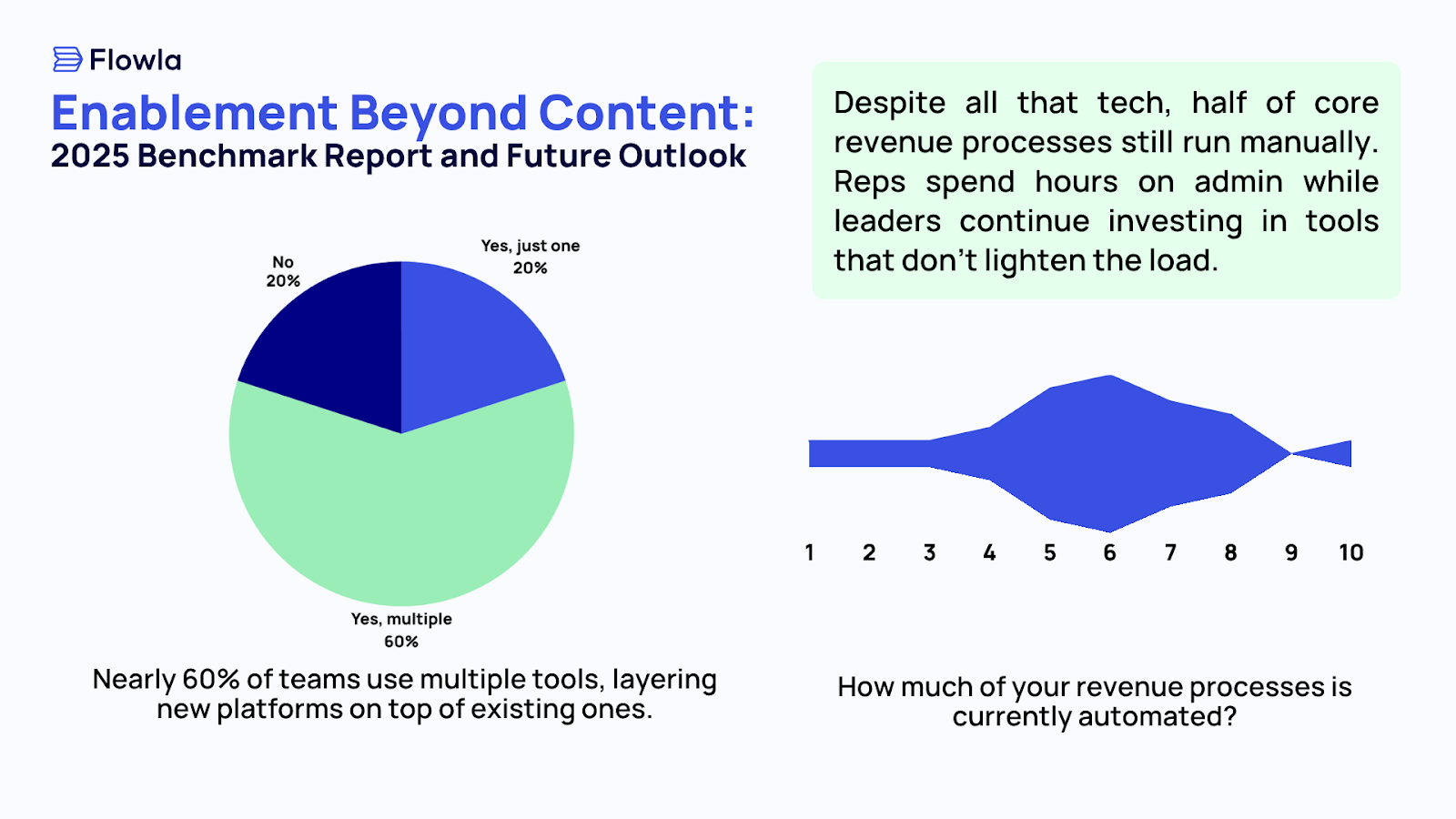
To move beyond this plateau, leaders are beginning to construct systems of motion – frameworks that keep revenue processes running smoothly without constant intervention. Here’s what that work looks like in practice.
1. Start small and automate one friction point
The most effective transformations begin with one workflow that matters. Choose a high-impact moment that slows teams down – a demo follow-up, a Sales-to-CS handoff, or onboarding prep. Design a simple workflow that eliminates that friction through automation.
The goal isn’t scale on day one; it’s proof. When one workflow runs faster, the savings and confidence multiply across the organization. Teams see that automation isn’t disruption – it’s momentum.
2. Build inside existing workflows
Enablement succeeds when it feels invisible. Reps shouldn’t have to learn new systems or change habits to benefit from better processes. Instead, design automations that appear where work already happens – the CRM, Slack, email, or meeting notes.
Embedding enablement into familiar tools turns process into behavior. It removes the need for constant enforcement and makes consistency the natural outcome of good design.
3. Connect signals to next steps
Modern enablement leaders have access to a flood of buyer data – but few have built mechanisms to respond to it. While 86 percent of teams track deal progression and 68 percent monitor meeting activity, only a small share act on these signals with any regularity.
Map the signals that matter most and link each one to a specific next step. When buyer engagement rises, when usage drops, when a new stakeholder appears – define what happens automatically. This closes the gap between awareness and action, ensuring momentum never depends on manual follow-up.
4. Measure motion over activity
Traditional enablement metrics track how much is produced; motion metrics track how far revenue actually moves. Focus measurement on cycle velocity, handoff speed, and engagement consistency – indicators that show whether the system is removing friction.
When these metrics trend upward, enablement stops being a support function and becomes an operational advantage.
Enablement 2.0 isn’t achieved through a single project or tool. It emerges from dozens of small, well-connected systems that quietly remove barriers from the revenue process. Over time, these systems compound, creating the kind of motion that makes high performance repeatable.
The next era of enablement
Enablement has never had more tools, visibility, or influence. Yet, the hardest work ahead is invisible. It’s not about the programs or playbooks we can see; it’s about the systems operating underneath them. The workflows, signals, and quiet automations that keep teams aligned and momentum alive without constant reminders.
The leaders who master that invisible layer will define the next era. They’ll measure enablement not by readiness, but by motion – how consistently, quickly, and intelligently revenue moves.
This shift is already underway. The only question is who will design the systems that make it possible.
👉 Read the full Enablement Beyond Content: 2025 Benchmark Report and Future Outlook report to see where enablement stands today and what comes next.


Sales enablement insider
Thank you for subscribing
Level up your sales enablement career & network with sales enablement experts.
An email has been successfully sent to confirm your subscription.
 Follow us on LinkedIn


.svg)

Start the conversation
Become a member of Sales Enablement Collective to start commenting.
Sign up now