


Too often, deal outcomes are pushed from one month to the next, then into the next quarter, but never marked as lost or actively rejected. For reporting purposes, these are still live opportunities. In reality, they are not progressing.
This is one of the most common issues I see in B2B businesses, and it isn’t caused by external factors like pricing or competition. More often, stalled deals are the result of how those opportunities were qualified, managed, and progressed by the sales team (or not).
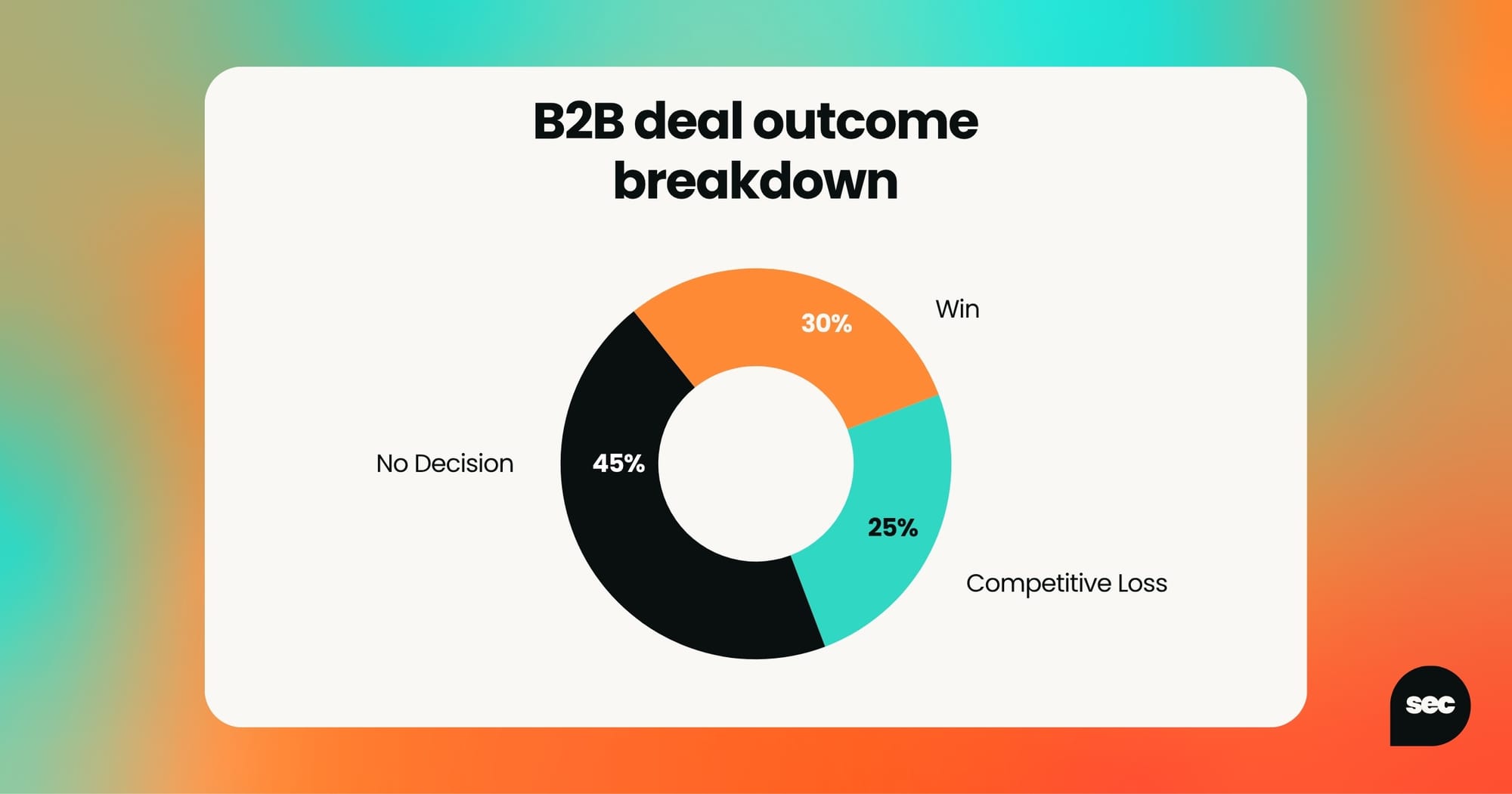
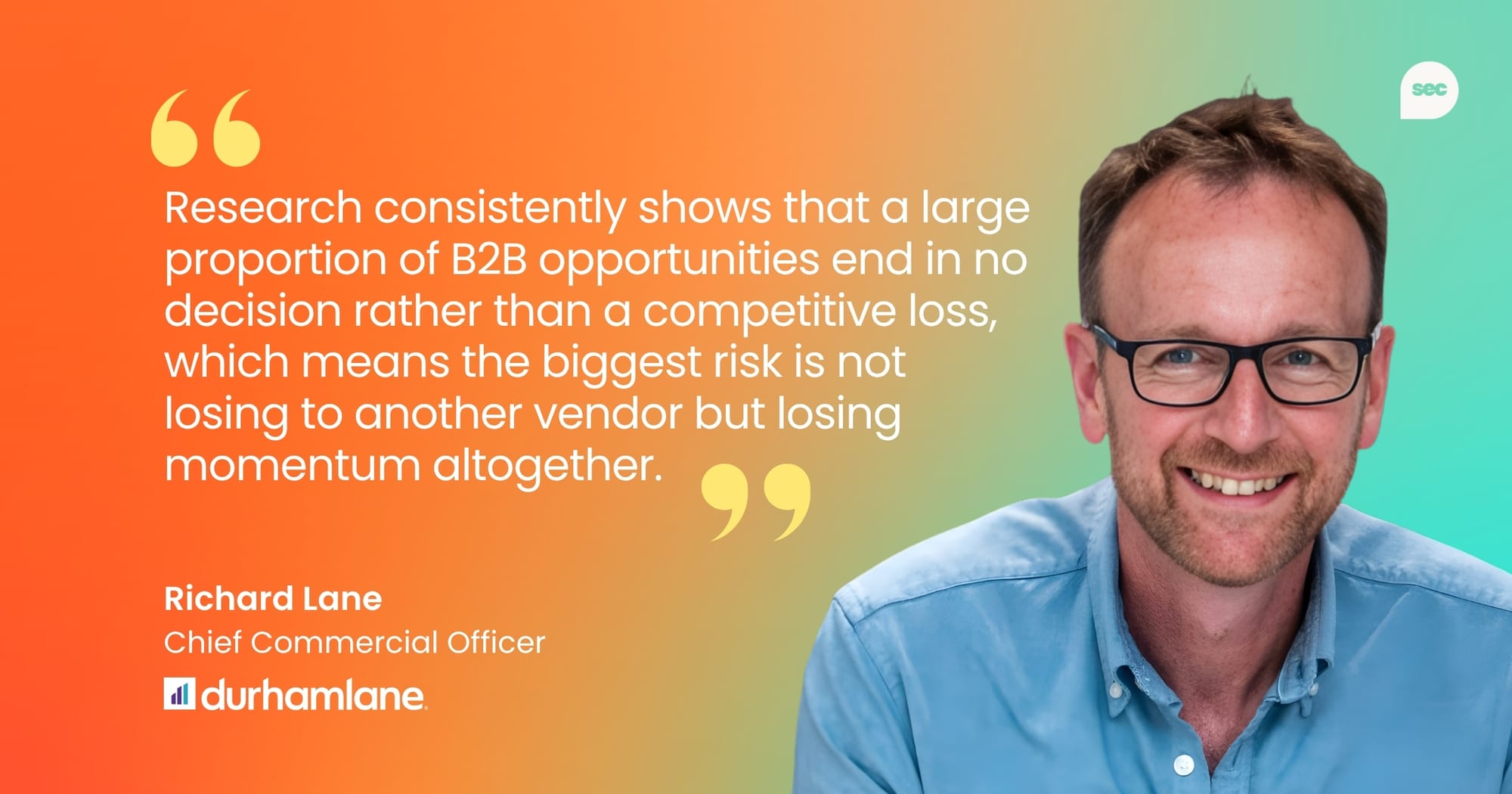
Research consistently shows that a large proportion of B2B opportunities end in no decision rather than a competitive loss, which means the biggest risk is not losing to another vendor but losing momentum altogether.
If you want to improve pipeline performance, it’s worth understanding why deals stall mid-pipeline, because that is where most of the damage happens.
What do I mean by mid-pipeline?
When I talk about mid-pipeline, I am referring to the no-man's land after evaluation and before shortlist evaluation, where deals go to die. This is typically where proposals are shared, internal discussions happen, and buyers evaluate risk more seriously.
At this point, you are no longer trying to generate interest. You are trying to guide a buying group through a decision. This means that deal discipline is more important than early-stage interest.
Reason 1: Poor qualification at the start
The most common cause of stalled deals is also the least surprising: the deal should not have entered the pipeline in its current form. The client's problem might be loosely defined or based on an assumption. There may be no clear urgency or consequence of inaction. Access to decision-makers is limited, or opportunities were created to hit targets rather than because the conditions were right.
In any of these cases, a deal may move initially because the buyer is willing to explore options. But as soon as scrutiny increases, the momentum will slow down.
This is consistent with what we see across most B2B pipelines.
Put simply, if the commercial foundations are not in place early on, the deal will almost always stall later.
This is why qualification frameworks matter. They are a practical filter. If you can’t clearly answer what problem is being solved, who owns it, and why it needs to be addressed now, the deal is active but not viable.
Reason 2: Weak understanding of the decision process
One of the biggest mistakes I see is assuming that interest equals progress.
A contact may be engaged. They may respond positively. They may even request a proposal but none of that means the business is ready to buy.
B2B decisions are made by groups, not individuals. Those groups, often known as the ‘buying committee’, have competing priorities, internal politics, and different levels of risk tolerance. If you do not understand how that decision will be made, the deal will slow down as soon as it reaches internal review.
The warning signs are consistent: no clear map of stakeholders, no visibility of approval steps through finance, legal, or procurement, no defined timeline, and too much reliance on a single contact to champion the deal internally.
Your role goes beyond selling a solution. You need to help the buyer navigate their own internal process. If that process is unclear to you, your progress will be inconsistent.
Reason 3: Lack of urgency and unclear value
A deal will only move as fast as the buyer's motivation to change. If that motivation is weak, the deal slows down regardless of how strong your solution is.
This shows up in familiar ways: proposals sent but never actively discussed, interest that remains warm but never converts into commitment, and the ever-reliable "let's revisit this next quarter."
At this stage, the issue is rarely functionality, competition, or price. More often, it is the absence of a compelling event, something that creates a real reason to act within a defined timeframe.
That could be a contract renewal, a new senior hire with a mandate to change approach, a regulatory requirement coming into force, or a budget that must be allocated before year-end. Without something like this, the deal relies on general interest rather than a genuine need to act.
For a deal to move, the buyer needs to be confident in three things: why they need to act, why they should choose you, and why they should act now. If any of those are unclear, the safest decision is to do nothing, which is exactly why so many deals end in indecision rather than loss.
There is a broader dynamic here worth naming. Buyers are risk-averse. They are more concerned with avoiding a bad decision than making a good one. If the perceived risk of change outweighs the perceived benefit, the deal will stall.
Reason 4: Inconsistent or passive follow-up
Every interaction should move the deal forward in a specific way. That means agreeing on what happens next, when it happens, and who is responsible.
When meetings end without a clear next step, when long gaps appear between touchpoints, or when proposals are sent without a scheduled review call, the deal drifts. And once a deal starts drifting, it rarely recovers on its own.
One of the simplest ways to address this is to introduce a mutual action plan, a shared document agreed upon with the buyer who outlines the key steps required to reach a decision. Who owns each step on both sides, and the timeline for those steps.
It covers when the proposal will be reviewed, when additional stakeholders will be brought in, when commercial discussions will happen, and what needs to be resolved before a final decision. The critical distinction is that these steps are agreed upon together, not assumed by the seller.
 Steve Mayernick
Reason 5: Over-reliance on the wrong pipeline signals
A final issue that causes B2B deals to stall mid-pipeline is how teams interpret pipeline data. Many businesses still rely on sales activity signals to judge deal health. They measure KPIs such as:
- Recent contact
- Number of meetings
- Volume of opportunities
- Pipeline coverage ratios
These metrics help track sales activity, but they do not tell you whether a deal is progressing or how that translates to pipeline movement.
Stalled deals often remain marked as “active” because something happened recently, even if nothing meaningful changed, which is why pipeline quality is more important than pipeline size.
Leading metrics for quality include:
- Stage aging
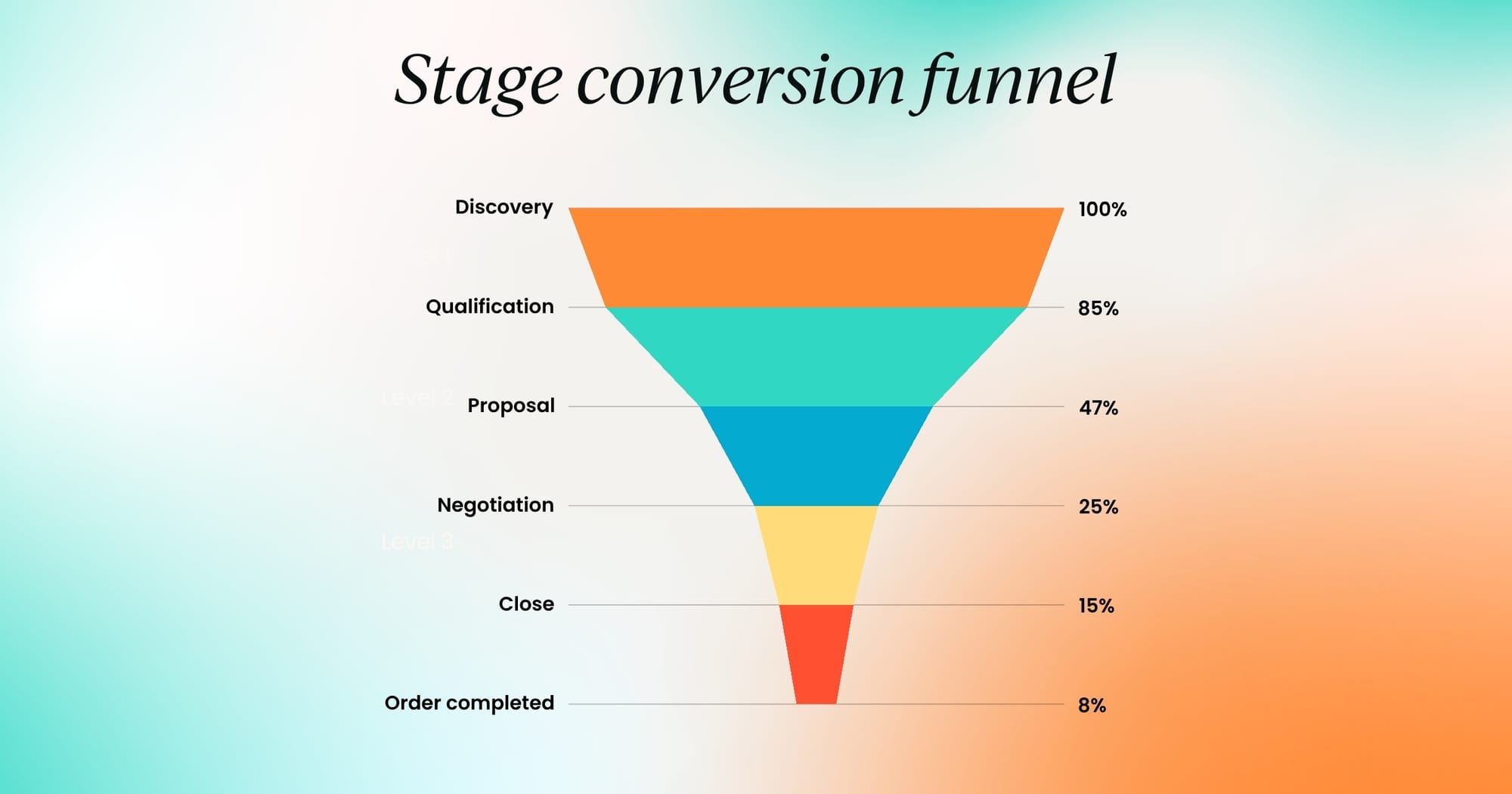
- Conversion rates between stages
- Opportunities with no clear next step
If you are not tracking these signals, you will miss early signs of stagnation and overestimate pipeline strength.
 Richard Lane
What should sales leaders do differently?
If this article has you ready and raring to address stalled deals in your CRM, the first piece of advice I can give you is to improve how deals are created, qualified, and progressed in the first place. A few small shifts can make a difference. Whenever I am asked to help an organization close more deals, I always go back to qualification.
Move performance conversations away from activity volume and towards stage conversion, time in stage, deal velocity, and win rate. These give you a far clearer picture of whether opportunities are genuinely moving.
Embed a qualification framework and use it consistently. That means defining clear stage exit criteria, requiring evidence of buyer commitment before moving deals forward, and challenging assumptions in deal reviews rather than accepting surface-level updates.
Look beyond surface-level updates. Instead, ask your sales development reps:
- What has changed since the last interaction?
- What has the buyer committed to?
- What is preventing the next step?
If they can’t answer those questions, the deal is not progressing.
Finally, align your enablement activity directly to deal progression. Content libraries, CRM tools, and messaging frameworks all have their place, but the central question should always be: what do sellers need to do differently to move a deal from one stage to the next? Everything enablement delivers should tie back to that.
Stalled deals are a signal
Stalled deals can’t be fixed by asking the team to call more or push harder. They are usually the result of how opportunities were qualified, how well the buying process was understood, how clearly value was communicated, and how consistently momentum was managed.
When those elements are in place, deals move forward. When they aren’t, they slow down. Simple as that.
For sales leaders looking to improve pipeline performance, start by reviewing what is progressing versus what is active. Be stricter on qualification. Be clearer on decision processes. Make sure every interaction ends with a defined next step. And pay closer attention to signals like time in stage and conversion, not just pipeline size.
Because in most cases, improving revenue performance is not about generating more leads and opportunities but getting more of them over the line.


Sales enablement insider
Thank you for subscribing
Level up your sales enablement career & network with sales enablement experts
An email has been successfully sent to confirm your subscription.
 Follow us on LinkedIn
Sales enablement insider
Thank you for subscribing
Level up your sales enablement career & network with sales enablement experts
An email has been successfully sent to confirm your subscription.



.svg)
