

The evolution of revenue enablement
Traditional sales enablement has long focused on equipping sales teams with the tools, training, and content needed to close deals efficiently.
However, as go-to-market (GTM) strategies evolve, organizations are realizing that enabling only the sales function is no longer enough.
Revenue enablement is the next stage of this evolution, empowering all customer-facing teams, including marketing, customer success (CS), product, and even partner ecosystems, to drive sustainable revenue growth and improve customer experiences.
To truly embrace revenue enablement, organizations must integrate cross-functional collaboration, redefine enablement strategies, and align all teams under a unified revenue engine.
Let’s explore what revenue enablement means, why it matters, and how different teams - especially marketing and customer success - can adapt to this shift.

The shift from sales enablement to revenue enablement
Unlike traditional sales enablement, which focuses primarily on sales reps and technical sellers, revenue enablement ensures that everyone who interacts with customers is equipped to drive revenue - from the first marketing touchpoint to post-sale retention and expansion efforts.
Why is this shift happening?
Revenue growth requires collaboration.
Sales alone cannot drive retention, expansion, and customer advocacy. Marketing and customer success play a crucial role in long-term revenue generation.
Customer expectations have shifted.
Today’s buyers seek seamless, value-driven experiences that extend from their initial interaction through ongoing support and expansion.
In response, many organizations are integrating outbound sales efforts and customer success into a unified revenue team to create a more cohesive and customer-centric approach.
As a result, the selling model has evolved.
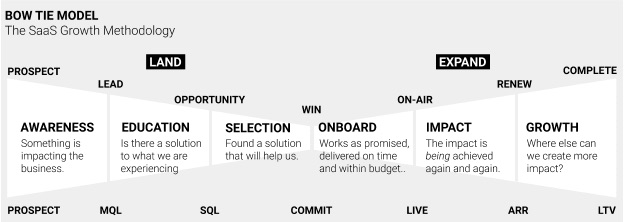
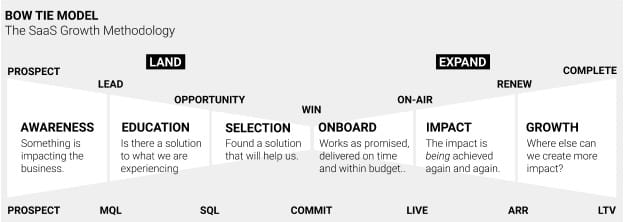
Today, selling is less of a traditional "funnel" that follows a linear path from awareness to purchase.
Instead, it resembles a "bow-tie" model, where the sales process extends beyond closing the deal to encompass retention, expansion, and long-term customer relationships.
How enablement can support marketing
Marketing teams benefit significantly from enablement initiatives that provide them with the insights, training, and tools needed to align their strategies with sales and customer success.
Here’s how enablement can empower marketing:
Providing market and sales insights
Enablement teams can bridge the gap between sales and marketing by sharing data on buyer behaviors, competitive intelligence, and deal insights.
By offering structured feedback loops, marketing teams can refine their messaging, content, and campaigns to better address customer pain points and sales challenges.
Aligning content with the buyer’s journey
Marketing must go beyond lead generation and actively support both sales and customer success. This involves developing content that aligns with each stage of the buyer’s journey, creating sales-ready assets such as case studies and ROI calculators, and leveraging real customer success stories to enhance credibility.
Frameworks like MEDDPICC help structure these conversations from early-stage discovery through post-sales activities, ensuring that the value promised to the customer is consistently delivered.
 Daniel O’Dowd
Training marketing on sales methodologies
Understanding sales methodologies and frameworks such as MEDDPICC or Challenger Selling allows marketing teams to create content that resonates with sales teams and buyers.
This involves developing content that aligns with each stage of the buyer’s journey, creating sales-ready assets such as case studies and ROI calculators, and leveraging real customer success stories to enhance credibility.
Enablement can provide targeted training sessions to help marketers align their strategies with the sales process.
Optimizing content utilization
Enablement ensures that marketing-created content is effectively utilized by sales teams. This includes establishing a centralized content repository, monitoring content engagement metrics, and guiding sales teams on when and how to use specific assets.
Tools such as sales enablement platforms, learning management systems, and engagement analytics help drive alignment and effectiveness.
 Rebecca Stewart
Customer success: The key to retention & expansion
I’ve previously written about customer success and its impact on retention and expansion. Success teams are a critical part of the revenue engine, ensuring that customers stay engaged, adopt products effectively, and expand their investments over time.
Here’s how CS teams can thrive in a revenue enablement framework:
Training and equipping CS teams
Customer success teams must be equipped with the right training and tools to drive product adoption, reduce churn, and identify expansion opportunities.
This includes training on consultative selling and upselling, providing structured onboarding frameworks, and leveraging customer health scores for proactive engagement.
Getting credit for value delivered
Customer success plays a pivotal role not only in delivering value but also in making sure it is clearly recognized. This ensures smoother expansion and retention discussions.
MEDDPICC and similar frameworks help align the buyer’s journey with the internal sales process, ensuring teams engage consistently with customers and prospects while driving value-based conversations that increase deal success rates.
However, many organizations struggle to bridge the gap between promised value and actual customer outcomes post-sale.
For customer success teams to effectively deliver and demonstrate value, they must have visibility into the insights and commitments established during the sales process.
 Sales Enablement Collective
As deals progress, key metrics should evolve - from identifying tangible value to leveraging industry-specific case studies and ultimately defining customized success metrics that reflect real business impact for customers.
Beyond delivering value, customer success must also ensure it is properly recognized, facilitating smoother expansion and retention discussions.
Revenue enablement enhances this alignment by integrating sales and customer success workflows, equipping both teams with the necessary training, methodologies, and tools to consistently reinforce value throughout the customer lifecycle.
Creating Seamless Sales-to-CS Transitions
Misalignment between sales and CS can lead to poor customer handoffs and missed expansion opportunities. Establishing a smooth post-sale transition process and sharing customer insights across teams ensures that CS is prepared to deliver ongoing value from day one.
 James Shaw
Leveraging Data for Proactive Engagement
Predictive analytics empowers CS teams to proactively identify at-risk customers, uncover upsell and cross-sell opportunities, and refine engagement strategies based on customer lifecycle stages.
By leveraging these insights, customer success managers (CSMs) can take targeted actions to enhance customer retention and expansion.
Enablement plays a crucial role by equipping CSMs with the necessary training and standardized frameworks to effectively navigate these conversations.
By aligning customer engagement strategies with predictive analytics, organizations can drive more meaningful interactions, foster stronger relationships, and optimize long-term customer value.
Conclusion
Revenue enablement is a comprehensive strategy that aligns marketing, sales - across internal teams, channel partners, and both technical and non-technical roles - and customer success to create a seamless customer experience.
By fostering collaboration, organizations can enhance engagement strategies, streamline processes, and ensure consistency from initial acquisition to long-term retention and expansion.
As revenue enablement evolves, businesses are leveraging data-driven insights, to scale their efforts and improve efficiency. Personalized, data-driven engagement strategies allow organizations to anticipate customer needs, increase retention, and maximize lifetime value.
Through targeted training, cross-functional collaboration, and actionable insights, revenue enablement strengthens internal alignment and ensures that all customer-facing teams work together effectively.
Companies that embrace this approach will not only enhance their go-to-market strategy but also build lasting, value-driven relationships with their customers.
About Mat
Mat Hill is an accomplished enablement leader with more than 15 years of experience in enablement - including 10+ years leading global teams – for companies such as Symantec, FireEye, WindRiver, and Anomali, specializing in bridging the gap between GTM strategy and field execution, ensuring sales teams are equipped to generate pipeline, accelerate deal velocity, and maximize retention & expansion. Mat is a Sales Enablement Collective Ambassador.


Sales enablement insider
Thank you for subscribing
Level up your sales enablement career & network with sales enablement experts
An email has been successfully sent to confirm your subscription.
 Follow us on LinkedIn
Sales enablement insider
Thank you for subscribing
Level up your sales enablement career & network with sales enablement experts
An email has been successfully sent to confirm your subscription.


.svg)