













You did everything right. You interviewed the SEs. You sat down with the product team. You combed through win/loss data, pulled the sharpest objections from Gong, and distilled all of it into a clean, scannable format. The battlecard went out. Reps said it was helpful. You called it done.
Then you listened to a call recording.
The prospect asked a pointed question about a competitor's integration capabilities. The rep said, "Let me look that up," and went quiet for twelve seconds.
You could hear the clicking. You could picture them scanning the card, trying to find the right section while the conversation stalled. When they came back, the answer was technically accurate and conversationally dead. The momentum they'd built over the previous twenty minutes had vanished.
The battlecard worked exactly as intended and it still wasn't enough.
If you've spent any real time in enablement, you've probably had this exact experience. You've built the thing, you've watched it get adopted, you've heard the positive feedback, and then you've sat with the uncomfortable realization that something is still missing in the live moment when it matters most. That gap is what I want to talk about.
The structural problem with static competitive docs
Battlecards were a genuine step forward for enablement. They gave reps a reference point. They standardized messaging across teams.
They gave enablement a way to package competitive knowledge at scale and distribute it without losing too much in translation. I'm not here to argue they shouldn't exist. They should, and they do useful work.
But there are three structural limitations that no amount of better formatting, smarter tagging, or prettier design can fix. These limitations are baked into the format itself.
They go stale faster than anyone can maintain them
Competitors ship updates constantly. Pricing changes. New integrations launch. A messaging shift on a competitor's homepage can change how your reps need to position against them, and most enablement teams find out weeks or months after the fact. A battlecard that was accurate in October may be quietly misleading by February.
Most teams don't have a reliable process for keeping competitive content current. There's no scheduled refresh, no automated trigger, and no system that flags when something has changed and reps who've been burned once or twice by outdated content start to quietly distrust all of it. They'll glance at the card, decide they can't fully rely on what they're reading, and fall back on their own instincts.
You can hire the best competitive intelligence analyst in the world and still lose this fight, because the speed at which the market moves outpaces the speed at which a human can maintain a document library.
Keywords are too blunt an instrument
When a prospect raises a concern about "security," they could mean any number of things. They could be asking about data residency. They could be asking about SOC 2 compliance. They could be asking about access controls. They could be referencing a specific incident they read about last week and want to know how you'd have handled it differently.
Surfacing a card tagged "security objections" gives the rep everything at once, which is effectively nothing. They still have to diagnose what the prospect actually means, find the relevant answer inside the card, and deliver it in a way that feels conversational rather than recited. All of this happens mid-conversation, while the prospect is watching their screen and waiting.
 Lawrence Chapman
The granularity that a real conversation demands is much finer than the granularity that a tagged document library can provide. Keywords are a reasonable starting point for organizing information, but they're a poor mechanism for retrieving the right piece of information at the moment it's needed.
They add cognitive load at the worst possible moment
Reading and speaking are different cognitive tasks. A rep generally can't scan a document and hold a fluid conversation at the same time. What you usually get is one of two things: a rep who ignores the card and wings it from memory, or a rep who pauses to read and loses the room. Neither of those is what you built the card for.
The moment of greatest pressure on a sales call is also the moment of greatest cognitive demand. The rep is listening, processing, formulating a response, watching the prospect's reaction, managing the time, and trying to keep the conversation moving forward.
Asking them to also scan a document, parse it, and synthesize an answer in real time is asking a lot. It's asking too much, frankly.
This isn't a knock on reps. It's just how human attention works.
What this looks like in the field
Here's a scenario most enablement managers will recognize.
A new rep, six weeks in, gets into a call with a strong prospect. The prospect asks how your product compares to a specific competitor they're actively evaluating. The rep has seen the battlecard in training. They've read it. They might have even flagged it in their notes.
But seeing something in training and retrieving the right part of it under pressure are not the same cognitive task. The rep stumbles. The answer comes out incomplete, hedged in places it shouldn't be, and vague in places it needs to be sharp.
The prospect, who came into the call skeptical, leaves more skeptical. Maybe they ghost. Maybe they keep evaluating but you've moved down their internal ranking. Either way, something was lost in that moment that you can't get back.
Nobody did anything wrong here. The rep studied. You built the card. The product team gave you good input. The system just has a gap, and that gap lives in the space between when a question lands and when a good answer needs to come out of someone's mouth.
 James Shaw
Now consider a different scenario. A more experienced rep, someone who knows the competitive landscape well, gets into a conversation that moves somewhere unexpected. A competitor is named that isn't top of mind. Maybe it's a smaller regional player. Maybe it's a tool the prospect uses in an adjacent workflow that's now creeping into your category. Maybe it's a startup that launched six weeks ago and hasn't made it into your competitive library yet.
The rep doesn't know enough to answer confidently. They say "I'll look into that and follow up." The call ends. The follow-up email gets sent a day or two later. By then, the window where that information would have actually moved the deal has closed. The prospect has already formed an impression. They've already had three other conversations. The moment passed.
These aren't skill problems. They're system problems. And battlecards weren't designed to solve them.
The conversation the enablement community needs to have
The competitive enablement conversation has shifted, and I think it's worth being honest about where it's shifted to. The question is no longer whether to build battlecards. The question is what happens after you build them and they hit their natural ceiling.
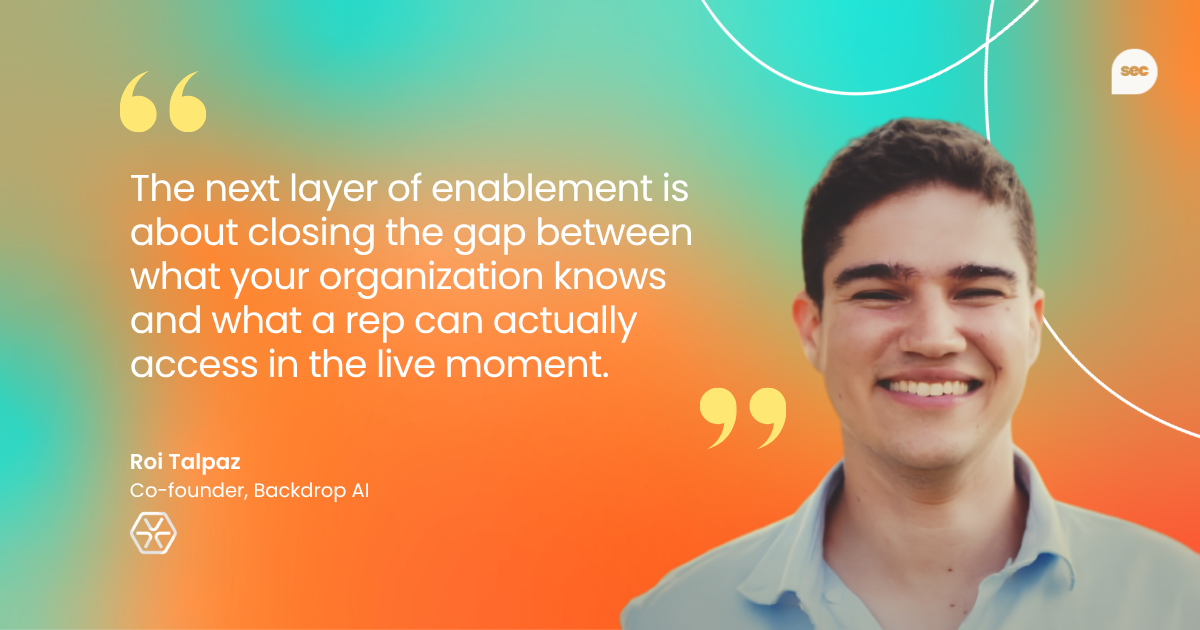
The next layer of enablement is about closing the gap between what your organization knows and what a rep can actually access in the live moment. That gap exists because static docs require a rep to pull information when they're least equipped to do it: under pressure, mid-conversation, with a skeptical buyer on the other end of a Zoom.
Think about how much institutional knowledge your organization has accumulated. The product team knows the roadmap in detail. The SEs know the technical edge cases. The customer success team knows how deals actually play out in deployment. Marketing knows the positioning. Win/loss interviews have surfaced patterns. All of this knowledge exists somewhere in your company, and almost none of it is available to a rep at the moment they need it on a call.
The tools addressing this gap are moving toward a real-time layer. AI that reads the conversation as it happens and surfaces the specific answer a rep needs, in the moment they need it, without requiring them to search, scroll, or stop to think about where to look. A few platforms are starting to operate in this space. The direction the field is heading is toward systems that are present during the conversation itself, rather than only before or after it.
For enablement leaders, the reframe matters. The question shifts from "did we give reps the information?" to "can reps actually use it, at the moment it counts?" Those are very different questions, and they lead to very different programs.
Where this leaves enablement teams
Battlecards are still worth building. They're useful for training. They're useful for asynchronous reference. They're useful for onboarding, for ramp-up plans, for giving new hires a structured way to learn the competitive landscape before they ever get on a live call. The argument here isn't against battlecards. It's that they shouldn't be the only layer.
You can think about enablement as having two distinct surfaces.
- The first is the preparation surface, where reps learn, study, practice, and absorb. Battlecards live here, alongside training programs, role-play sessions, certification paths, and competitive briefings. This surface is well-developed in most organizations. It's where enablement has historically focused its energy.
- The second surface is the live conversation surface. This is where the rep is actually on a call with a prospect and where the value of all that preparation either translates into a great moment or doesn't. Historically, this surface has been almost entirely dependent on the rep's memory and improvisation. The preparation surface fed into the life surface through the rep's own brain, with all the friction and forgetting that implies.
The shift that's happening now is that the live conversation surface is becoming its own enablement layer. Not a replacement for preparation, but an addition to it. The goal isn't to make preparation unnecessary. The goal is to make sure that the gap between what was prepared and what gets retrieved in the moment shrinks toward zero.
The hardest moments on a call are usually not the ones reps practiced in training. They're the unexpected ones. The left-field competitor question. The technical objection that wasn't in the deck. The follow-up that exposes a knowledge gap nobody anticipated. Enablement that only covers expected scenarios covers less than half the territory.
A few questions worth asking your team
If you're sitting with all of this and wondering what to actually do with it, here are a few questions that might be useful to bring to your next planning conversation.
When was the last time your competitive content was audited for accuracy? Not reviewed, but actually checked against what competitors are doing today. If it's been more than a quarter, you probably have some staleness in the system that's quietly eroding rep confidence.
 Ariel Acha
How do your reps actually use battlecards on live calls? Have you watched? Have you asked them in a way that invites honest answers rather than the answers they think you want to hear? You might be surprised how much of your content is being skipped in the moment, even by reps who'd tell you in a survey that they find it valuable.
What happens when a rep gets a question they can't answer on a call? What's the actual path from "I don't know" to "Here's the answer the prospect needed"? In most organizations, that path runs through follow-up emails, internal Slack threads, and several hours of delay. If you mapped that path and timed it, you'd probably see how much deal momentum is being lost in the gaps.
Where in your competitive program are you investing in the live conversation layer versus the preparation layer? If the answer is "almost entirely in preparation," that's worth examining. It's likely where your next meaningful gains are sitting.
The programs are pulling ahead
The programs pulling ahead in competitive enablement are building the layer that comes after the battlecard. The layer that shows up on the call. The layer that meets the rep in the moment of need rather than expecting the rep to retrieve everything from memory or from a document they don't have time to read.
 Daniel O’Dowd
I'm not suggesting this is a solved problem. The tooling is still maturing. The integrations into existing workflows are still being worked out. The change management challenge of getting reps comfortable with a real-time layer alongside their existing prep is real, and enablement leaders will need to think carefully about how to roll it out without overwhelming the team.
But the direction is clear. Static competitive docs were a good first answer to a hard problem. They've taken us as far as they can. The next step is building enablement that's present in the conversation, that updates as the market updates, and that closes the gap between organizational knowledge and the rep's mouth in the moment a prospect is waiting for an answer.
The reps you support are doing their best with the system you've given them. Give them a better system, and you'll see better moments. That's where the work is now.
 Sales Enablement Collective


Sales enablement insider
Thank you for subscribing
Level up your sales enablement career & network with sales enablement experts.
An email has been successfully sent to confirm your subscription.
 Follow us on LinkedIn


.svg)

Start the conversation
Become a member of Sales Enablement Collective to start commenting.
Sign up now