
















Sales leaders rarely doubt that negotiation skills matter.
What they doubt is whether a program changes anything once reps are back at their desks, staring at discounted requests from procurement.
 Sales Enablement Collective
Negotiation training is worth it for most sales teams, but only under specific conditions. Delivered as a single workshop with no follow-up, it fades within weeks and leaves the budget looking wasted. Built into a system of practice, coaching, and measurement, it protects margin and lifts win rates enough to return several dollars for every one spent.
The honest answer, then, is yes, with conditions attached.
What follows lays out the numbers, the reasons training so often disappoints, and how to tell if your team is a suitable candidate.
What does the ROI actually look like?
The headline figures are strong. Sales training returns roughly $4.53 for every dollar invested, a 353% return, according to statistics compiled by The Sales Collective.
Negotiation training specifically tends to report even higher numbers, though these come mostly from vendors.
RED BEAR claims an average return of $54 for every dollar spent across its client base and cites a Fortune 1000 packaging company that saw a 46.7 to 1 ratio.
Ringover references a 466% return within nine months. Treat vendor case studies as directional rather than independent proof, since the companies reporting them also sell the training.
Buyers are getting sharper, and the pressure on seller margins is the reason budgets keep moving toward negotiation as a discrete skill.
Why does so much negotiation training fail?
Here is the uncomfortable counterweight to those ROI numbers.
Only 33% of companies rate their sales training as highly effective, according to RAIN Group's Continuous Learning in Sales research.
The reason is rarely the content. It is what happens after. Most legacy training delivers only 10 to 15% retention six to twelve weeks after the session, a decay attributed to the forgetting curve first described by Hermann Ebbinghaus.
Skills taught on a Tuesday are mostly gone by the following month.
Reinforcement is the missing piece.
A study of 8,561 sales leaders found that 62% see outdated content as the biggest barrier to effective training and 59% of companies name a different problem: reps are not expected to apply what they learned.
Without coaching, follow-up, and metrics tied to behavior change, even good material sits unused.
This is where the difference between sales enablement and sales training becomes practical rather than semantic. Training is an event. Enablement is the surrounding system that makes the event stick.
What separates a workshop from a system?
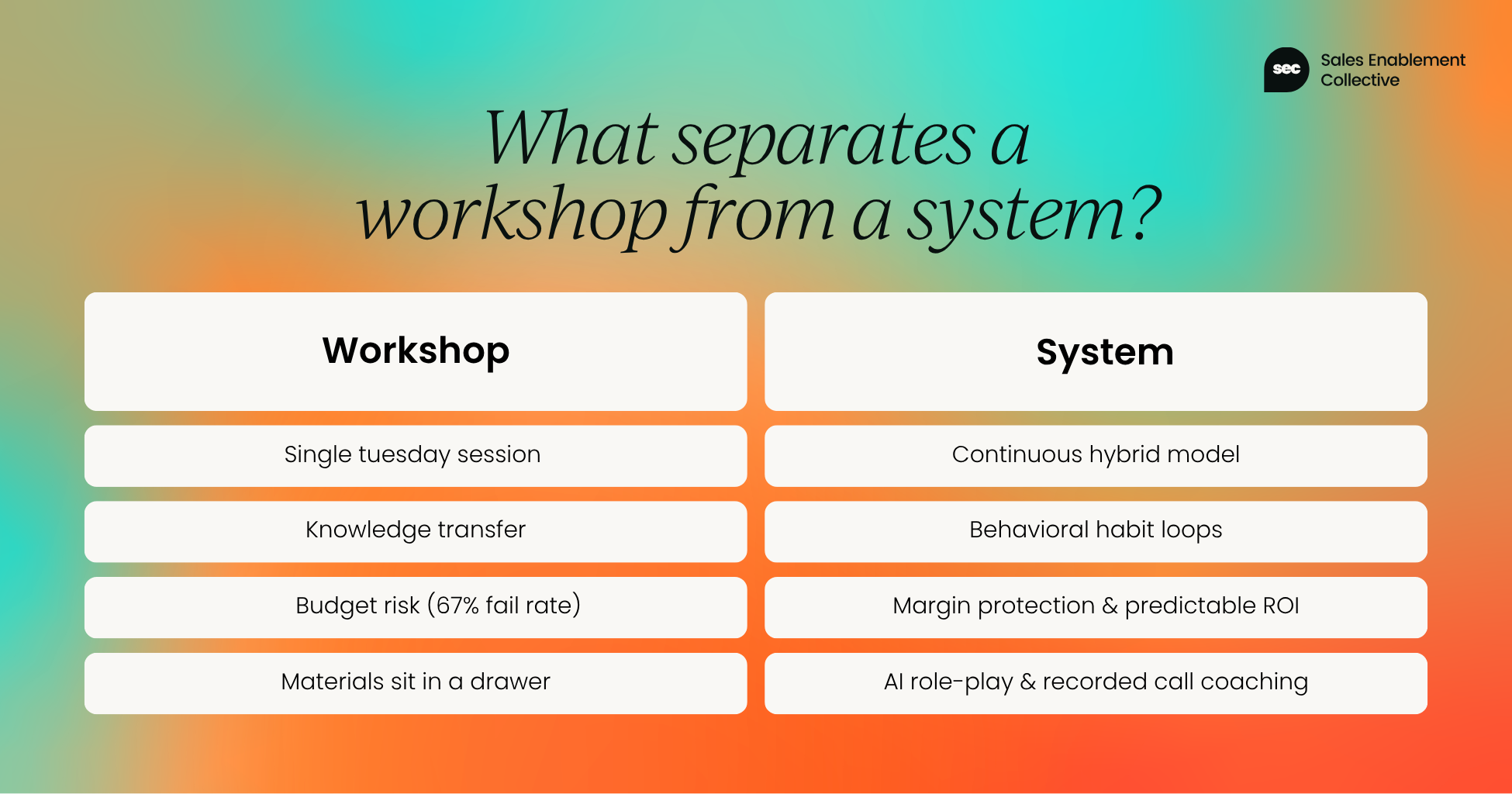
A workshop transfers knowledge. The surrounding system changes behavior.
Teams that report real returns treat the workshop as the start of the work, not the whole of it.
The pattern that holds up in 2026 analyses is a hybrid one: a few live sessions each year for shared language and cohesion, then frequent short practice sessions, increasingly through AI role-play, so reps rehearse objections and price defense before they meet a real buyer.
Practice is what moves a skill from the classroom into the deal.
Coaching is the other half. Managers who study recorded negotiation calls with their reps and set specific development goals turn abstract technique into habit.
Our guides on creating an effective sales coaching program and the modern sales coaching model make the same point: the manager, not the trainer, is where retention is won or lost.
Where do negotiation skills move the number?
Negotiation skills move three numbers in particular: margin, win rate, and deal size.
The clearest is discounting. Reps who cannot defend a price give it away, and every point of discount comes straight off profit rather than revenue. Trained negotiators reframe the conversation around value, which is why the strongest programs pair negotiation technique with value-selling methods rather than teaching tactics in isolation.
Deal size is the compounding lever. Even a 10% increase in average deal size, a common benchmark in 2026 sales-training ROI analyses such as Auto Interview AI's, multiplies across an entire team into meaningful annual revenue.
The psychology underneath this, including anchoring and concession discipline, is well covered in our breakdown of sales psychology principles.
Win rate improves more slowly because it depends on the whole cycle. Negotiation training helps most at the end, protecting deals that would otherwise stall or close at a loss.
How do you know if your team needs it?
Diagnose before you spend.
If reps consistently find themselves defending price, conceding early, or closing at margins below target, the shortfall is likely in negotiation rather than prospecting or discovery.
A structured sales competencies assessment is the cleanest way to see this. Score reps against the specific skills that matter, and the picture usually sharpens quickly.
Some teams need discovery work, others need closing and negotiation, and spending on the wrong one wastes both the budget and the goodwill.
How should you measure the return?
Set a baseline first.
Record win rate, average deal size, discount depth, and sales-cycle length before any training begins, ideally alongside a control group of reps who train later.
Then watch leading indicators, not just revenue. Concession ratio, proposal-to-close rate, and the length of negotiation conversations all shift before the revenue line moves. This is where most organizations fall short: only 25% directly measure these leading behaviors, according to ValueSelling Associates research.
We cover the mechanics in our guides on measuring sales coaching effectiveness, the three key ways to measure training impact, and the sales metrics worth tracking.
Attach a number to the behavior, then attach the behavior to the outcome.
So, is negotiation training worth it?
For most teams, yes, provided you treat it as a system rather than a one-off.
The ROI figures are real but conditional. They belong to the companies that reinforce the training, coach against it, and measure the behaviors it is meant to change.
Buy a workshop and hope, and you will likely join the two-thirds who rate their training as less than highly effective. Build the surrounding system, and negotiation becomes one of the few sales investments that can pay back inside a single quarter.
FAQs
- How long before negotiation training shows results? Leading indicators such as concession ratio and proposal-to-close rate can shift within a quarter. Revenue effects usually take one to two quarters since they depend on deals moving through the full cycle.
- Is negotiation training better delivered in person or online? Analyses in 2026 favor a hybrid model: one or two live sessions a year for cohesion, supported by frequent short online or AI-driven practice for retention. Practice frequency matters more than format.
- What is the single biggest reason negotiation training fails? Lack of reinforcement. 59% of companies say reps are not expected to apply what they learn, which is why retention collapses without coaching and follow-up.
- How do you calculate the ROI of negotiation training? Compare the incremental margin and revenue gained after training against the total program cost: (revenue gain minus training cost) divided by training cost, times 100. Isolating the training effect requires a baseline and, ideally, a control group that trains later.


Sales enablement insider
Thank you for subscribing
Level up your sales enablement career & network with sales enablement experts.
An email has been successfully sent to confirm your subscription.
 Follow us on LinkedIn


.svg)

Start the conversation
Become a member of Sales Enablement Collective to start commenting.
Sign up now