


Let's be brutally honest for a second. Does your leadership actually get what you do?
Our latest Sales Enablement Landscape & Salary Report suggests that for half of you, the answer is probably no. And that's a problem.
51% of enablement practitioners we spoke to for the report are not "in agreement" with their organization's leadership when it comes to metrics and measurement.
This isn't some minor squabble over dashboard colors. This is a significant chasm that's hurting careers.
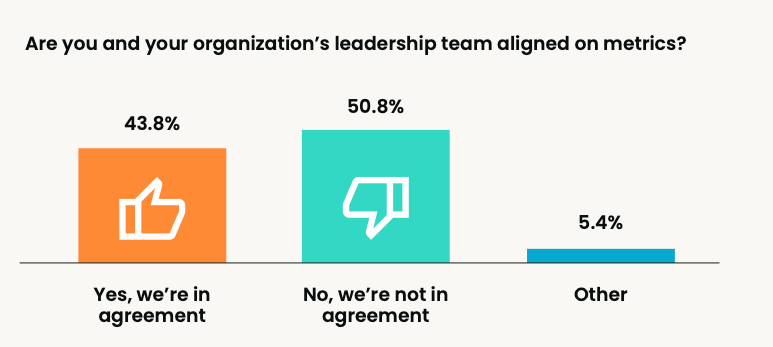
This metrics gap appears to be the root cause of what respondents named as their single biggest challenge.
When asked to identify the top three challenges facing their own teams, the no.1 answer, cited by 61.2% of professionals, was: "Difficulty in measuring the impact and effectiveness of enablement efforts".
This is a critical finding. It suggests that for a majority of teams, the struggle to prove ROI is not necessarily due to a lack of effort or sophisticated tools, but rather because the very definition of "impact" has not been agreed upon with the leaders who ultimately judge that value.
This 50.8% misalignment isn't just a vague feeling. Our data shows that enablement teams are effectively forced to operate with two different sets of "dashboards": one that measures their actual work and another that they must present to leadership to prove their value.
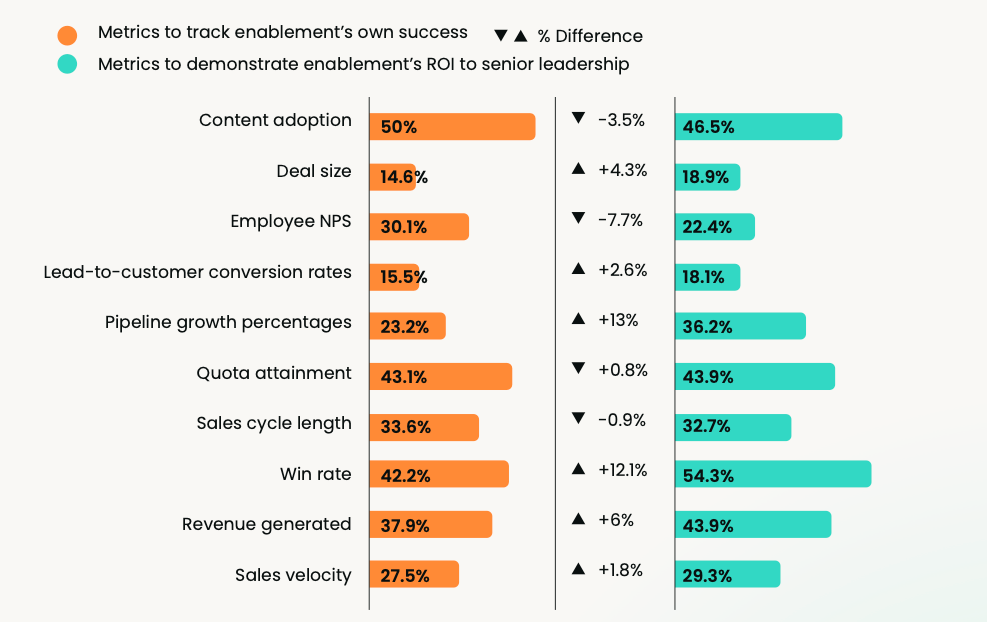
The chasm is most obvious when you compare the metrics enablement teams use for their own success versus those they use to demonstrate ROI to senior leadership.
What leadership wants to see from enablement
From our research, it's clear that leadership values lagging, revenue-centric indicators. Win Rate is considered 12.1 points more important for leadership (54.3%) than for enablement's own internal success tracking (42.2%).
Likewise, Pipeline Growth sees a +13-point jump in perceived importance for leadership (36.2%) versus internal tracking (23.2%).
What metrics do enablement teams value?
A key metric that enablement teams themselves value is Employee NPS, a vital leading indicator of program health and rep sentiment, that's deemed 7.7 points less valuable to leadership (14.6%) than it is to the enablement team itself (22.4%).
The data points to the fact that enablement is caught in a constant, inefficient translation layer. It must spend its energy converting its leading-indicator-focused work (like rep satisfaction, content adoption, and program engagement) into the specific, lagging revenue metrics that leadership demands.
This isn't true alignment. Instead, it's a forced reporting exercise, and it's a direct symptom of the underlying strategic disconnect.
The connection between structure and strategy
Diving deeper into the data, one thing becomes clear: the cause of the disconnect around measurement is organizational structure.
Currently, the most common reporting line for enablement teams is into RevOps (39.4%), followed by Sales (25.4%). While these are, without question, critical cross-functional partnerships, reporting into a specific vertical can inadvertently subordinate enablement's strategic goals to that department's immediate operational targets.
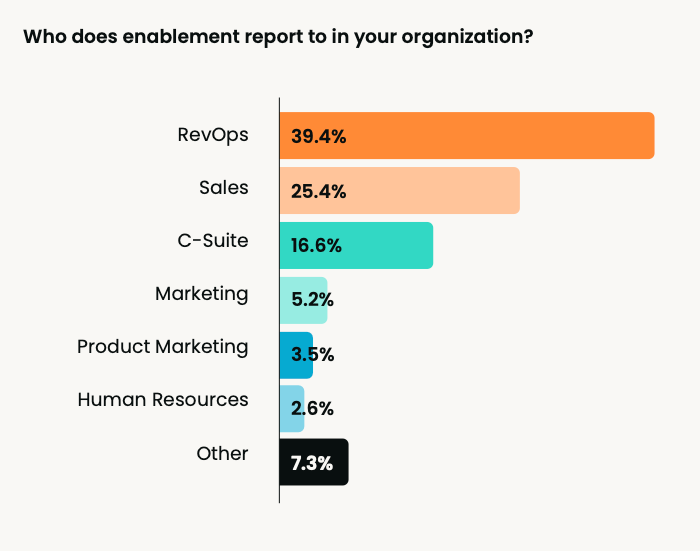
When enablement is a sub-function of sales or ops, it can be more difficult to maintain a holistic, strategic position that orchestrates all go-to-market teams, from marketing to product to customer success. This structure can limit the function's ability to act as the central "connective tissue" for the entire revenue engine.
Enablement professionals themselves see a different path to success.
When asked about the ideal reporting structure, the answer was clear. A plurality of 47.4% believe the function should report directly to the C-Suite.
This aspiration, shared among a large section of enablement professionals, is not about proximity to power, but rather a desire for strategic alignment. A direct line to the C-Suite would, in theory, ensure enablement's objectives are directly tied to the company's highest-level strategic goals, rather than filtered through a single department.
It would, in other words, provide the "seat at the table" necessary to get executive buy-in and establish unified metrics before programs are launched, not after.
Bridging the alignment gap
While organizational structures are often slow to change, our data highlights a clear mandate for enablement leaders. To bridge the 50.8% gap, enablement practitioners must become more adept at communicating and demonstrating value in terms that senior leadership understands.
Our full 2025 Enablement Landscape report provides a critical starting point, detailing not only the challenges but also the specific metrics your peers are using to demonstrate ROI to leadership versus those they use to track their own success.
Armed with this data, you can begin to build a more compelling, data-driven case for your function's strategic value.
Get your copy right here.


Sales enablement insider
Thank you for subscribing
Level up your sales enablement career & network with sales enablement experts
An email has been successfully sent to confirm your subscription.
 Follow us on LinkedIn
Sales enablement insider
Thank you for subscribing
Level up your sales enablement career & network with sales enablement experts
An email has been successfully sent to confirm your subscription.


.svg)
