












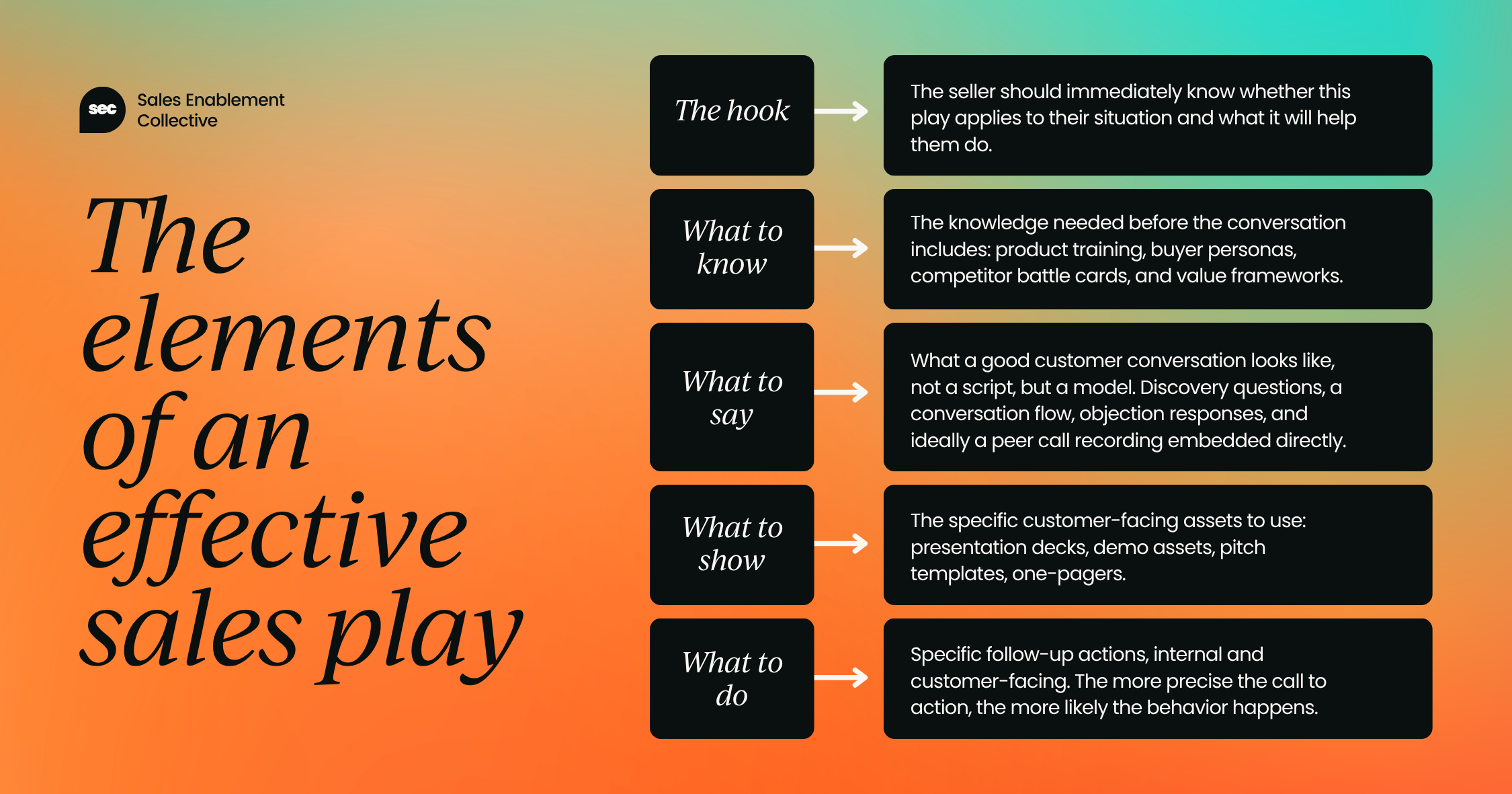
A sales play is a structured, action-oriented guide that tells a seller exactly what to know, say, show, and do in a specific selling situation.
It pulls together every resource a seller needs, like messaging, assets, discovery questions, call recordings, and follow-up actions, into a single, digestible format that lives where sellers actually work.
Think of it as a precise field guide for a particular scenario: winning a deal against a named competitor, introducing a new product to an existing customer, or recovering a stalled opportunity.
 Rebecca Stewart
The modern sales play is not a three-ring binder. It is not an 80-page PDF. It is not a general reference document written for management. It is built for the seller, around a specific action, designed to remove guesswork and drive consistent behavior.
For a more in-depth look at the full scope of what's covered in this guide, the Essential Guide to Sales Plays eBook covers additional play types and diagnostic frameworks.
Sales play vs. sales playbook
These two terms are often used interchangeably, but they describe different things and confusing them leads to playbooks nobody reads and plays nobody uses.
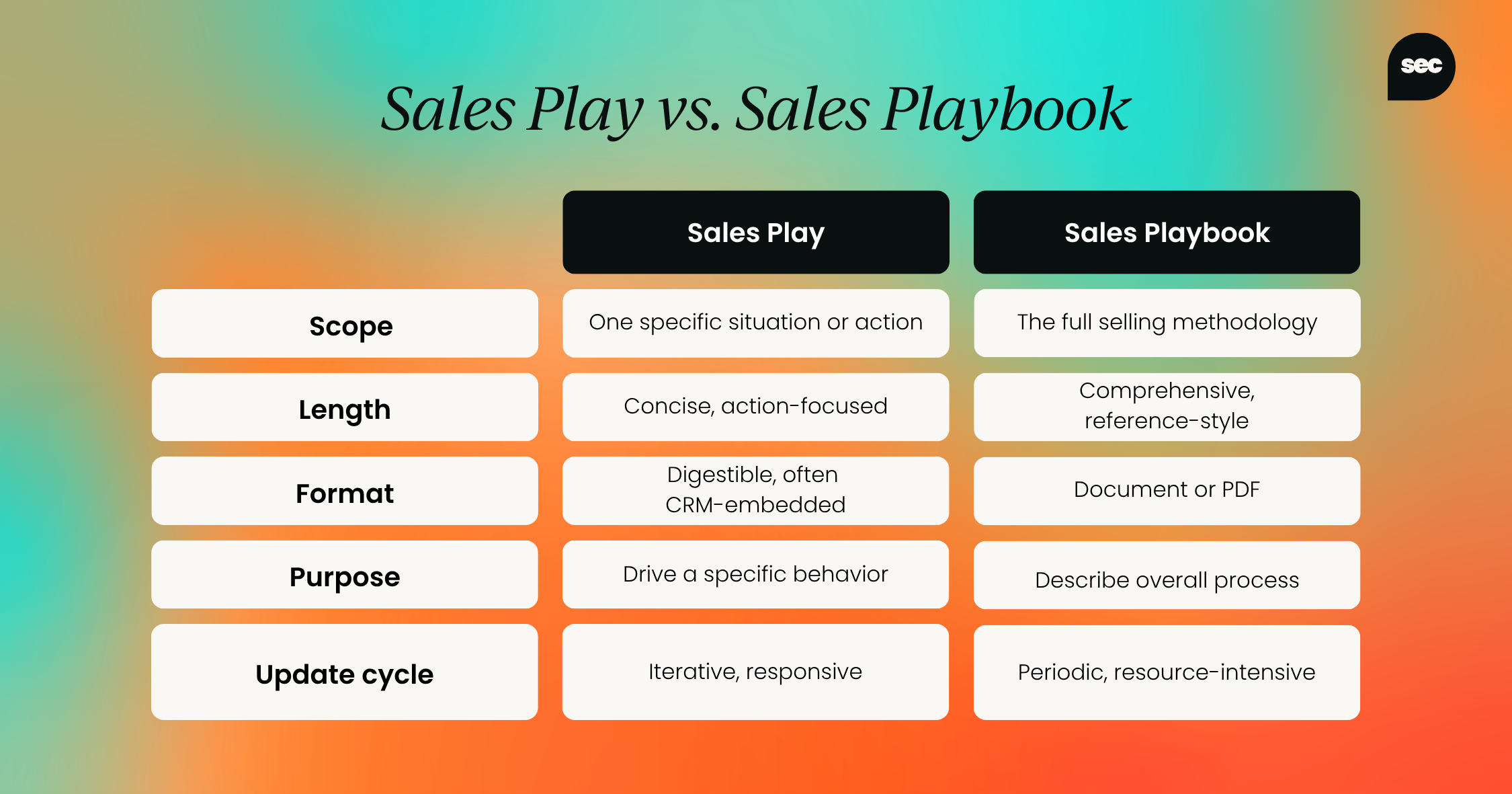
Old-style playbooks tried to document everything. The problem is that comprehensiveness and usability work against each other. A 100-page playbook describes the theory of how deals should happen; a sales play tells a rep what to actually do before their next call.
Sales plays don't replace a playbook. They operationalize it, taking the highest-priority behaviors from your methodology and making them executable.
Why most sales organizations struggle without plays
If you want sellers to do something new or different, you have to be specific about exactly what that looks like.
Think of how your organization prepares sellers for an effective first meeting. In many companies, the process looks something like this:
- The official slides live in a content management system that sellers can't easily navigate.
- Discovery questions are in a separate document that is rarely found when needed.
- Peer call examples exist in a recording tool but require significant time to surface.
- Marketing has created follow-up assets that sit in a different repository, disconnected from the conversation.
Two problems underlie all of this. Sellers don't have one place to find what they need and the organization never communicated what "good" looks like, forcing each rep to invent their own version.
A few experienced, talented, or lucky people will find their way. Most will get lost, not because they lack ability, but because no one gave them a map.
Sales play examples by use case
1. New product launch play
- Trigger: A new offering goes live that the company needs reps to cross-sell to existing accounts.
- Focus: This play details the product overview, ideal account profiles, and crucially, the opening conversation. While standard product launch kits explain what the product does, an effective product launch sales playbook focuses on what the rep should do first, providing a tactical sequence that managers can easily coach and inspect.
 Shun Cheah
2. Competitive displacement play
- Trigger: A prospect is currently locked into a competitor’s contract but shows signs of friction.
- Focus: It highlights known competitor vulnerabilities, advanced trap-setting questions, and contextual differentiators. Instead of linking out to external tools, live competitive intelligence battlecards should be embedded directly within the play for instant access during live calls.
3. Upsell and cross-sell play
- Trigger: An account approaches a natural expansion point, such as a renewal window, high feature adoption, or a new corporate initiative.
- Focus: This play defines how to spot expansion-ready accounts, open the conversation without sounding transactional, and pitch a narrative connecting their current success to a broader scope. It also clarifies the internal handoff process when involving a specialized account engineer or customer success manager. Teams can master these motions by deploying a dedicated upsell cross-sell framework.
4. Stalled deal recovery play
- Trigger: A once-promising opportunity has blown past its close date and gone completely dark.
- Focus: It delivers diagnostic frameworks to uncover the root cause of the silence (e.g., champion departure, budget freeze, or shifting priorities) alongside re-engagement messaging tailored to each scenario, helping reps rebuild urgency without sounding desperate.
 James Shaw
Types of sales plays
Sales kits
The simplest form. A sales kit gathers all relevant assets on a topic into one place with no specific call to action. Use these for process updates, minor product launches, and anything where the goal is awareness rather than behavior change. Quick to build, low-maintenance.
Action-based sales plays
Built around one specific action, typically one conversation or one moment in the sales cycle. This is the play type that drives real behavior change. It transforms a broad initiative ("cross-sell the new product") into something a rep can practice and a manager can coach.
Coaching-enabled sales plays
The most sophisticated version pairs a seller-facing play with a companion coaching play for managers. The manager's play covers what to inspect, what good looks like, and how to provide feedback on the specific behavior. When both are present, the whole performance system aligns.
 Richard Bracchi
Measuring adoption
Publishing a play is not the same as driving change. Tracking read rates tells you almost nothing about whether behavior changed.
The best organizations run the full Equip — Train — Coach cycle. The play handles equipping. Training builds confidence. Coaching sustains the behavior.
Use this as your starting structure.
Decide which outcome you are driving before deciding which play to build.
If you want sellers to find content more easily, start with a sales kit and keep it simple. If you need to change a high-impact behavior, build an action-based or coaching-enabled play and follow through on adoption.
Bring together three roles: an audience SME (a respected front-line seller or manager), a topic SME (product marketer, competitive analyst, depending on the play), and an enablement SME to ensure consistency. This trio cuts through functional silos in ways traditional processes rarely manage.
 Darlene Samer
This article builds on the original guide published by Highspot. This version expands that foundation with a defined glossary, a sales play vs. playbook comparison, use-case examples, and a ready-to-use template.


Sales enablement insider
Thank you for subscribing
Level up your sales enablement career & network with sales enablement experts.
An email has been successfully sent to confirm your subscription.
 Follow us on LinkedIn


.svg)

Start the conversation
Become a member of Sales Enablement Collective to start commenting.
Sign up now