







Open almost any kitchen cabinet in America, and you'll find one. Reusable coffee cups are tucked into backpacks, sit beside laptops, and line shelves in break rooms. They've become one of those products that almost everyone seems to own.
And yet, we don't use them nearly as much as we think.
I recently facilitated a Sales Enablement Collective gathering focused on the skills AI cannot replace. To kick things off, I shared an image of a drawer overflowing with reusable coffee cups and the data that went with it. Around 69 percent of Americans own one. About 24 percent say they bring one to a café. But just 1.2 percent of Starbucks orders are actually filled in a reusable cup.
A substantial gap exists between owning the thing and realizing its intended benefit and I think we're starting to see something very similar play out with AI in sales enablement.
The gap between having AI and using it well
Over the last few years, enablement teams have understandably raced to drive AI adoption. We've built prompt libraries, hosted workshops, rolled out licenses, and celebrated strong usage rates. Sellers are using these tools to summarize meetings, research accounts, draft emails, prepare for calls, and build presentations.
All of that can be genuinely useful. But there's a real danger in mistaking usage for impact.
Think about it this way. A seller could use AI 20 times a day and become significantly faster without becoming better. They might write more emails without developing better judgment about which customers deserve an email in the first place. They might prepare for a meeting in half the time without becoming any more curious once the meeting actually starts. They might produce a polished account plan without learning to recognize the political dynamics inside an account.
This is one of the central questions I brought to our workshop: as AI accelerates and cheapens task-based work, where will talent development and enablement create the most value? The answer, I'd argue, is somewhere most of us haven't been spending enough time.
What Starbucks can teach us about development
It's easy to think of Starbucks training as a fairly straightforward exercise in knowledge transfer. A new barista needs to learn recipes, equipment, procedures, safety standards, and the seemingly endless taxonomy of drinks available to someone standing at the counter.
But Starbucks has built something considerably broader around the barista role, and it's worth paying attention to.
New employees receive structured training early in their tenure, but development continues well beyond initial onboarding.
The company has experimented with coaching roles embedded in coffeehouses, created pathways into store leadership, and invested heavily in education through programs like the Starbucks College Achievement Plan, which provides eligible employees with upfront tuition coverage for a first bachelor's degree through Arizona State University.
Starbucks says roughly 60 percent of its U.S. and Canadian store managers started as baristas, and the company has stated a goal of filling 90 percent of retail leadership positions internally.
Those investments tell us something important about how Starbucks understands the person behind the counter. A barista isn't simply someone who needs to learn enough to make a flat white correctly. The job can be an entry point into a much longer process of learning a craft, receiving coaching, developing judgment, and eventually becoming capable of coaching and leading others.
Training is organized around task completion. Enablement organizes around revenue attainment. Formation organizes itself around who we are becoming.
That's a meaningful distinction, and it's one our profession hasn't fully grappled with yet.
When the recipe gets cheap
Here's a thought experiment worth sitting with. Imagine AI becomes perfect at supporting the procedural parts of being a barista. A barista forgets the recipe for an unfamiliar drink and gets an answer immediately. The system anticipates the next step, notices an error, or suggests how to sequence several orders more efficiently.
The knowledge hasn't become worthless but accessing the knowledge has become cheap. So what becomes more valuable as a result?
The barista who notices that a regular customer seems unusually quiet. The experienced employee who can keep a chaotic store calm during the morning rush. The person who knows when to stop following the standard operating procedure and actually solve a customer's problem. The shift supervisor who can give a struggling new employee feedback without embarrassing them.
Those abilities are genuinely difficult to capture in a training module because they aren't simply pieces of information. They develop through experience. Someone tries something, reflects on it, receives feedback, watches someone more experienced handle a similar situation, and tries again. Over time, they begin to see situations differently.
 Renzo Bojanovich
Sales works much the same way.
AI can retrieve product information. It can summarize the discovery call and draft the follow-up email. It can research the account, generate the presentation, and recommend questions for the next conversation.
But a list of good discovery questions isn't the same thing as curiosity. A sound business case isn't the same thing as commercial judgment. A suggested response to an objection isn't the same thing as knowing how to pick your battles.
These are human capacities to develop. They require formation. And that's where enablement has a genuinely exciting opportunity right now.
How AI changes the job of enablement
For a long time, enablement has had a scale problem. There are only so many coaches, trainers, and enablement professionals available to support hundreds or thousands of sellers.
So we built systems that could distribute content efficiently: LMS courses, content repositories, playbooks, certifications, battlecards, and increasingly sophisticated technology stacks.
Now, content creation and distribution have become radically easier.
That should cause us to genuinely reconsider where we spend our time.
If AI can provide the answer to a product question in seconds, perhaps enablement doesn't need to spend quite as much energy making sure sellers can recall every product spec.
If AI can create a realistic role-play whenever a seller wants one, perhaps the rep doesn't need to wait for the next workshop to practice. If AI can analyze a sales conversation and surface moments worth discussing, perhaps managers can spend less of their coaching time reconstructing what happened and more of it helping the seller understand why it happened.
And that changes the questions we should be asking about AI adoption. Rather than simply tracking how many sellers are using the tool, we might ask whether sellers are developing better judgment because of it.
Are managers having more empathetic coaching conversations? Are sellers becoming more perceptive, noticing things they previously missed? Are they becoming better at challenging assumptions, telling stories, navigating ambiguity, and earning trust?
Perhaps most importantly: what are people doing with the time AI gives back to them? If the answer is simply "producing more stuff," we may have missed the real opportunity entirely.
The metrics we're measuring and the ones we're missing
This is where I want to push back a little on how many enablement teams are currently thinking about AI success. Usage rates are easy to report. Licenses activated, prompts submitted, content generated, hours saved. These numbers look good in a slide deck, and they're not meaningless. But they can create a false sense of progress.
Going back to the coffee cup analogy: owning 69 percent of the cups doesn't mean you're getting 69 percent of the environmental benefit. The gap between possession and realized value is where the real story lives.
The same is true with AI in sales. A seller who uses AI to draft every email faster might be saving 30 minutes a day. But if those emails are less thoughtful, less tailored, or sent to the wrong people entirely, the net effect on revenue could be flat or even negative.
Those are harder questions to answer but they're the right ones.
From training programs to forming people
There's a strange paradox inside all the anxiety about AI and the future of work. This rapid push toward automation may ultimately push our profession toward a more human understanding of what development actually means, one rooted in purpose and growth rather than content delivery and certification completion.
When information was difficult to distribute, enablement had to spend enormous energy creating content. When practice was expensive, we had to gatekeep access to coaching and mentorship. When managers had limited visibility into seller behavior, coaching often became a conversation about visible activity and pipeline data.
Those constraints are eroding. And when they fall, the job becomes much more interesting.
The future of AI enablement probably isn't another workshop on ten prompts every seller should know. It's creating environments where people can practice more frequently, receive better feedback, reflect on their decisions, learn alongside experienced practitioners, and gradually develop the judgment, curiosity, and cultivated attention required to navigate volatile and uncertain environments.
Think about what that could look like in practice. A seller finishes a difficult discovery call. Instead of waiting two weeks for their next one-on-one with their manager, AI surfaces the key moments from that conversation worth discussing. The manager comes to the coaching session already knowing what happened.
The conversation can focus entirely on what the seller was thinking, what they noticed, what they'd do differently, and why. That's a richer development conversation than most sellers ever get.
Or consider a new rep who wants to practice handling a specific objection. Rather than waiting for the next scheduled role-play session, they can practice it ten times in an afternoon with an AI partner that gives them immediate feedback. By the time they're in front of a real prospect, they've already worked through the rough edges.
 Daniel O’Dowd
The technology makes those things possible. But the enablement professional still has to design the environment, set the developmental goals, coach the manager on how to use the insights, and help the seller reflect in ways that actually build lasting capability. The human work doesn't disappear. It shifts.
What this means for how you think about your role
If you're an enablement professional reading this, here's the honest question worth sitting with: how much of your current work is focused on content and information transfer, and how much is focused on helping people develop judgment, curiosity, and the ability to navigate complexity?
For most teams, the balance has historically tilted heavily toward the former. That made sense when distributing content was hard and expensive. It makes less sense now.
The sellers who'll be most valuable in the next five years probably won't be the ones who are best at using AI tools. They'll be the ones who've developed genuine commercial judgment, the ability to read a room, to ask that changes the direction of a conversation, to earn trust with a skeptical buyer, and to know when the playbook applies and when it doesn't.
Those capacities develop through experience, reflection, feedback, and formation. AI can support that process in meaningful ways. It can create more opportunities to practice, surface better data for coaching conversations, and free up time that could be reinvested in development.
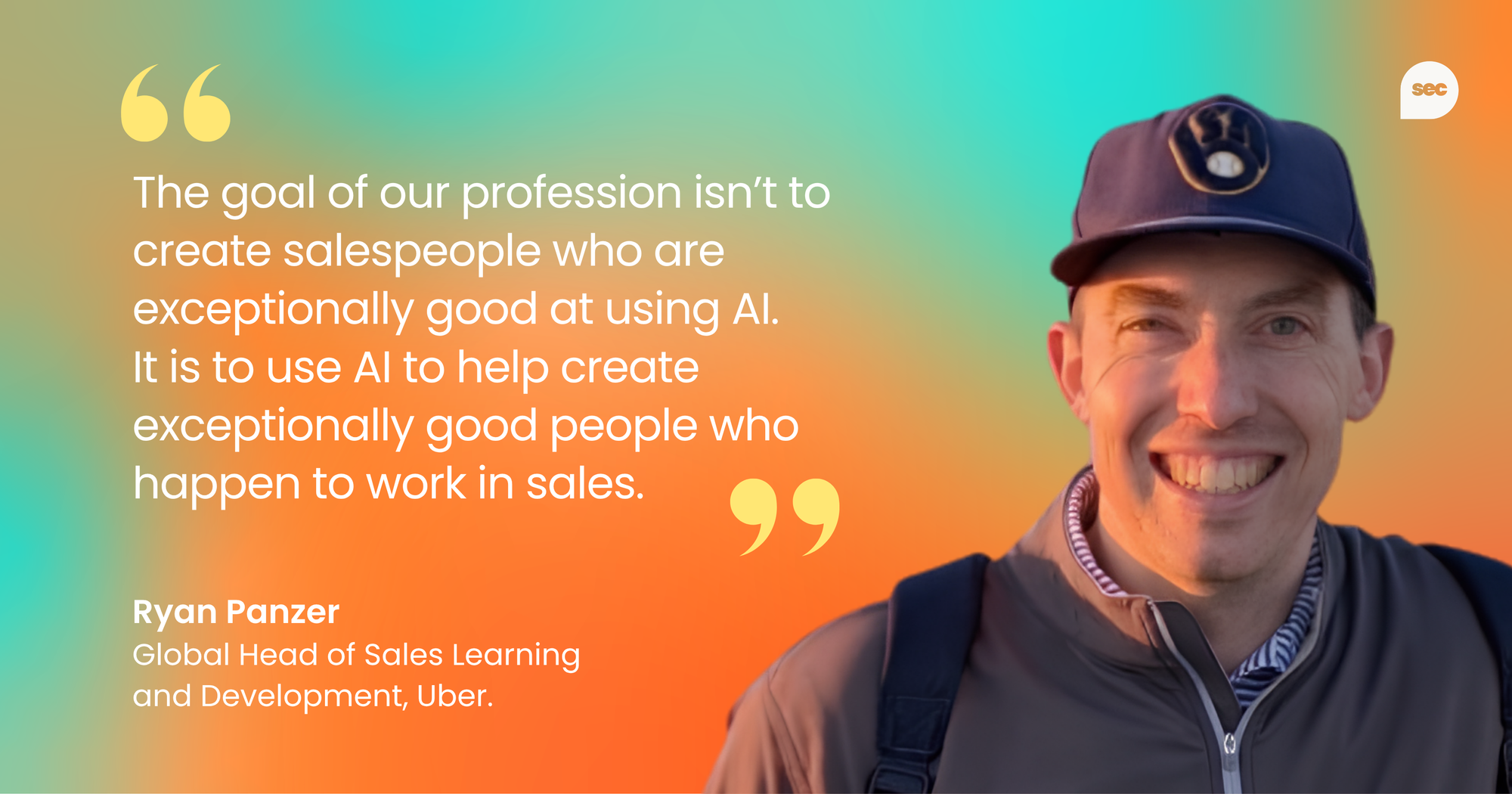
But the goal of our profession, when you really think about it, has always been to help people grow. AI doesn't change that. If anything, it clarifies it.
The real question for enablement teams
Here's where I'd encourage you to start. Take an honest look at your current AI enablement strategy and ask whether it's primarily helping sellers work faster or helping sellers become better.
Faster is fine. Faster can free up time and reduce friction. But if faster is all you're getting, you're leaving the most important part of the opportunity on the table.
The reusable coffee cup is sitting in the drawer. The AI license is activated. The prompt library is built. The question is whether you're actually using it to realize its intended benefit, which in this case isn't just efficiency. It's growth.
It's the development of people who are genuinely better at the complex, human, judgment-intensive work that AI can support but never fully replace.
That's the work worth doing. And honestly, it's the most interesting version of this profession I've seen in a long time.


Sales enablement insider
Thank you for subscribing
Level up your sales enablement career & network with sales enablement experts.
An email has been successfully sent to confirm your subscription.
 Follow us on LinkedIn


.svg)

Start the conversation
Become a member of Sales Enablement Collective to start commenting.
Sign up now