


Sales enablement continues to grow as a function, and as more professionals look to move into the function, one topic becomes ever more important: salary.
At Sales Enablement Collective we aim to elevate the importance of sales enablement, and part of that is publishing our annual Sales Enablement Landscape and Salary Report.
Built with the help of our community, our goal with this report is to drive salary transparency and allow sales enablement managers to understand their worth.
What does a sales enablement manager do?
Before looking at the figures in our Sales Enablement Salary Report, let's understand what makes a sales enablement manager valuable and why some roles command higher compensation than others.
Core responsibilities that drive business impact
A sales enablement manager helps sales teams perform more consistently by improving training, content, systems, and day-to-day execution. In practice, that often means building onboarding programs, maintaining playbooks, supporting product launches, improving messaging, and making sure reps can find the right resources at the right time.
 Alex Walton
This role usually sits at the intersection of sales, marketing, product, and revenue operations. Strong enablement managers coordinate across those teams so that sellers have current content, clear positioning, and repeatable processes. In more mature organizations, they also help manage the enablement tech stack, including platforms like Salesforce, HubSpot, Gong, Seismic, Highspot, Outreach, and Clari.
In a small team, or while working alone, a sales enablement manager might be responsible for sales enablement in an end-to-end fashion — strategizing, managing, and executing projects. In larger teams, the manager role often focuses more on deliverable execution, while a more senior counterpart such as a Head of Sales Enablement handles strategic initiatives and wider project management.
Skills and qualifications that can increase salary
Compensation tends to rise when a sales enablement manager brings skills that are hard to replace or directly tied to revenue performance. Examples include sales analytics, program measurement, revenue operations knowledge, change management, and experience with enablement platforms.
AI fluency is no longer optional. Our report found that 76.7% of enablement teams use AI every day, so if you can coach reps, surface content, or automate workflows with those tools, you're better positioned for the top pay bands.
It's also worth noting what's happening at the team level. According to the same report, 23.6% of respondents' teams decreased in headcount over the past 12 months, which means individual contributors are often being asked to do more with less. That scope expansion, when you can demonstrate and articulate it, becomes a legitimate basis for a compensation conversation.
Career progression and salary trajectory
Many professionals start in support roles such as sales enablement specialist or coordinator, then move into manager positions once they've owned onboarding, training, or content programs. From there, the typical path leads to senior manager, director, and eventually head of enablement or revenue enablement leadership roles.
As scope expands, so does pay. Entry-level roles focus more on execution. Manager-level roles add program ownership and cross-functional collaboration. Senior and director-level roles are expected to influence sales productivity, forecast readiness, ramp time, and broader GTM performance.
The language in your title can shift your paycheck too.
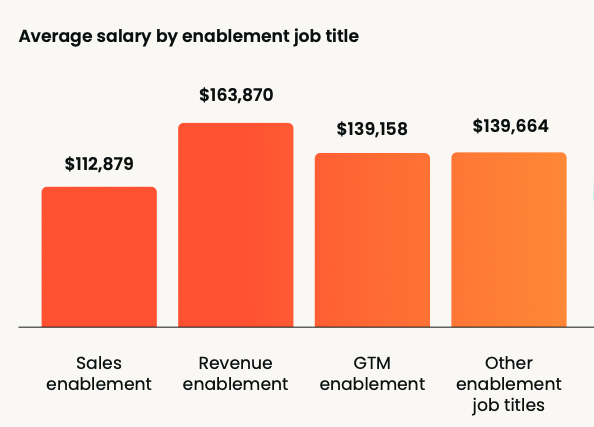
Revenue enablement professionals earn an average of $163,870, compared to $112,879 for those with sales enablement in their title, a difference of over $50,000 for work that often looks very similar day-to-day.
What's the current salary range for sales enablement managers?
The global median salary for an enablement professional is $125,000, with the average reaching $131,400. But those headline figures obscure a lot. Compensation varies considerably based on seniority, location, company size, and how the role is scoped.
It's also worth noting a broader trend: average compensation across the profession declined by $5,619 compared to the previous year, dropping from $137,032 to $131,413. This arrives at an odd moment, enablement teams are taking on broader strategic responsibilities and demonstrating more measurable revenue impact than ever.
Base salary ranges by seniority level
Our latest data breaks compensation down clearly by career level:
- Junior/entry-level: Average $75,517 | Median $69,000
- Sales Enablement Manager: Average $116,800 | Median $122,000
- Head of Sales Enablement: Average $147,000 | Median $150,000
- Director and above: Average $190,000 | Median $186,000
These figures represent base pay and do not include bonuses, commission, or stock options.
Base salary is only part of the picture.
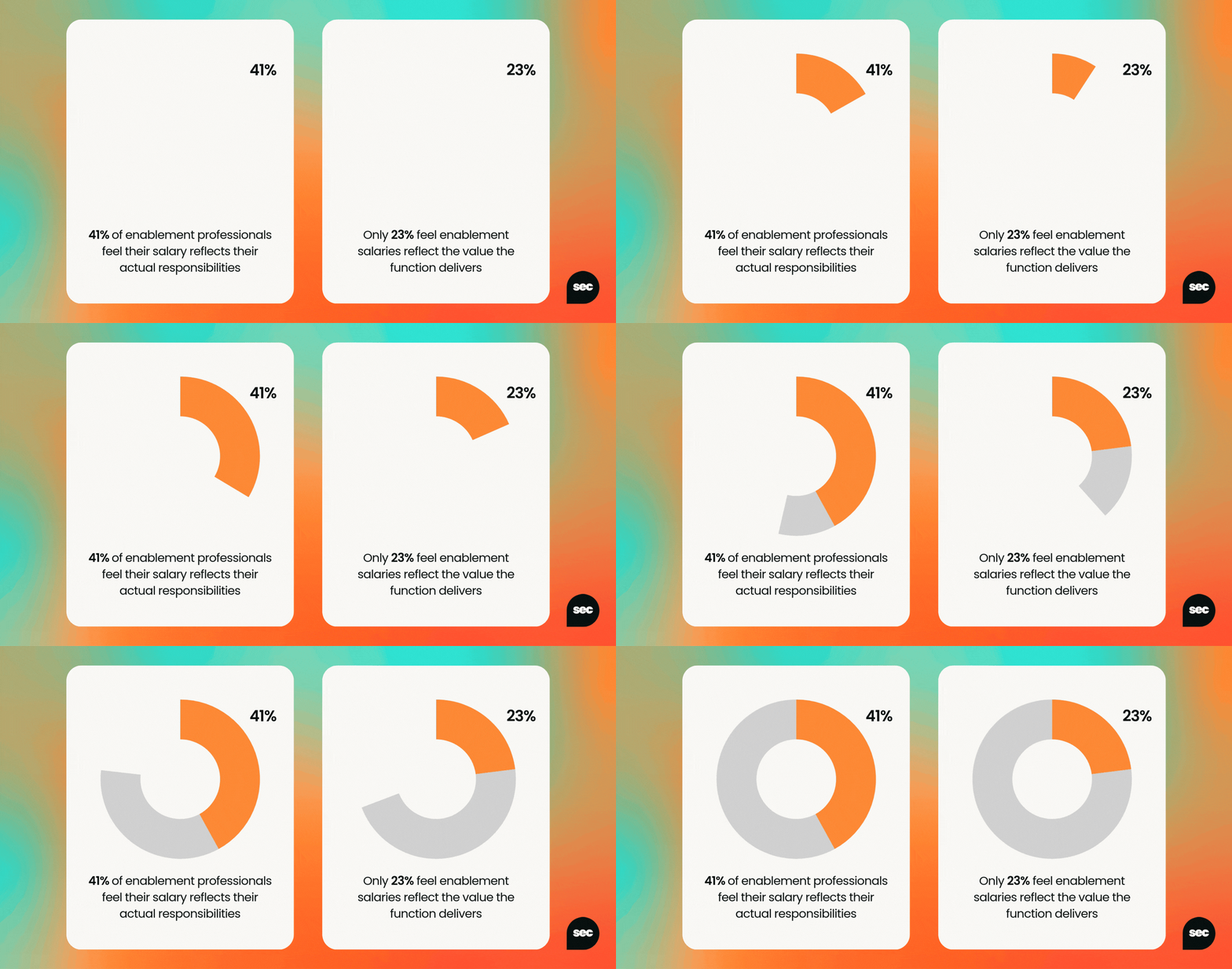
Our 2025/26 report found that 73% of enablement professionals receive bonuses or commission on top of their base. Crucially, those receiving variable compensation also report higher base salaries on average, $129,037 versus $112,870 for those without. This suggests that bonus structures typically augment competitive packages rather than compensate for below-market base pay.
 Sales Enablement Collective
Equity and total compensation packages
In SaaS, tech, and high-growth companies, equity can be a meaningful part of total compensation. Stock options or restricted stock units may significantly increase the long-term value of an offer, especially for senior manager, director, or revenue enablement roles.
That makes total compensation a better benchmark than salary alone. When comparing roles, evaluate base salary, target bonus or commission, equity value, benefits, and role scope.
How experience shapes your sales enablement salary
Experience has a strong effect on compensation, but the relationship is not entirely linear. Our data shows a notable dip in the 4–5 year range — a point where professionals have typically outgrown junior positions but may not yet have moved into management or director-level roles.
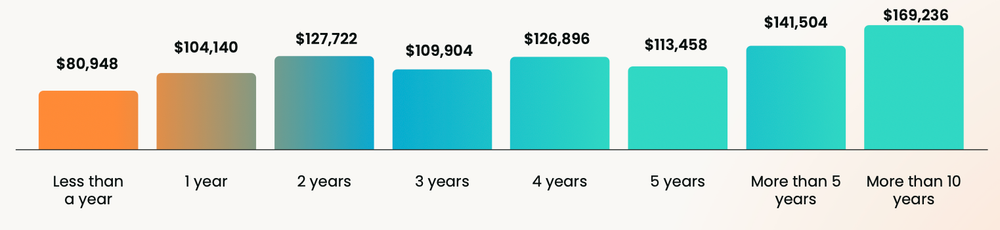
Proactive career management at this stage, whether through pursuing leadership opportunities, changing organizations, or specializing in high-value areas, becomes especially important.
Entry-level: Building your foundation (0–2 years)
At the entry level, you'll typically work in coordinator or specialist roles, supporting onboarding, organizing content, maintaining systems, and helping deliver training. CRM familiarity, content organization, basic reporting, and comfort with platforms like Salesforce or HubSpot are the most valuable early skills.
Mid-level: Owning programs and execution (3–5 years)
By mid-level, sales enablement managers are expected to build and run programs rather than support them. Compensation rises when you can show business impact — faster rep ramp times, higher content adoption, improved win rates, or better cross-functional alignment.
Senior-level: Leading strategy and scale (5–10 years)
Senior managers and directors typically carry broader ownership across regions, business units, or product lines. Revenue enablement scope becomes especially relevant here, both in terms of impact and compensation potential.
Leadership roles: Driving organizational impact (10+ years)
At the leadership level, compensation reflects enterprise-wide influence. Directors of sales enablement, heads of enablement, and VPs carry responsibility for strategy, team structure, executive alignment, and measurable GTM performance. These roles are most likely to include meaningful bonus upside and equity.
 Katie Van Hoomissen
Geographic variations in sales enablement compensation
Location still plays a major role in compensation, but remote work has changed how many companies set pay. You'll find more useful insights by looking at specific markets, cost of living differences, and whether a company uses local, regional, or location-agnostic pay bands.
Major US cities and tech hubs
Large US markets like San Francisco, New York, Seattle, Boston, and Austin often offer the highest compensation for sales enablement managers. These tech hubs have a higher concentration of SaaS, enterprise tech, and venture-backed companies—which increases demand for enablement talent.
Salary levels in these markets are influenced by both competition for talent and cost of living. You should expect higher pay in top tech hubs, but weigh housing costs, taxes, and equity upside when comparing offers.
European markets
In Europe, compensation varies widely by country and city. London typically offers some of the strongest pay for enablement roles, while other major hubs like Berlin, Amsterdam, and Paris may also offer competitive packages depending on company stage and sector.
European roles can differ not just in salary, but in how compensation is structured. Some scale-ups may offer equity, while more traditional employers emphasize salary and benefits. This geographic salary difference makes location-specific research essential.
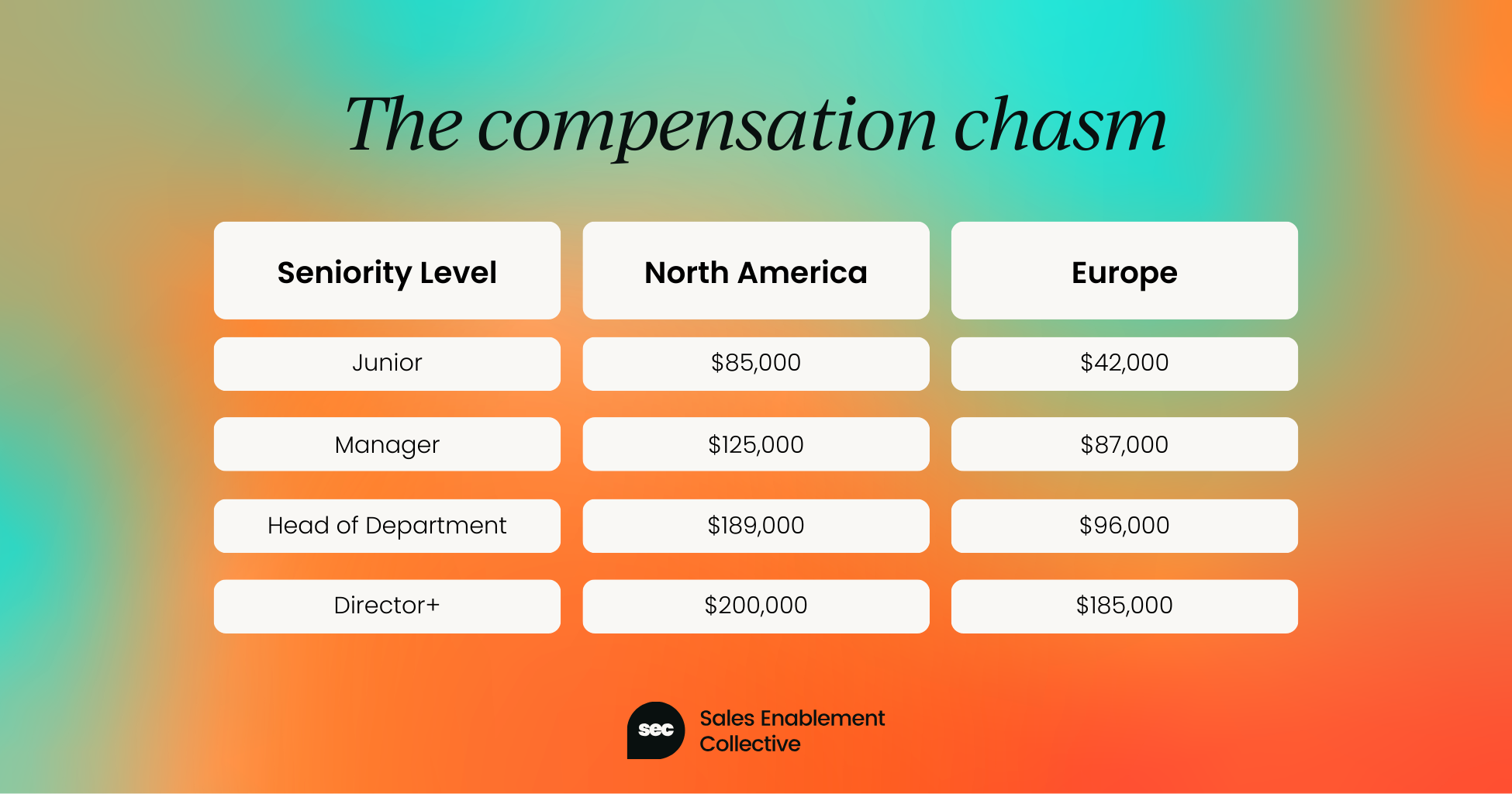
Remote work and emerging markets
Remote work has made geographic salary differences more nuanced. Some employers still benchmark compensation against your location, while others anchor pay to headquarters or use broader regional bands. Two remote roles with similar responsibilities can have very different pay outcomes.
Here are the right questions to ask:
- Is pay tied to headquarters or your location?
- Does the company apply cos- of-living adjustments?
- Is compensation location-agnostic for senior roles?
- Are bonuses and equity handled differently for international hires?
Understanding these policies helps you evaluate remote opportunities more effectively in today's distributed workforce.
 Alex Walton
Maximizing your sales enablement compensation
Salary data is most useful when you know how to apply it. Here's how to benchmark your value, negotiate more effectively, and make career moves that increase your long-term compensation.
How to benchmark your market value
Don't rely on a single salary site. Compare multiple sources like Glassdoor, Salary.com, and Comparably to get a complete picture.
Your salary research should factor in:
- Location and cost of living
- Company size and stage
- Industry (SaaS typically pays more than traditional sectors)
- Role scope and responsibilities
- Total compensation, not just base salary
- Title variations across companies
It's especially important to compare related titles like revenue enablement manager, GTM enablement, or sales effectiveness roles. Similar work might be paid differently depending on how companies position these functions.
Negotiation strategies for enablement roles
The strongest salary negotiation strategy in enablement? Translate your work into business outcomes. Document metrics like:
- Reduced ramp time for new hires
- Improved quota attainment rates
- Higher training completion and content adoption
- Better win rates and deal velocity
- Stronger forecast accuracy
Position enablement as a revenue-driving function, not a support function. When you can show direct impact on sales performance, you're in a much stronger negotiating position.
How to move into higher-paying roles
For many enablement professionals, the fastest path to higher compensation is expanding scope. That might mean moving from sales enablement into revenue enablement, taking on strategic analytics work, learning rev ops systems, or gaining experience in higher-paying sectors like fintech or enterprise software.
Compensation growth often comes from a mix of:
- Better positioning of your role's strategic value
- Broader scope across the entire revenue organization
- Stronger metrics that tie to business outcomes
- More strategic titles that reflect your impact
- Movement into companies with mature GTM teams
Want more detailed salary insights? Our Sales Enablement Salary Report dives deeper into how gender, experience, seniority, and location affect compensation worldwide.
You can also join our Slack community to network with 5,500+ sales enablement peers and get real-time advice on salary benchmarking and career advancement.


Sales enablement insider
Thank you for subscribing
Level up your sales enablement career & network with sales enablement experts
An email has been successfully sent to confirm your subscription.
 Follow us on LinkedIn
Sales enablement insider
Thank you for subscribing
Level up your sales enablement career & network with sales enablement experts
An email has been successfully sent to confirm your subscription.


.svg)
