


Ask any sales enablement professional and they’ll tell you that sales kickoffs are a big deal.
These (usually yearly) events require months of planning, sharp execution on the day of the event, and reinforcement of the learnings in the weeks and months afterwards.
The aim of a sales kickoff (SKO) is to set the stage for the upcoming year and prepare your sales force for the next 12 months of going to market.
Key words to keep in mind while planning your annual sales kickoffs are:
- Alignment
- Motivation
- Empowerment
These are the principles your sales enablement team should keep in mind – the goal is to impart these on to your sales organization.
SKOs are one of, if not the most important events on the sales calendar. But with so much involved, they’re difficult to get right.
Our guide is full of tried-and-tested advice that’ll help you ace every aspect of your next SKO. 👇
1. Planning a sales kickoff event
Whether it’s virtual, hybrid, or in-person, there’s a lot of work involved in making a sales kickoff happen.
Planning usually starts months in advance to allow for as much time as possible to organise the logistics of the day(s).
For example, many enablement professionals will begin work around August or September for a January or February SKO.
The first order of business when planning? Setting out clear goals, objectives, and outcomes for the event.
Goals and objectives
Everything you plan for your sales kickoff should be tied back to the event’s primary goals. Ask yourself about the information you want to impart onto sales team members, and then use that as your North Star for planning.
You should be able to link back every keynote speaker, every breakout session, and every event activity back to your North Star goal.
That way, you decrease the risk of scope creep and ensure that every part of your SKO is relevant to the event’s overall objective.
For me, it always starts with defining the key outcomes I want our sales team to walk away with - what do I want them to know, feel, and be able to do differently as a result of being at kickoff?
This could be anything from introducing new products and features to aligning on go-to-market strategy, highlighting customer success stories, reinforcing critical selling skills, or simply reigniting their excitement about the year ahead.
- Lisa Duncan, Senior Director of Revenue Enablement
In short? The key is to set an overall, aligned goal for your SKO event and keep that at the center of all your planning.
Be intentional about the event. Chances are you won’t be able to fit in everything you or your sales leaders would like to.
To help, have a clear list of both knowledge and action objectives that you want your event attendees to leave with, in order of importance. You can then prioritize the sessions and assess what the best audience and format would be for each.
- Celine Grey, GTM Transformation Leader
Establishing timelines
We briefly mentioned timelines earlier, but it’s important enough to reiterate. Sales kickoffs are big events.
Depending on the size of your organization, it could involve multiple full days of content, flights and accommodation for thousands of people, and a lot of your organization’s money.
The last thing you want to do is find yourself with a month until the big day with no keynote speakers lined up, half an agenda, and not enough time to pull it all together.
Starting to plan your sales kickoff early accounts for delays, lets you fit the planning in alongside your usual work, and takes away the stress of a last-minute scramble to organize.
When possible, I start planning in August for a January event. This allows me to focus on big-picture goals and themes without feeling overwhelmed by the day-to-day details.
- Lisa Duncan, Senior Director of Revenue Enablement
2. Building your sales kickoff’s agenda
Once you’ve aligned with your key stakeholders on an overarching goal or objective for the event, you can start to piece together your agenda.
Your sales kickoff meeting agenda will vary significantly depending on whether your event is virtual or in-person, the number of attendees, the number of days the event stretches, your budget, and more.
That being said, there are a few rules of thumb to keep in mind regardless of your organization’s individual factors.
I lean on a pretty consistent formula that I've developed over the years, making tweaks as needed based on the specific business priorities. The non-negotiables for me are:
1. Opening remarks from the CEO and/or CRO to set the strategic vision. 2. Updates from product on new capabilities and roadmaps. 3. Guidance from marketing on how they'll be supporting the sales team. 4. Customer success stories and testimonials. 5. Opportunities for reps to share their own best practices
I try to mix up the formats too - not just back-to-back presentations. Maybe we'll do a fireside chat with the CEO, a panel discussion with customers, or interactive workshops on specific selling skills. Of course, I also always make sure to build in some fun, high-energy moments to keep the team engaged and energized.
- Lisa Duncan, Senior Director of Revenue Enablement
Product updates, changes to sales processes and go-to-market strategy, and motivational keynotes to set the tone for the year all have a place at SKO (not to mention the all important Happy Hour too!).
Your role as an enablement professional? Fitting these items into your agenda based on priority – another area where communication with internal stakeholders will help.
Inevitably, something will have to be cut due to time or scope constraints, and cross-functional chat will help ensure everyone’s happy with the finalized agenda.
 Nikki Schanzer
3. Picking the right SKO speakers
Sales kickoffs, in their most simple forms, are a way of presenting new information to your sales team. And like it or not, but keynote speakers and presentations are a popular way of doing that.
That means your SKO will live or die based on the quality of speakers that you bring to the event.
Speaker quality is the difference between putting your sellers to sleep as they listen to presenter after presenter drone on in a monotone voice, and getting the sales team excited to sell as they listen to enthusiastic, engaging personalities.
There are a few critical qualities to look for in SKO speakers:
Credibility and expertise
First and foremost, your speakers should be credible – your sellers aren’t interested in listening to someone who doesn’t know what they’re talking about for 30 minutes.
Whether your speaker is an internal subject matter expert or an external thought leader, their presentation should be delivered from a position of credibility and expertise.
This ensures that your audience is engaged and ready to learn from the speaker’s experience.
The best SKO speakers bring deep experience in sales, understanding of the company’s products and solutions, knowledge of different customer personas and their pain points, and proven strategies to win customers and land deals.
Their long-term exposure to the trade allows them to provide highly practical and actionable insights as well as share valuable best practices with the audience. They can speak to the specific challenges and blockers the sales team may be facing and offer solutions, guidance, and best practices on how to overcome them.
- Neha Divakarla, Leader in Sales & Revenue Enablement, Learning & Design, and Management Consulting
For example, if your CEO is a confident, charismatic speaker (which they often are), they might be a great fit to kick off the day by presenting on the overall company direction for the upcoming fiscal year.
Similarly, if part of your upcoming year’s sales strategy is to implement the MEDDIC methodology, hiring an expert MEDDIC trainer could be a great option if it’s within your budget.
Passionate and memorable
But being an expert alone isn’t enough – we all had a science teacher who managed to make even the most interesting topics seem boring, despite their expertise!
The truly great SKO speakers are passionate, memorable, and their message should stick with the sales team for months to come.
A great SKO speaker exudes energy and passion for both the topic and the profession of sales. They exhibit contagious enthusiasm that fires up the inspiration in sales reps and urges them to embrace the new fiscal charter with vigor and positivity.
- Neha Divakarla, Leader in Sales & Revenue Enablement, Learning & Design, and Management Consulting
An enthusiastic delivery can make the difference between information being forgotten about, and it being retained.
For example, imagine you want one of your product leaders to deliver a keynote about new product features that’ll help your reps get more deals over the line.
If your Head of Product isn’t comfortable with public speaking, instead of pushing them to do it anyway, ask if there’s a member of their team who has a passion for presenting, and is willing to step up to the plate instead.
Speaker preparation
Lastly, don’t leave your speakers alone to guess what they need to do on the day – overcommunicate!
After booking them in, make sure to check in regularly to see how they’re doing preparation-wise, to inform them of time slots, and to hold prep sessions and tech checks.
There are three types of speakers: Overprepared speakers who are completely flat, underprepared speakers who come on stage and aren’t prepared at all, and rogue speakers, who come in off the left-field and off-topic.
Speaker prep is so important. Asking the speakers what they’re comfortable with, giving them the layout sooner, and having prep sessions allows people to understand what works for them and what doesn't.
- Nikki Schanzer, Senior Leadership Development Sales Performance Consultant & Stephanie Middaugh, Director, Customer Success
Every SKO planner’s nightmare scenario involves speakers showing up with broken PowerPoints, reading hastily-written notes from their phone, or going off-script and ignoring their original brief.
Speaker preparation means helping them so that they can help you on the big day.
 Neha Divakarla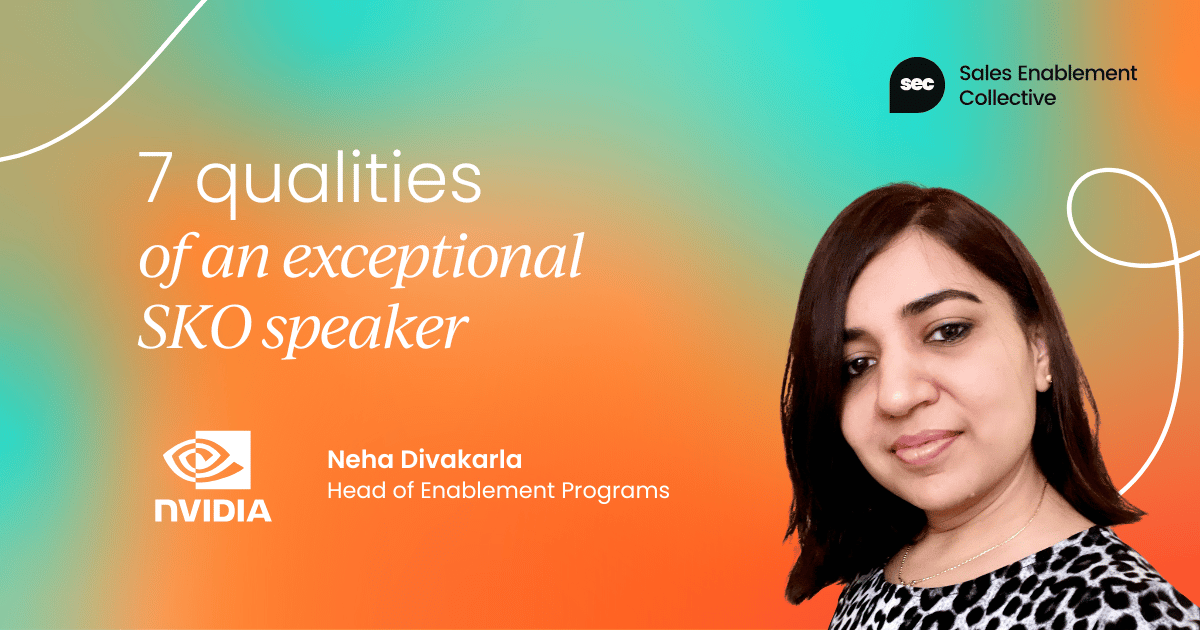
4. Getting creative & sales kickoff themes
While speakers are a key component of sales kickoff, they don’t have to be the only component. Even the greatest presenters will struggle if the audience has had to sit through back-to-back-to-back keynotes.
Don’t be afraid to get creative, incorporate unique workshops and activities, and leverage a theme to make the entire experience fun as well as useful.
A “sales olympics” theme, with sellers broken up into teams that compete for medals during pitching or roleplay competitions, is just one example of a sales kickoff theme that can invigorate an event!
Remember to make it fun
It might sound obvious, but it bears repeating – people remember fun times!
If you want to improve knowledge retention at your SKO, doing your best to ensure everyone has a good time is an easy way to set yourself up for success and help your sellers hit their sales goals for the year.
Include mini-games throughout, make them 5 to 30 minutes depending on time and the size of the team. Mini Jeopardy, role-plays, Who Wants to be a Millionaire, word bingo, and more. You can also invest in online escape games, murder mysteries, etc. It’s a great opportunity to create healthy competition and recognise people who did great work!
- Celine Grey, GTM Transformation Leader
A fun-packed, balanced agenda will help keep sellers engaged with the information they’re receiving, will encourage networking and relationship-building with their colleagues, and help prevent keynote fatigue (an even bigger problem in virtual events, when paired with Zoom fatigue).
A piece that is often overlooked when developing the agenda is how to make the sessions engaging and enjoyable. Delivering more engaging and memorable sessions is going to help your key messages be remembered beyond the SKO. Most of these events take between 3 days to 1 week, off site, all day and are quite intense. Adding an element of creativity adds that much-needed energy boost.
- Annabel Hosking, Global Sales Enablement Manager
5a. Engaging sellers during in-person SKOs
Depending on the organizations, SKOs can stretch out to last two, three, or even four days. Accounting for an eight-hour working day, it means that enablers can have to keep their sales organization engaged and enthused for up to 32 hours!
There are some tried-and-tested ways to support this arduous task, however.
 Daniel O’Dowd
Keeping it short and sweet
Believe it or not, but sellers are people – and people get restless if they’re made to sit still for hours on end.
Try cutting down your sessions to 30 minutes (45 max!) and then providing opportunities for attendees to walk around, grab a coffee, and connect with peers between sessions.
This ensures that when the time comes to focus on the session at hand, attendees’ minds and bodies are fresh and equipped to absorb the information at hand.
Mention a 90-minute lecture to anybody and you'll be met with a grimace – factor in your audience being jetlagged, hungry, too hot or too cold, and their focus is immediately drifting. The key: shorter is often better!
By limiting each session to between 30-45 minutes and then having people get up, move around, network and digest the information they have just heard, they commit more of those key messages to long term memory.
- Annabel Hosking, Global Sales Enablement Manager
Leverage peer-to-peer learning
While we stressed the importance of credible, expert speakers earlier, make sure that they’re not the only people talking on the day.
Sellers trust each other, and by leveraging that you can build the team’s trust in the message you’re trying to deliver.
While leaders and enablers have a place at SKOs, the sore reality is most people in sales like to hear from each other. This is an enabler's greatest tool, a surefire way to ensure the right behaviours and actions are being propagated.
- Annabel Hosking, Global Sales Enablement Manager
For example, try calling upon some high-performing reps to share discovery call tactics that they’ve found success with.
This type of real-life anecdote will usually resonate more with fellow sellers than a trainer simply talking at the reps about how to approach those calls.
 Annabel Hosking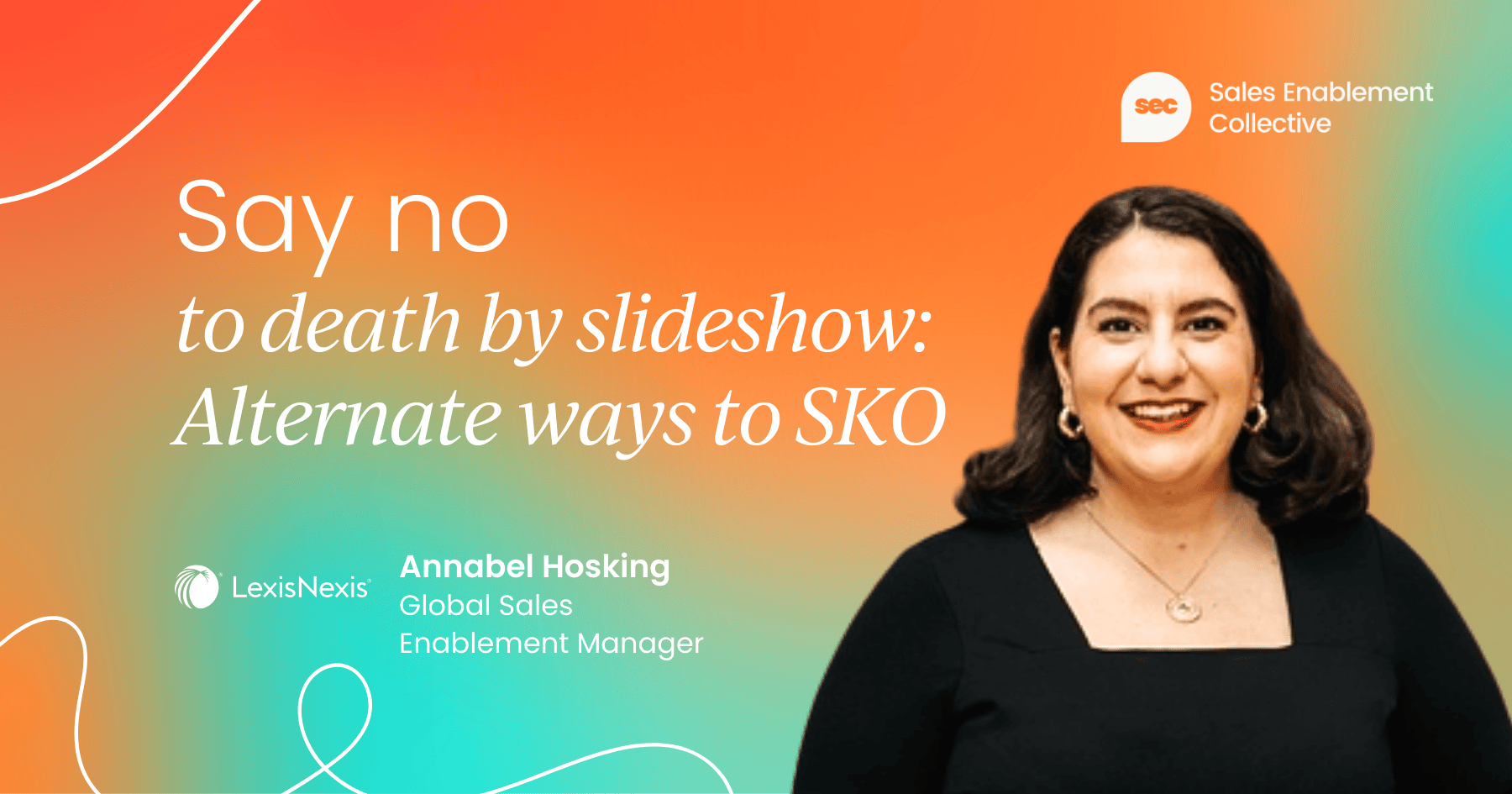
5b. Engaging sellers in a virtual setting
The virtual sales kickoff format makes certain SKO challenges easier to handle (think travel and accommodation), but makes others that much more tricky to handle.
Zoom fatigue, tech problems (“Can you see my screen?”), and hidden faces all make SKO sessions harder to run in an engaging manner.
The tips and tricks from the previous section still apply here, but there are a few extra considerations when your team isn’t meeting in person.
Providing a space for networking
The networking and relationship-building aspect of SKO is critically important. The event is a great way to get your sales team on the same wavelength, developing connections, and becoming a team.
While this happens organically in-person during coffee breaks or at the water cooler, during a virtual event you have to be much more deliberate.
Networking is something to be leveraged. For an SKO, the most important thing is to make sure that people are interacting with one another. In a virtual SKO, you have to go that extra mile to figure out how to provide a space or an avenue to allow people to have those connections.
- Nikki Schanzer, Senior Leadership Development Sales Performance Consultant & Stephanie Middaugh, Director, Customer Success
Most presentation tech will have built-in features to help you with this, such as breakout rooms, polls, chat modes, and more.
If you’re hosting a virtual sales kickoff, explore the feature set and give some thought to how you can use the tools at your disposal to maximize networking opportunities.
Maximize the advantages of virtual
The best approach to take when running a virtual SKO? Don’t try to replicate an in-person event ineffectively.
Instead, maximize what you have at your disposal to make it a great virtual event.
It’s about delivering key messages, then taking a break and allowing them to settle in. We also have the ability to use breakout rooms – if you want to do things regionally, we provide people in that region an opportunity to break out, have their discussion, and come back to say: "Okay, this is what we’ve come up with". It creates momentum.
- Tanya Jeffers-McAllister, Senior Director Personal Banking Operations Strategic Enablement
Take inspiration not from the best in-person events, but the best virtual ones. That way, you can capture the magic of SKO in a way that actually suits the format you’re working with.
If, for example, your SKO is taking place during the colder months, you could use winter-themed greenscreen backgrounds and filters to bring some fun to the event – in a way that’s totally unique to a virtual environment.
One of the perks of virtual SKOs is that you have access to speakers from all around the world, as well as people you may not have been able to bring to a face-to-face conference.
- Celine Grey, GTM Transformation Leader
 James Shaw
6. Post-event reinforcement
After months of planning, SKO day (or week) comes and goes. Does that mean it’s done, dusted, and forgotten about? No!
Sales kickoff is supposed to set the tone for the upcoming year. That means sellers need to carry all the learnings from the event into the coming weeks and months.
Most enablement professionals will be aware of the forgetting curve, which outlines that people forget 50% of all new information within a day, and 90% of all new information within a week – that means reinforcement becomes critical to making key knowledge stick in your sales team’s minds.
It’s a universally acknowledged truth that no matter how creative, how interactive or how peer-focused your SKOs are, key information will be forgotten as soon as people get back to work on Monday and real life customers start flooding their inboxes.
There is no way to fully mitigate this, but one way to drive home key concepts is to end every session with the three main takeaways. Then, have your managers, your leaders, and yes, us enablers, keep repeating and reinforcing those concepts when everyone's back at their desks on Monday morning.
- Annabel Hosking, Global Sales Enablement Manager
Your ongoing enablement initiatives should be built in unison with your SKO. That way, every product training session, for example, is reinforcing and building on the product knowledge that was shared at your sales kickoff weeks or months earlier.
This repetition of key concepts, combined with a memorable day, will help ensure that sellers retain as much of what they learned as possible.
Our revenue goal is one of the easiest things for us to pin down as an OKR. And we’re also working to upskill our reps from SMB into enterprise – so knowing those goals and having clarity of vision from my entire leadership team, I then said: “Okay, two easy things we can do are: 1. An account planning workshop and, 2. An ABM workshop with my marketing counterparts [at SKO]”.
The logical follow-ups from that would be things like weekly ABM coaching sessions with our director of ABM programs, follow-up training and certifications on account planning quarterly, and sales managers using new and updated pipeline review call methods biweekly.
- Samantha Thompson, Head of Revenue Enablement
Concept reinforcement also ties into how you measure the success of your SKO. And with finding quantifiable results being a pain point for many enablers, it becomes even more important to reinforce, reinforce, reinforce!
 Rebecca Stewart
7. Measuring the success of your sales kickoff
Measuring any enablement initiative is tricky – and if you’re not careful and deliberate? SKO can be the same.
The key, as with any enablement measurement, is to decide on what you’re measuring before SKO, so that once the day arrives, the pieces are already in place to track the metrics decided upon months beforehand.
On the short-term side of the equation, qualitative things like Net Promoter Score surveys can help you gauge how people felt about the day. Did they enjoy certain sessions more than others? What can you take from that into your next event?
When it comes to quantitative metrics, virtual events allow you to track things like the number of people engaged in the chat or in polls, while in-person events can lean on how many people asked questions or raised their hands per session.
We look at post-event surveys and completion, for pitches and role playing exercises, we use Rubrik to capture completion and scoring, and we have interactivity metrics through Zoom polls. We also plan reinforcement sessions of some of the key concepts to use as a bridge to what we emphasized at SKO.
- Danny De Los Santos, Manager, Strategic Account Management & Marco Galvan, Revenue Enablement Lead
On the longer-term side of the equation, you can track specific metrics related to the behaviors you aimed to drive through your SKO and the reinforcement.
If you focused heavily on converting stage one discovery calls into stage two at the event (and in follow-up sessions), did sellers improve in that specific area?
While you can’t take all the credit as an enablement team, you can feel confident in saying you positively influenced that area if the respective metric goes up after you make it a focus of your training.
 James Shaw
Need more SKO know-how?
If you’re brand new to planning sales kickoffs, or just want an expert-led refresher, you can take our official Sales Kickoff certification!
Led by Miryam Meir, Product Marketing Director at Salesforce, the course includes:
- 5 insight-packed modules that cover the breadth of a sales kickoff
- Over 3 hours of content, including bonus material from the SEC archives
- Optional coursework and frameworks to consolidate your learning
And more!
Best of all? You can purchase individually, or get it included as part of our Pro+ membership alongside a whole host of extra value.
Sales Enablement Collective's Sales Kickoff course was great and gave me some wonderful ideas to put into practice for my organization's upcoming sales kickoff. SEC also provided some great resources that I can share with the rest of my team.
Sharon Moore, Revenue Enablement Program Manager at SailPoint


Sales enablement insider
Thank you for subscribing
Level up your sales enablement career & network with sales enablement experts
An email has been successfully sent to confirm your subscription.
 Follow us on LinkedIn
Sales enablement insider
Thank you for subscribing
Level up your sales enablement career & network with sales enablement experts
An email has been successfully sent to confirm your subscription.


.svg)
