








Most articles about AI in sales are written for the people around the rep. The enablers, the RevOps team, and the sales leaders are trying to figure out where to invest. All useful but that's not the person on a call at 4pm trying to remember what the buyer said in discovery three weeks ago.
This one is for the rep.
Think of it as a map of your actual selling week, prospecting, outreach, calls, follow-up, proposals, and admin with an honest line drawn through it. Where generative AI genuinely earns its place. And, just as importantly, where it doesn't.
If you lead an enablement team, this is the piece to share with your reps. It's the seller-facing companion to our AI for sales enablement certification.
 Sales Enablement Collective
Where does generative AI actually help sales reps?
The short answer: in the preparation and admin work around selling.
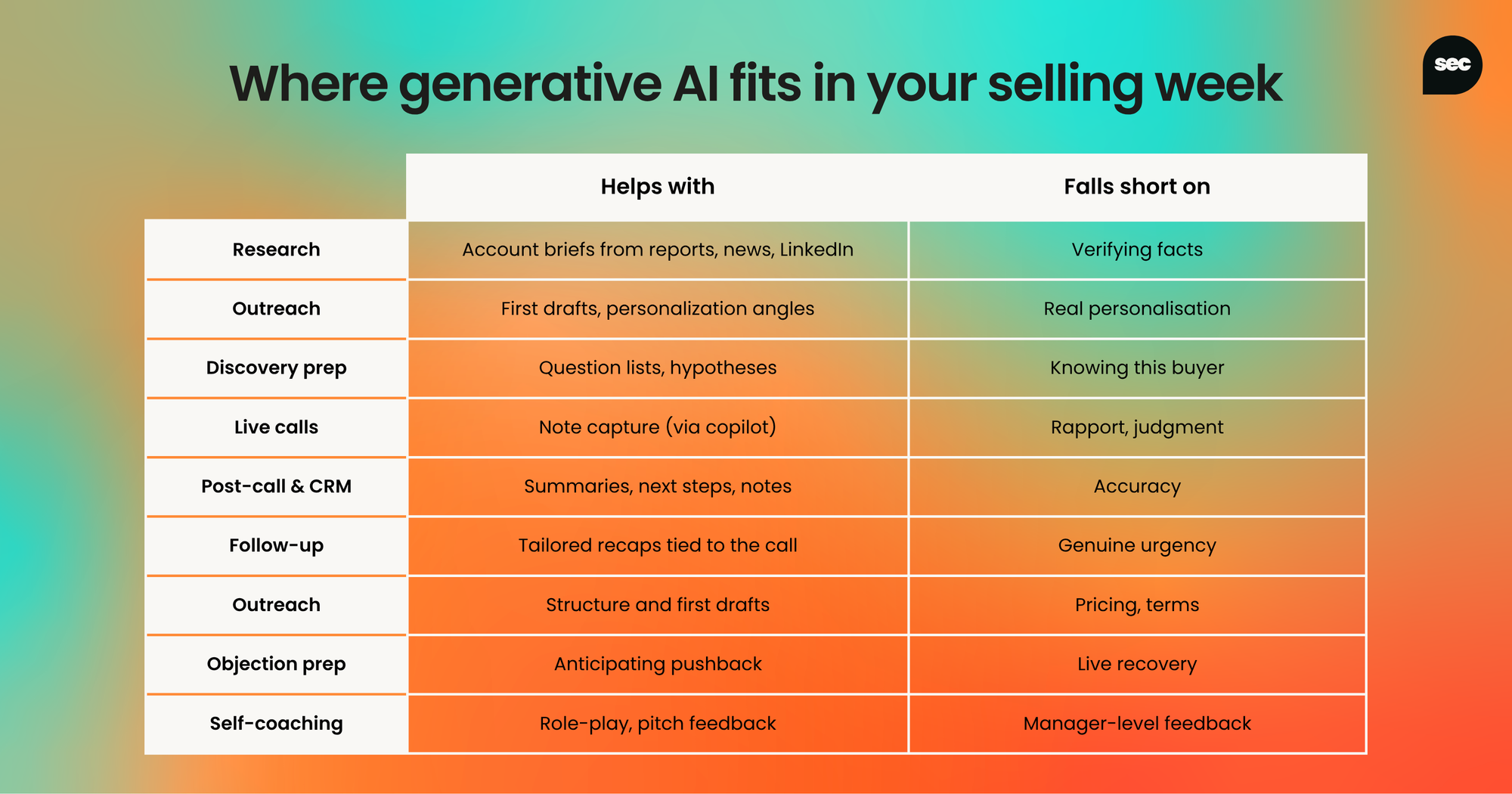
AI clears the runway so you spend more of your week actually selling.
That matters because the runway is long. Reps in 2026 still spend only around a third of their week in front of buyers, according to Salesforce's long-running data. The rest goes to research, drafting, prep, and CRM entry. Generative AI attacks that other two-thirds.
And it's landing. Roughly 43% of sales reps now use AI tools in their daily workflow, nearly double the 24% from a year earlier. Reps who use AI daily are about twice as likely to hit their targets. The recurring theme across the data is reclaimed time.
The same source as above put the average saving at four to seven hours per week per rep, mostly from research, drafting, and CRM logging.
One caveat worth sitting with before we go further: those hours only turn into revenue if you redirect them to selling.
One 2026 analysis found AI-augmented reps generated 41% more revenue while running 18% fewer activities but only when saved time went back into customer conversations, not into more meetings.
AI buys you time but what you do with it is still on you.
Let's dive deeper into some of them:
Prospecting and account research
This is generative AI's strongest, safest use case for reps.
Feed it an annual report, a batch of recent news, a LinkedIn profile, or a set of review-site comments, and ask for a structured brief: top priorities, likely pain points, who the buyer reports to, and what they'd care about. What used to take 30–60 minutes per account becomes a few minutes.
The payoff shows up in the data.
According to HubSpot's 2026 ROI of AI research, 38% of sellers reported significant improvement in researching leads and companies, saving around 1.5 hours a week on that task alone.
Cold outreach and personalization
Generative AI is good at getting you to a first draft of an email, a LinkedIn message, or a full sequence and at generating angles you hadn't considered.
Drafting outbound is one of the most time-intensive daily tasks; AI reliably takes 30–45 minutes a day off it but this is also where reps get it most wrong.
If your whole team pastes the same prompt into the same tool, buyers get the same beige email.
The personalization has to be real, a specific trigger, a specific line from their earnings call, a specific problem their role owns.
Use AI to draft and to vary; use your own judgment to make it land. The tool writes faster than you but it doesn't know your buyer better than you.
Discovery call prep
Ask for a question list, a set of hypotheses about the buyer's situation, and a "things I'd want to confirm" checklist tailored to the role and company type. It's a strong rehearsal partner and a good hedge against walking in underprepared.
What it can't do is tell you what actually matters to this human. That's what the call is for. Related reading if you want to go deeper on roles and where they sit in the cycle: BDRs, SDRs, and account executives — what sets them apart.
Live calls
Real-time copilots that transcribe, capture notes, and surface a battle card when a competitor comes up are genuinely useful, that's AI-guided selling, and it works because it removes the note-taking load so you can actually listen.
A chatbot open in another tab during a live call is a liability, not an asset.
Let it capture the call and you do the conversation bit.
Post-call, CRM, and follow-up
This is the quiet, boring win, and it might be the biggest one.
Ask AI to turn your rough call notes into a clean CRM summary, a set of next steps, and a first-draft follow-up tied to what the buyer actually said.
Proposals, business cases, and objection prep
Generative AI is a fast way to get a proposal or one-page business case structured and drafted, especially when you frame it around a priority the buyer stated out loud.
Keep your commercial judgment in the loop. Pricing, terms, discounting, and the read on hodifficultrd to push are yours. If you want the psychology behind why certain framings land, our 8 sales psychology principles piece pairs well here.
Self-coaching and role-play
You don't have to wait for your manager's next 1:1 to practice.
Ask AI to role-play a skeptical CFO, a price-sensitive procurement lead, or a champion who's gone quiet, then have it score your pitch and push back. It's a safe, repeatable rep.
It's a supplement, not a substitute. A model can't see your live deals or your blind spots the way a good manager can, a gap our AI vs. Human Coaching Report digs into directly.
How to use AI on a budget
Where generative AI does not help reps
The honest part and the part most AI-in-sales content skips.
- Building trust. Buyers buy from people. AI can draft the words; it can't be the person the buyer decides to rely on.
- Reading the room. The pause, the flicker of doubt, the thing left unsaid, that's your read, in real time.
- Negotiation leverage. Knowing when to hold, when to concede, and when to walk is judgment built from your specific deal and relationship.
- Anything requiring account-specific truth. Generative models hallucinate. Never let unverified AI output reach a buyer as fact.
- Sending raw output. Unedited AI copy is obvious, and buyers have learned to spot it. Everything it produces is a first draft.
The pattern underneath all five: AI is excellent at the work around the conversation and poor at the conversation itself.
How to actually start (this week)
Don't try to automate everything at once, that's the fastest way to abandon the tools. Pick one high-friction task and win there first.
- Monday: Use it for account research before one meeting.
- Wednesday: Have it draft (and you edit) your follow-ups for a day.
- Friday: Feed it your rough call notes and let it write your CRM summaries.
Pick only 3 tasks this week. If it saves you real time, expand. If it doesn't, drop it. The ROI test isn't "Did I use AI" but it's whether your share of the week spent actually selling went up and whether you put those recovered hours back into deals.
Lead an enablement team? Equipping reps to use AI well, safely, consistently, and with real revenue impact; is precisely what AI for Sales Enablement Certified: Advanced Practitioner is built to help you do.


Sales enablement insider
Thank you for subscribing
Level up your sales enablement career & network with sales enablement experts.
An email has been successfully sent to confirm your subscription.
 Follow us on LinkedIn


.svg)

Start the conversation
Become a member of Sales Enablement Collective to start commenting.
Sign up now