











Looking at my background in the sales training and technology space, I see an industry that has made many well-intentioned promises over the years. We’ve talked about delivering learning in the flow of work, the 70-20-10 model, experiential learning, and just-in-time support. We've used all the buzz phrases.
But if we're being honest, I don't think we've exactly lived up to those promises. It’s not a lack of trying; there have been genuine limitations that stopped us from achieving these goals.
The good news is that we're at a really exciting time now because many of those prior barriers are being lowered. For someone like me, who is in product, this is a thrilling moment. We’re finally able to fulfill those promises, and there's a lot of enthusiasm for the future.
I see a convergence of several factors that have brought us to this meeting point. It’s a combination of technology, culture, and even legislation that’s creating this perfect storm of opportunity.
The convergence of tech, culture, and legislation
Technology is the most obvious one, and it’s more than just AI. The proliferation of APIs and advancements in voice-to-text transcription are all coming together.
Culturally, the way we embrace tech has shifted. People were once scared of AI, but now they're embracing it. Even call recording, which used to make people uneasy, is now commonplace, especially after COVID made us all accustomed to being on camera.
Of course, there's a risk of overload. I feel for the enablement leaders who have to make buying decisions because there's so much to sift through in this AI frenzy. But for me, all of this equals tremendous potential.
 Alex Walton
Overcoming the fear of another failed implementation
You’ve likely had conversations with stakeholders where you promised learning in the flow of work, only to deliver a fragmented solution that didn't show a clear return on investment. Many platforms, from CRMs to sales enablement content management systems, are great if they’re used to their full capacity. The problem is when people don't use them.
This creates a legitimate fear for any enablement leader on a buying committee. You stick your neck out, advocate for a new tool, implement it, and then… nothing happens. Your reputation and budget are on the line.
Start with a crawl, walk, run strategy
When I work with clients, the first thing I try to do is alleviate that fear. My approach is to encourage them to take small bites.
We use a crawl, walk, run strategy.
For phase one, let's just focus on achieving time-to-first-value for an individual rep. Let's focus on them and bring them into the process.
We might start with just one team, one part of the sales process, or one product line.
By narrowing the focus and doing a "nail it and scale it" pilot, you can prove the value before you go big. Breaking it down this way makes everyone much more comfortable.
Erdem Gelal
Demand service, not just software
The industry is maturing. We've moved past the era of VC-backed tech companies just wanting to lob seats over a fence to keep their investors happy. There’s now an expectation that "as a service" actually means something and includes real service.
Showing that we're in it for the long haul and will help prove that value before scaling is key. This partnership approach helps build trust and gets around the anxiety of past broken promises.
Rebecca Stewart
The urgent need to rebuild foundational sales skills
The remote environment has entirely changed how we work and learn.
It wasn't long ago that you could get everyone in a conference room for an hour a week for training. You could remove distractions and give them physical takeaways. That world is gone.
Sellers' expectations have also changed. They're trying to get more done, and asking them to spend an hour on a training call is a lot. This has led us to a point where we still have the same goals for enablement, but the methods for learning and reinforcement are struggling to keep up.
The problem with asynchronous learning
The first phase of this shift was to build an asynchronous learning management system (LMS) and use video calls but now we're realizing that doesn't really work either. It’s a "lead a horse to water" situation.
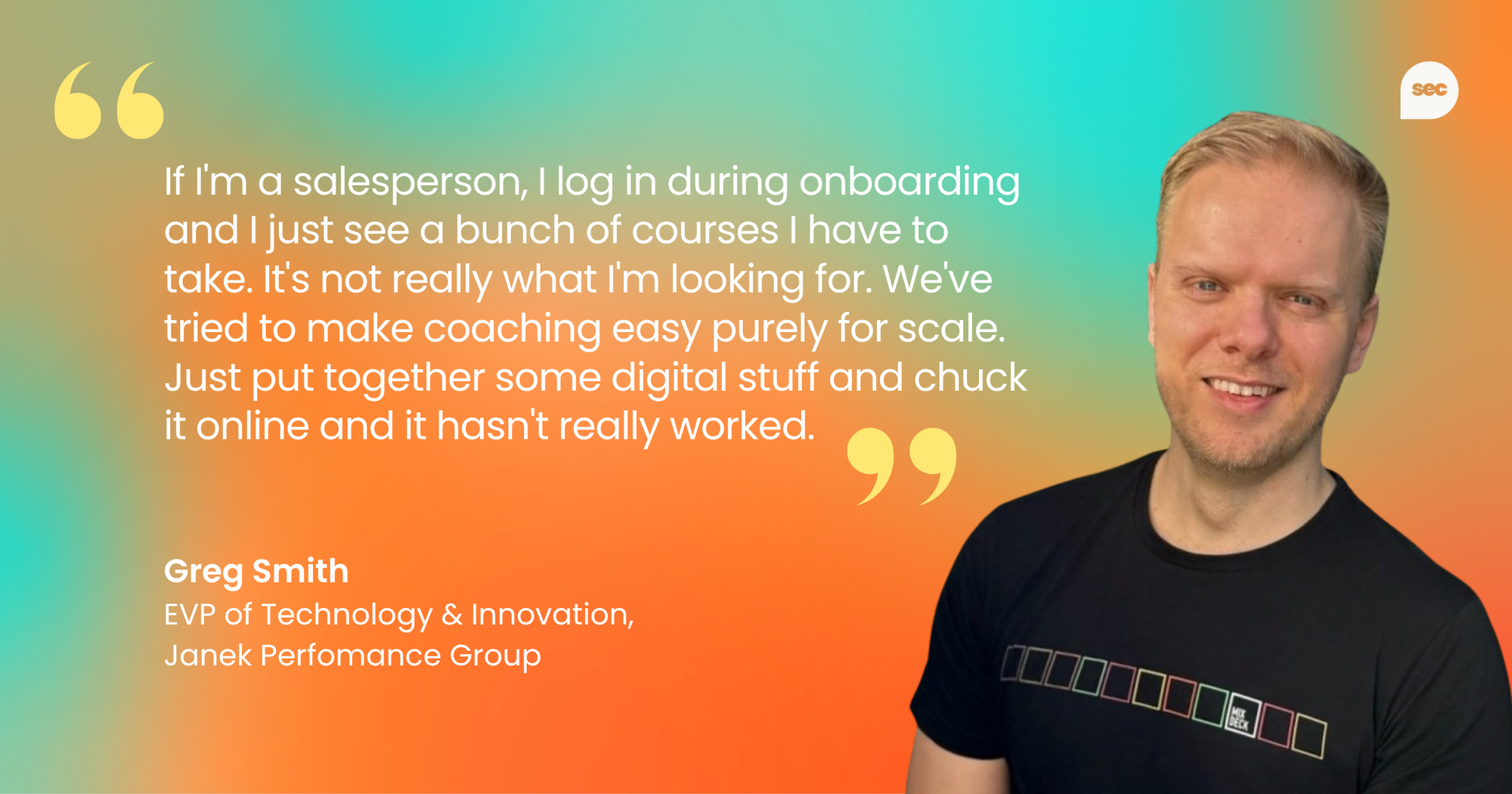
An LMS packed with courses is great, but if I'm a salesperson, logging in to see a list of required courses doesn't feel productive. It feels like busy work.
In our rush to find scalable solutions, we've gotten away from true skill development. It's crazy; we have more tech and resources than ever, but we're neglecting skills.
A market flooded with order-takers
For years, many companies were pumped up with capital, driving product-led or marketing-led growth. Salespeople were often just taking orders. When that came crashing down, the market was flooded with people who were paid very well but hadn't ever really developed core selling skills.
Now, those skills are required again. I’m supposed to be the tech guy, but I'm skeptical that tech can do it all. I believe there's just as much need for involvement from actual humans as ever. Tech can, however, enhance and scale that human involvement.
Embracing self-enablement with the right guardrails
The concept of self-enablement came out of observing what reps were already doing. When formal training wasn't providing what they needed, I'd see people reading a Jeffrey Gitomer book, watching Zig Ziglar on YouTube, or leaning over to ask a deskmate for advice. They were already finding their own ways to get better.
I think people use what they choose. Our job as enablers is to create an environment with some guardrails but also let people figure things out. When you choose to learn something yourself, you're much more likely to remember and adopt it.
Usually, the catalyst is getting burned in a real situation, which is a far more powerful motivator than being told to complete a course.
How AI can provide structure without stifling individuality
This idea might send some enablers into a tailspin. "You can use whatever methodology you want?" That sounds like a recipe for chaos and it would be if you just gave everyone a ChatGPT license and let them go. The way I interact with a public AI is different from how you would, and our approaches would diverge exponentially.
That’s where guardrails become critical. In our world, the AI madness happens within walls we put up. We use AI, but it's taught the skills and methodologies we provide, and the client provides all the product information and relevant context. You're letting reps use these tools to explore and express themselves, but the system is designed to keep them on track.
A decent system should also be able to code the unstructured mess back to a common framework. It should be smart enough to identify that while you and a colleague might say something differently, you're both demonstrating the same core skill. This allows a manager to coach both of you effectively. The tech is finally at a place where we can do this.
A tactical framework for just-in-time enablement
So what does this look like in practice?
At Janek, we have a legacy as a training company. We used to teach salespeople how to use tools like negotiation worksheets and call planners on paper. They’d get left in the workshop and never be seen again. Then we built them as digital assets in Salesforce, which was a good intention but just ended up being more form-filling.
Now, we can turn what would be a paper asset into a coaching experience. We provide these tools as agents that live in the place of work, like Salesforce. We use a simple concept we call the 4Ps.
- Prepare: Let’s say a rep has a call coming up. The system is smart enough to trigger a call planner. It's proactive. It looks at Salesforce and everything it knows about the situation and pre-fills the planner for you. The rep is then guided through planning everything from the opening to building rapport and anticipating objections. They are relearning concepts without even realizing it’s a learning experience.
- Practice: With one button, a rep can turn that call planner into a role-play experience. It could be with a voice or video avatar, which are getting scarily realistic. This allows them to practice the call in a safe environment where they can screw up without losing a deal. It's about having an actual practice session, not a graded assignment.
- Perform: Armed with the plan and the practice, the rep goes and does their job. They're encouraged to take that learning into the actual call. If the call is recorded, we can feed that into a call evaluation tool that’s connected to a platform like Gong.
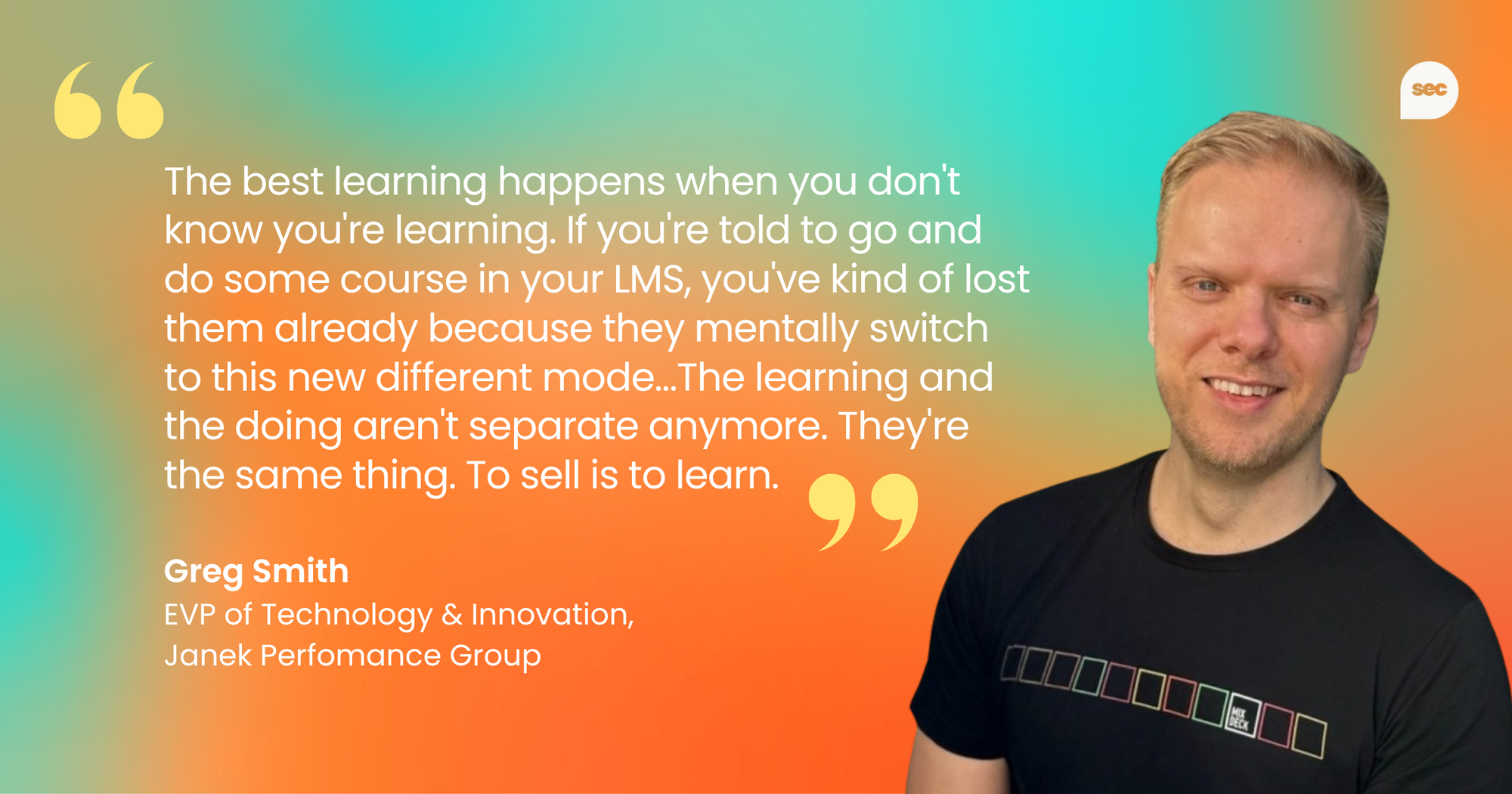
- Progress: This involves debriefing from the call, planning next steps, and actioning the things that were agreed upon. This 4P model is a simple cycle that salespeople can do multiple times a day. The learning and the doing are no longer separate; they are the same thing. To sell is to learn.
Sales Enablement Collective
A common question is whether this technology will reduce the need for enablement headcount. I've seen many enablers laid off lately, so I understand the concern.
Our goal is not to get people out of a job. If anything, a tool like our Jenius platform would most closely augment a sales manager, but the ambition is to scale the manager, not replace them.
Role-play is a great example. It's very difficult to do at scale, and you have to be good at playing the buyer. Our tech helps with that. I don't think this will shrink teams; I think it will allow you to do more.
From trainer to orchestrator
The role of the enabler may change. We might see a merging of the RevOps and Sales Ops functions. Much like the SDR role is evolving into a "sales development operator" who orchestrates tools from a command center, the requirements for enablers will shift. You'll need to master these AI tools and become the orchestrator of the entire system.
This is an opportunity for enablers to upskill and offer more strategic value to the company. You become the leader of this performance enhancement function, driving more impact than ever before.
It's about leaning into the fact that reps don't need to remember everything from a three-day workshop. You can provide the resources and let them relearn and apply concepts exactly when they need them most.
The anxiety of "What if they forget?" is gone, replaced by a system of continuous, just-in-time reinforcement.


Sales enablement insider
Thank you for subscribing
Level up your sales enablement career & network with sales enablement experts.
An email has been successfully sent to confirm your subscription.
 Follow us on LinkedIn


.svg)

Start the conversation
Become a member of Sales Enablement Collective to start commenting.
Sign up now