

















Our annual Salary and Landscape Report says that in 2024, certified enablement professionals made $5,646 more per year than their non-certified peers at the same level.
However, our most recent report, the 2025/26 Salary and Landscape Report, shows that the difference had almost doubled.
The number moved but the reason behind it stayed the same.
The proof problem most enablers live with
Anyone who has spent real time in an enablement role knows the feeling.
A rep closes with more confidence than they had six months ago. A deal moves faster through the pipeline. A new hire ramps in six weeks instead of ten. The impact is felt across the team. But when leadership asks what enablement actually produced this quarter, the answer often lacks anything concrete to point to.
That's the proof problem, and it's widespread. The report mentioned above found that proving revenue impact ranks as the hardest part of the enablement role for 61.2% of enablement teams, the single largest ongoing challenge the function faces.
Most of enablement's value shows up without a receipt attached. The work resembles good infrastructure: noticed most when it's missing, difficult to point to when it's working. "You'd notice if it were gone" makes a weak case in a budget meeting.
This is where certification and structured training start to matter, for reasons that go beyond the content of the courses themselves.
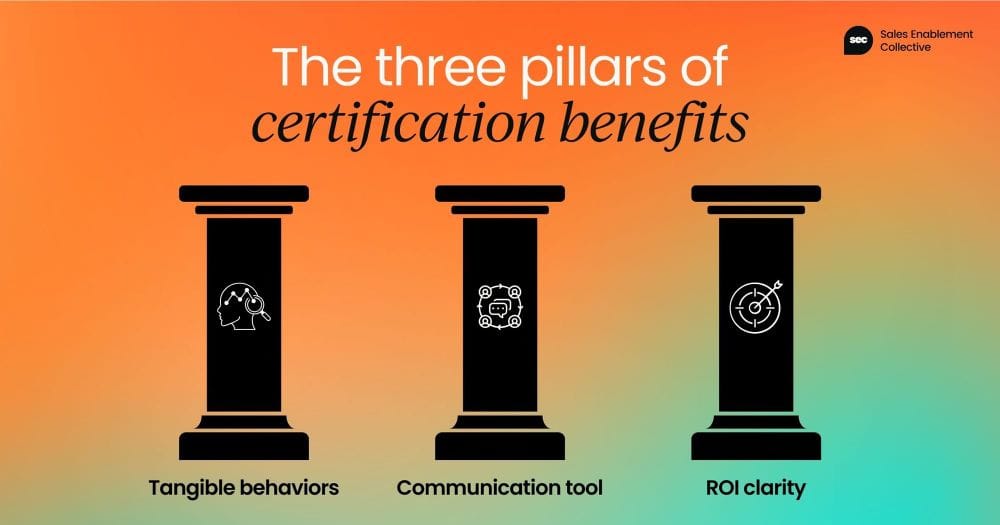
What certification actually gives you
A credential doesn't manufacture impact. Weak work stays weak work regardless of the certificate attached to it but for people already doing strong work inside organizations where enablement still has to justify its existence, a recognized credential provides something real to point to.
Here is what it offers in practical terms: a shared vocabulary, a recognized standard, and a signal to leadership that the function operates according to something more rigorous than instinct.
When a VP of Sales asks why enablement deserves a bigger headcount or a larger budget, "I'm certified to a standard the industry recognizes" lands with more weight than an appeal to trust alone. That's the honest argument for training. It's narrower than most vendors make and more credible for being narrower.
"Worth it compared to what?" is the real question
Anyone asking whether a sales training course is worth it should first ask: worth it compared to what?
Compared to doing nothing, the data reads clearly. The salary gap is significant and grew substantially between 2024 and 2025, a strong signal of how the market values demonstrated, credentialed competence over time but the fuller picture has a second layer.
In an organization where leadership already trusts the enablement function, where the team gets rewarded on output rather than credentials, and where nobody demands justification for the seat at the table, the premium likely shrinks. The proof problem that certification addresses was never really present there.
Training pays off most exactly where it's needed most: newer functions, teams still establishing their value, organizations where leadership hasn't built a mental model for what good enablement looks like, or teams that have outgrown their ability to articulate what they do.
In those environments, certification shifts the conversation from "What do you actually do?" to "Here's what we do, here's the standard we're trained to, and here's why it matters."
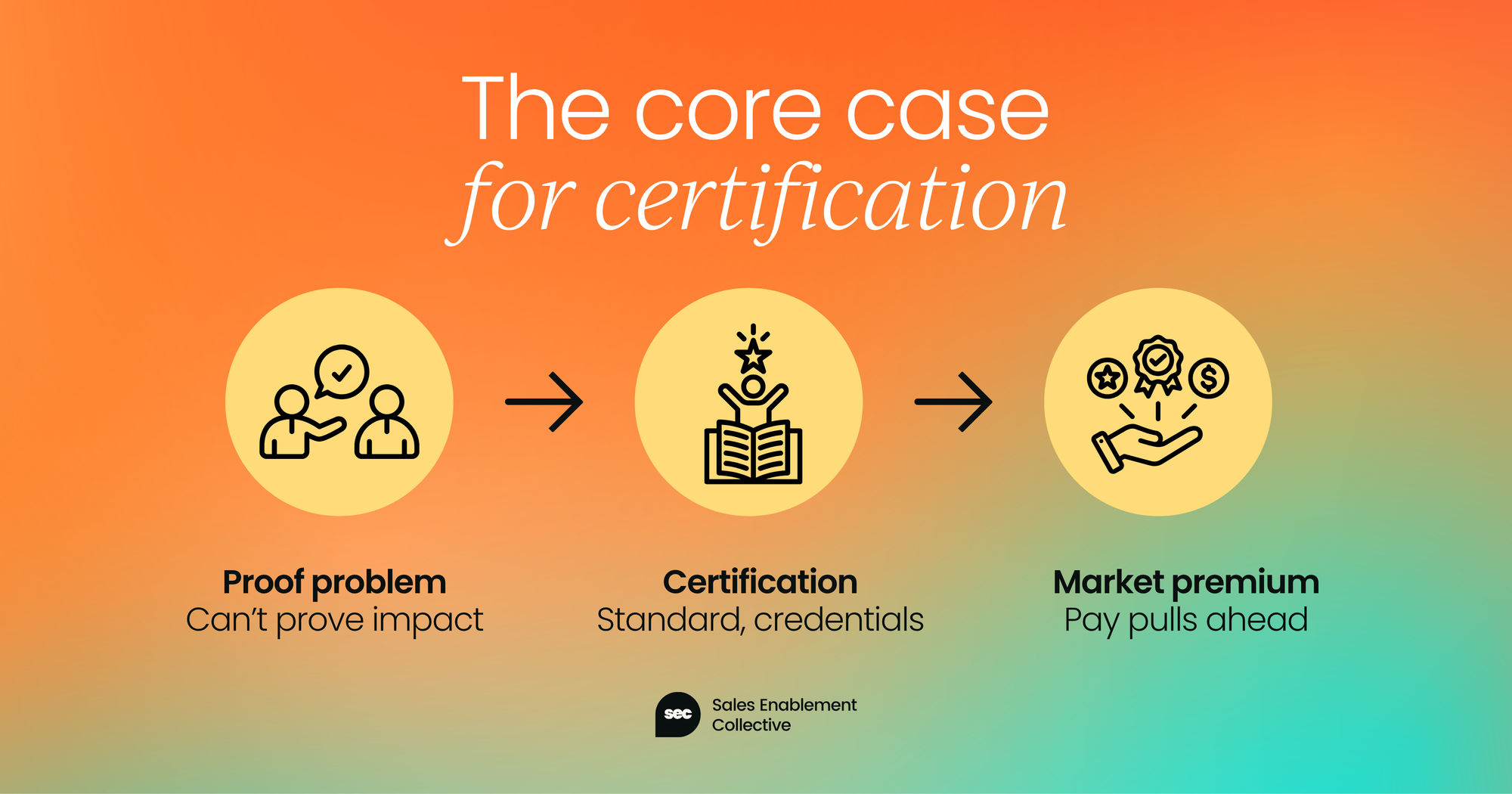
The case for investing in a team and for investing in yourself
Leaders deciding whether to fund a team's training can treat the salary data as a reasonable starting point.
There's a retention angle too: enablement professionals who feel invested in tend to stay longer and perform better, a pattern that holds well beyond enablement specifically and the near-doubling of the salary premium between 2024 and 2025 points to a market trend worth getting ahead of rather than reacting to later.
Individuals weighing the cost themselves face a harder call, and the answer depends on career stage.
Earlier in an enablement career, structured training accelerates development in ways difficult to replicate through experience alone; the frameworks picked up through a quality program offer a way of thinking about problems that otherwise takes years to develop.
Further along, the content may matter less than the credential itself, which becomes a recognized signal when negotiating compensation or positioning for a more senior role. Either way, context shapes the calculation. A well-trusted, well-understood enablement function reduces the credential's marginal value. A function still establishing itself raises it substantially.
 David Fisher
Certification pays, and the trend keeps moving in one direction. It pays because enablement carries a persistent proof problem, and credentialed professionals hold better tools for addressing it. It pays because markets respond to recognized standards. It pays because structured learning gives competent people a shared vocabulary and a clearer way of making their case.
The credential doesn't replace good work. It amplifies it, giving it a language and a price the market has already learned to pay.


Sales enablement insider
Thank you for subscribing
Level up your sales enablement career & network with sales enablement experts.
An email has been successfully sent to confirm your subscription.
 Follow us on LinkedIn



.svg)

Start the conversation
Become a member of Sales Enablement Collective to start commenting.
Sign up now