












Picture a scene that plays out on thousands of sales calls every day.
Your account executive is thirty minutes into a discovery call with a technical buyer. The buyer's been nodding along, agreeing that their current process is broken, manual, and costing them hours of productive work every week.
The AE can feel the momentum building. They're mentally drafting the next steps email.
Then the buyer says it: "Honestly, we could probably just build this ourselves over a couple of sprints. It doesn't look that complicated."
And just like that, the energy shifts.
What happens next is, frankly, a silent tragedy. The AE freezes. Their heart rate spikes. They buy time by launching into what our data shows is a 21-second defensive monologue, talking fast, listing niche features, maybe floating a premature discount to protect the deal.
The conversation, which had been moving in exactly the right direction, suddenly becomes a debate over price and features rather than a discussion about the buyer's strategic goals.
Based on our review of over 10,000 technical sales calls, reps who defend pricing immediately after a build objection consistently lose momentum. The instinct to defend is understandable, but it's the wrong move every time.
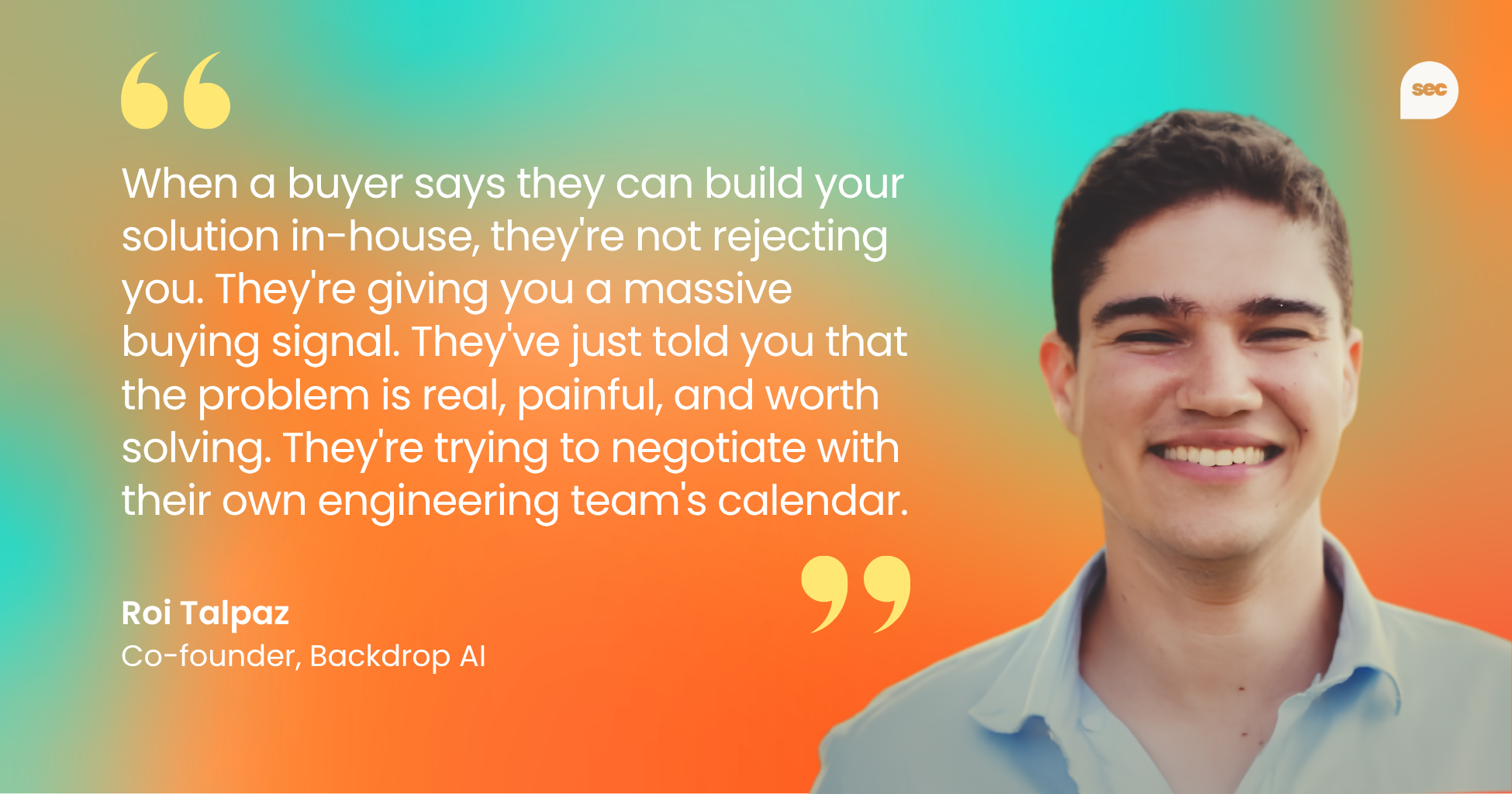
When a buyer says they can build your solution in-house, they're not rejecting you. They're giving you a massive buying signal. They've just told you that the problem is real, painful, and worth solving. They're trying to negotiate with their own engineering team's calendar.
Your job, and the job of every enablement professional equipping reps for these moments, is to redirect that energy rather than fight it.
If your reps defend your software, they lose. If they shift focus to the buyer's internal resource allocation, they win.
Let me walk you through exactly how to make that happen.
The weekend project fallacy
Technical buyers suffer from a very specific cognitive bias, one I've come to call the weekend project fallacy.
To a talented engineer, version one of almost any software looks achievable in a few days. They see the user interface, mentally sketch the basic database schema, and assume they can ship a working prototype over a long weekend. And honestly? They're usually right about version one.
What they consistently fail to account for are versions two through ten. The plumbing. The maintenance. The third-party APIs that change unexpectedly. The constant stream of user feedback that turns a tidy script into an ever-expanding product backlog.
We saw this play out recently with an enterprise software team that decided to build their own internal provisioning tool. They shipped a basic script in a week.
Within twelve months, the original developer had left, the APIs had changed without documentation, and the tool broke entirely. The engineering lead ended up pulling three senior developers off a major client release just to rewrite the integration. The "free" internal tool ended up costing them months of product delay.
That story is more common than most technical buyers want to admit.
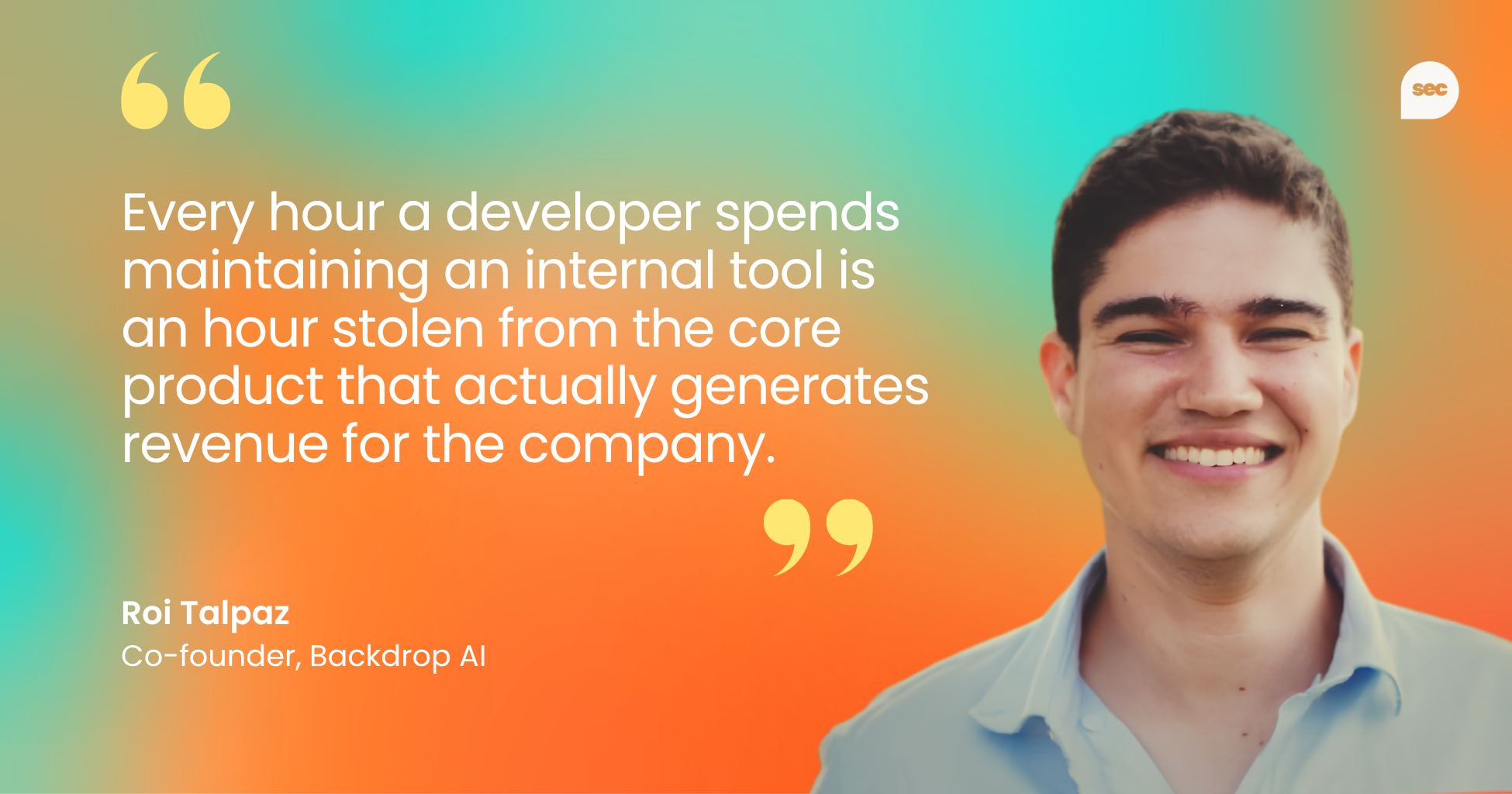
When an organization decides to build a tool internally, they're making a commitment that extends well beyond the initial development sprint. They're establishing a permanent software team inside their business. They're signing up to support, update, and manage a product indefinitely, using developers who never signed up to be internal IT support.
There's a useful way to frame this: think about the difference between core IP and context. Core IP is what your customers pay you for. Context is everything else required to keep the lights on. When engineering resources get redirected from core IP to context, the business actively hurts itself, even if nobody's tracking that cost on a spreadsheet.
Your reps need to help buyers see that. The conversation has to move away from cost and toward focus.
Why traditional enablement fails on live calls
Most sales enablement teams tackle the build vs. buy objection the same way: they build a battlecard.
 Roi Talpaz
A beautifully formatted slide deck with total cost of ownership charts, engineering salary calculators, and feature comparisons. They upload it to the knowledge base, run a training session, and check the box.
Then the rep gets on a live call, the buyer says "we can build this," and the playbook is nowhere to be found.
The cognitive load of a live sales call is genuinely immense. Your rep is reading body language, actively listening, taking notes, and planning their next move, all at the same time. They don't have the mental bandwidth to open a second screen, search the corporate wiki, scan a battlecard, and maintain a natural conversation simultaneously. Something has to give. And what gives is usually the playbook.
Because they can't retrieve the right information under pressure, they default to defensive talking. They argue about features rather than asking questions.
This is the core problem with what I'd call the pull model of training, where reps have to search for answers when they need them. It sounds logical in theory. In practice, it breaks down at exactly the moment it matters most. The shift enablement teams need to make is toward a push model, where the right questions are delivered to the rep in the moment they're needed, without any searching required.
That shift is the foundation of a truly repeatable sales playbook, one that actually changes behavior during the live conversation rather than just in the training room.
Three discovery questions that expose the real cost of building
To surface the hidden costs of an internal build, your reps don't need to deliver a lecture on engineering economics. They need three targeted, high-friction discovery questions. These questions are designed to prompt the buyer to calculate the actual cost of building themselves, right there on the call, before the conversation moves on.
Question one: who owns the product roadmap?
"When your internal teams start asking for changes or reporting bugs, who's going to act as the product manager for this tool, and what core customer-facing project do they get pulled off to manage it?"
Most buyers assume that once the code is written, the job is done. They forget that internal users are still users. They'll want new features, bug fixes, and UI updates. They'll file tickets. They'll escalate when things break.
This question works because it forces the buyer to confront the ongoing organizational reality of owning internal software. If they don't designate a product manager, the tool becomes shelfware, abandoned because nobody's maintaining it.
If they do designate one, they're pulling a valuable employee away from the revenue-generating product. Either way, the "simple build" starts to look a lot more complicated.
Question two: who fixes the integrations?
"Our platform connects directly with X, Y, and Z, and we have a dedicated team that updates those integrations every time their APIs change. When those APIs update next quarter, which of your engineers gets pulled off their sprint to fix the broken integrations in your internal tool?"
Modern software doesn't exist in isolation. It relies on an ecosystem of integrations, APIs, and third-party platforms, all of which change on their own schedules, often without much notice.
This question works because technical buyers know exactly how frustrating API maintenance is. By surfacing the reality that third-party platforms regularly update their APIs, you're highlighting a recurring disruption that will interrupt engineering sprints for as long as the internal tool exists. It reframes the buying decision as an insurance policy against ongoing developer distraction, rather than a simple software purchase.
Question three: what about the enterprise scaffolding?
"We typically see engineering teams spend twenty percent of their build time on the core business logic, and eighty percent on enterprise scaffolding like security, role-based access control, single sign-on, and audit logs. Do you want your developers spending their sprints building enterprise scaffolding instead of your core product?"
When engineers estimate a build, they estimate the core feature. They almost always underestimate, or simply ignore, the administrative infrastructure required to make the tool enterprise-ready.
This question works because it directly targets that estimation error. Every enterprise buyer needs security compliance, role-based access control, and audit logs to pass security reviews. Building those features is tedious, expensive, and completely unrelated to the actual problem the buyer is trying to solve. The 80/20 framing makes the scale of that hidden work concrete and difficult to dismiss.
Taken together, these three questions do something that a feature comparison or a pricing defense never can: they make the buyer calculate the true cost of building in real time, using their own context, their own team, and their own projects as the raw material.
Delivering the playbook in the moment that counts
Here's the catch. These three questions are only effective if they're asked at the exact moment the objection arises. Ask them ten minutes later and the moment has passed. Send them in a follow-up email and the buyer has already moved on. The window is narrow, and it closes fast.
Your enablement playbook is only as good as your rep's ability to recall it under pressure. And as we've already established, live calls are high-pressure environments where recall breaks down.
This is where the build vs. buy objection becomes a useful lens for thinking about the future of sales enablement more broadly. Static battlecards, even excellent ones, have a fundamental limitation: they require the rep to go looking for help. They depend on memory and retrieval at exactly the moment when cognitive load is highest.
Forward-thinking sales organizations are starting to address this with live, in-call assistance tools. Rather than forcing reps to search through internal wikis mid-conversation, these platforms ride along on Zoom or Teams calls, read the live transcript, and push the right discovery questions to the rep's screen the moment a buyer mentions building in-house.
The rep doesn't have to search, remember, or improvise. They look at their screen, take a breath, and ask that moves the conversation forward.
I previously shared in detail what happens when your battlecards aren't enough.
The broader lesson for sales enablement
There's a principle underneath all of this that applies well beyond the build vs. buy objection. Sales enablement has historically been excellent at creating content and very inconsistent at ensuring that content actually gets used in the moments it was designed for.
We build battlecards. We run training sessions. We create certification programs. And then we watch reps default to their own instincts the moment a difficult conversation unfolds live.
The gap between "rep has access to the playbook" and "rep uses the playbook on a live call" is the most important gap in sales enablement right now.
Closing it requires rethinking how we deliver information, moving away from the assumption that reps will search for guidance and toward systems that bring guidance to them.
 Thomas Cheriyan
The build vs. buy objection is a perfect test case for this because it's so predictable. Technical buyers raise it constantly. The right response is well-defined. The cost of a poor response is measurable. If your reps are still freezing when they hear "we can build this ourselves," that's a delivery problem, not a content problem. The playbook probably exists. It's just not getting to the rep at the right time.
Fix the delivery, and you fix the outcome.
Putting it all together
The build vs. buy objection is fundamentally about focus. When a buyer threatens to build internally, they're revealing something important: they believe the problem is really enough to justify engineering investment.
Your rep's job is to help them understand what that investment actually costs, in developer hours, sprint disruptions, product delays, and organizational distraction.
But those questions only work if they're asked live, in the moment, with confidence. That's the enablement challenge and it's one that requires more than a well-designed battlecard. It requires systems that deliver the right guidance at the right time, without asking the rep to search for it under pressure.
Equip your reps with the right questions. Deliver them in the moment of truth and you'll find that the buyer's engineering calendar, the very thing that felt like a threat, becomes your most powerful sales tool.


Sales enablement insider
Thank you for subscribing
Level up your sales enablement career & network with sales enablement experts.
An email has been successfully sent to confirm your subscription.
 Follow us on LinkedIn



.svg)

Start the conversation
Become a member of Sales Enablement Collective to start commenting.
Sign up now