

















You can pour everything you have into your sales enablement program.
The late nights, the careful planning, the thoughtful content, the onboarding frameworks. All of it. And still find yourself sitting in a leadership meeting, struggling to articulate why any of it matters.
That's a frustrating place to be. And honestly, it's more common than people admit.
The thing is, effort alone doesn't build credibility with executives or earn you more budget. What does? Numbers. Clear, well-chosen metrics that show your program is working and that sales performance is improving because of it.
That's what this is really about:
Why measurement matters more than you might think
Most people, when asked why we measure in sales enablement, will say something like, "To make sure the sales org is on track," and that's true, but it's a pretty narrow view of what measurement actually does for you.
Laura Welch offers a much more complete picture in the Enablement Metrics Masters course.
 Sales Enablement Collective
Her framework is worth sitting with because it reframes measurement from a reporting obligation into a strategic tool.
- First, you measure to ensure goal and vision alignment. At the end of the quarter or year, you want to be able to look back and confirm that the work you've been doing is actually connected to your strategy and vision. Without measurement, that connection is just an assumption.
- Second, you measure to distribute resources efficiently. Sales enablement teams can do many things, but they can't do everything. Measurement tells you which activities are generating real value and which ones are consuming time without producing results. That's how you make informed decisions about where to focus.
- Third, you measure to course correct. If something isn't working, the data will tell you and that's valuable because it means you can either stop doing the thing that isn't working or adjust your approach before too much time has passed.
- Fourth, you measure to show the value of your people and your team. When leadership can clearly see the impact your team is making, you're far more likely to get approval for additional resources, tools, and headcount. The numbers make the case for you.
- And fifth, you measure so that you know when you've accomplished something worth celebrating. That matters more than people give it credit for. Recognizing wins, even incremental ones, keeps teams motivated and reinforces what good looks like.
That's five distinct, meaningful reasons to take measurement seriously and each one is as important as the next.
Start with what you're actually trying to achieve
Before you start pulling reports or building dashboards, you need to get clear on your goals. What are you trying to accomplish with your sales enablement program?
Are you attempting to increase sales productivity? Bring in more revenue? Speed up the sales cycle? Improve win rates? Reduce ramp time for new hires?
The answer shapes everything that comes after because the metrics you track should be directly tied to the outcomes you're working toward.
This might sound obvious, but it's easy to skip past. There's a temptation to measure everything or to default to whatever metrics are easiest to pull from your CRM. Resist that.
All of this should be clearly outlined in your sales enablement strategy and charter. If it's not, that's a good place to start.
How often should you be checking in?
Once you know what you're measuring, you need to decide how often you're going to look at it. Some teams check in monthly. Others prefer quarterly.
The cadence you choose should also be connected to your performance milestones.
Establishing clear checkpoints, whether that's every month, every two months, or every six months, gives you a structured way to evaluate progress and communicate it to stakeholders. It also helps you catch problems early, before they compound.
What you want to avoid is measuring in isolation. The data is only useful if you're using it to make decisions. If you see something isn't working, that's your signal to bring in the right stakeholders and work on a solution together.
Alignment is already happening, but there's still work to do
One encouraging finding from our Measuring Sales Enablement report: 91.9% of respondents said their enablement metrics are either completely or partially aligned with their organization's overall business strategy. That's a strong signal that most practitioners understand the importance of connecting their metrics to broader business goals.
But "somewhat aligned" still leaves room for improvement. Alignment means more than just picking metrics that loosely correspond to company priorities. It means making sure everyone, from managers to new hires, understands what's being measured, why it's being measured, and what success looks like. That kind of shared understanding is what turns data into action.
Understanding the three types of metrics
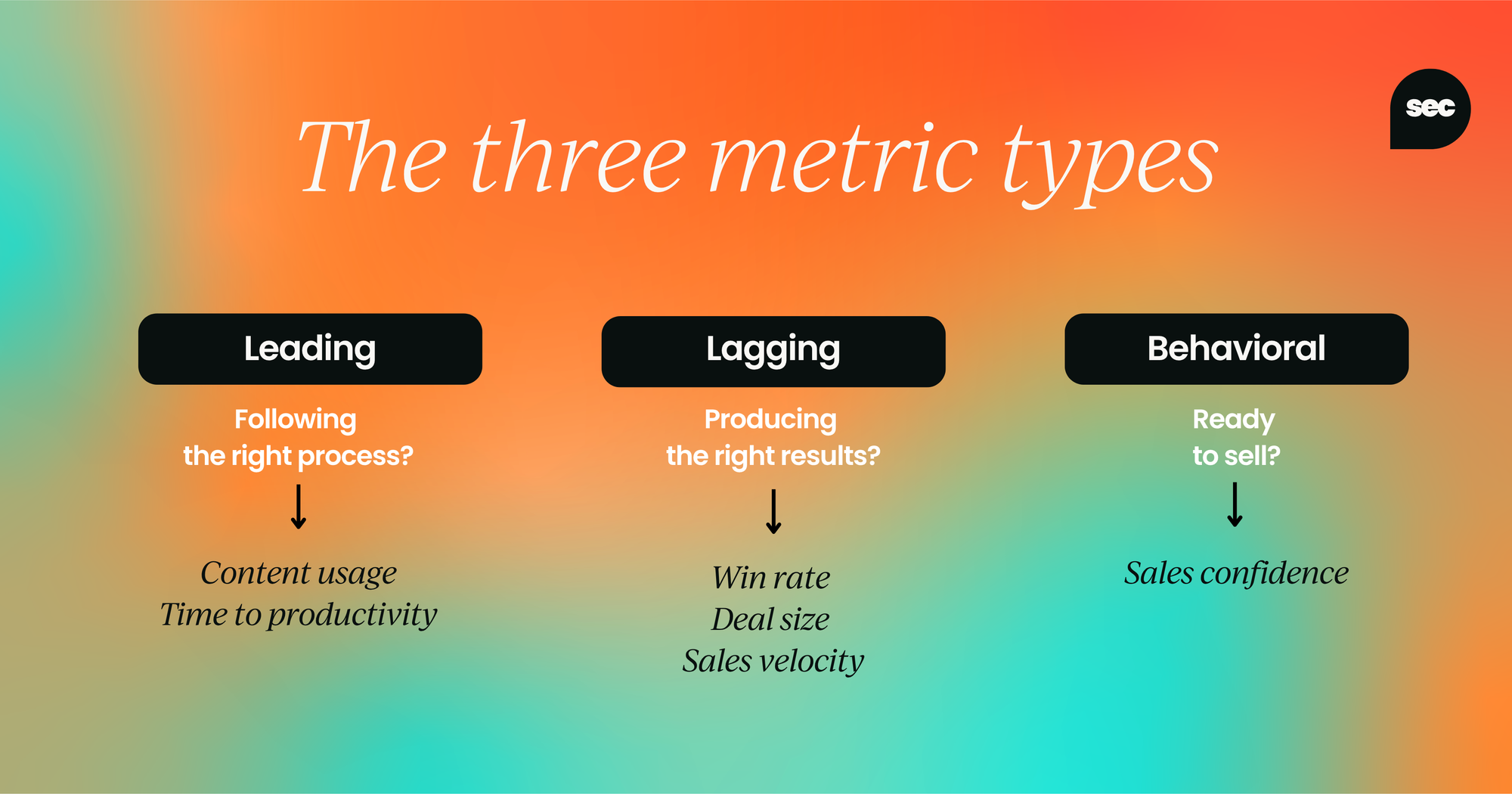
When we talk about what to measure in sales enablement, it helps to have a framework. Three categories of metrics tend to come up consistently: leading indicators, lagging indicators, and behavioral indicators.
Each one tells a different part of the story.
Leading indicators
Leading indicators cover everything that leads up to closing a sale. They tell you how well your enablement inputs are influencing performance, and crucially, they give you the opportunity to influence the outcome while there's still time to do so.
Think of leading indicators as the process metrics. They answer the question: are reps following the right processes? Things like content usage and time to productivity fall into this category.
Lagging indicators
Lagging indicators are the output metrics. They measure actual results: win rates, average deal size, revenue growth, and sales velocity. These are the numbers that leadership tends to care most about, and for good reason. They show the business impact of your enablement work.
The catch with lagging indicators is that they're retrospective. By the time they show a problem, the problem has already happened. That's why they're sometimes described as more of a sales metric than a pure enablement metric. Still, they're essential because they tell you whether reps are producing the expected results and can point to where reps might be struggling along the buyer's journey.
Behavioral indicators
Behavioral indicators measure the impact of your enablement activities on rep competencies. They take into account things like feedback from reps and assessments of readiness. The question they answer is: are reps ready to sell?
This is arguably the category most directly tied to the work of enablement.
What practitioners actually prioritize
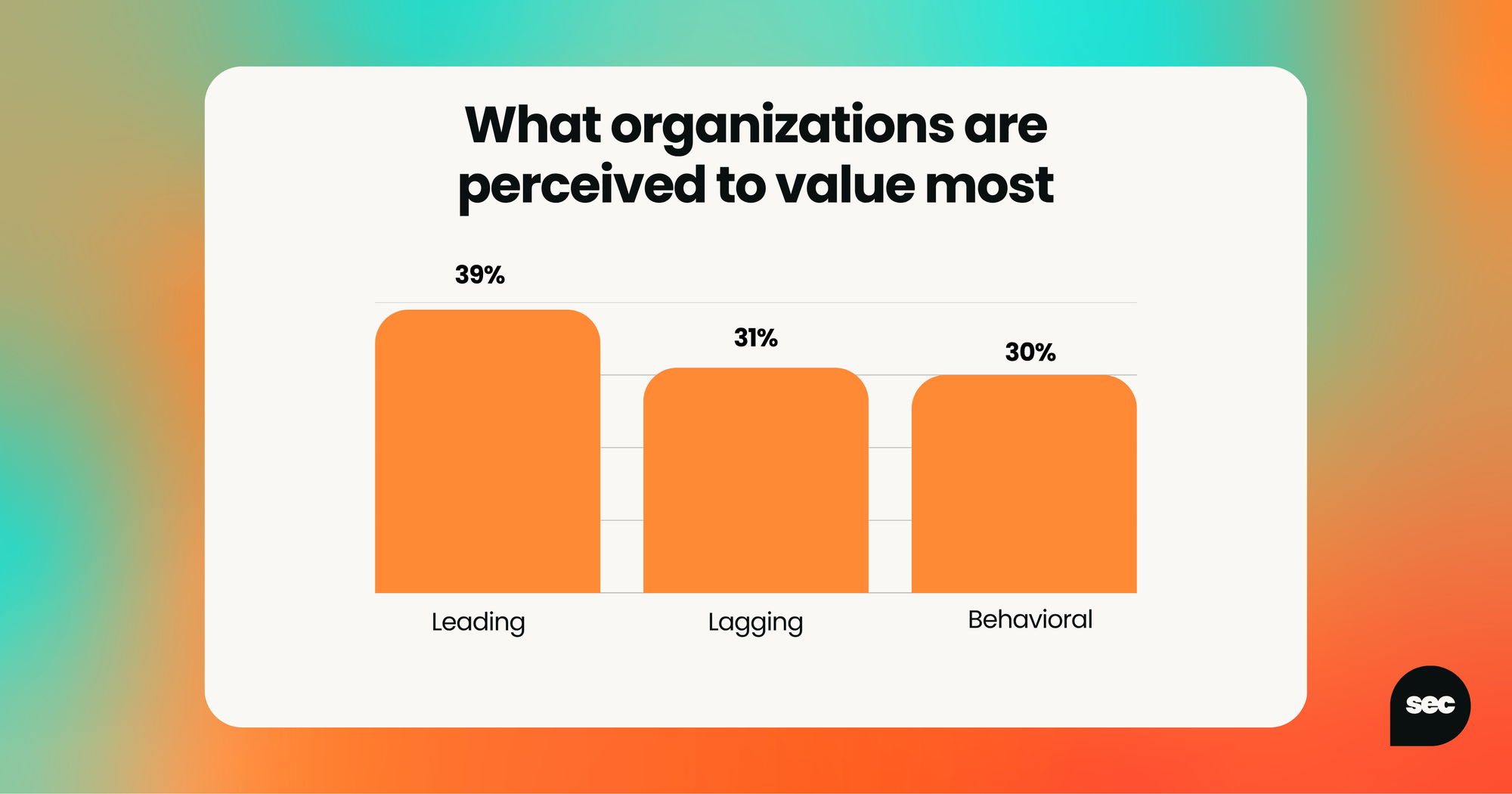
Our research found that leading indicators have a narrow edge when it comes to what sales enablement professionals perceive their organizations to value most, coming in at 39%. Lagging indicators followed at 31%, with behavioral indicators close behind at 30%.
The fact that all three are relatively close together is interesting. It suggests that most organizations recognize the value of looking at the full picture, not just the final results.
The metrics worth tracking
So what does this look like in practice? Here's a look at some of the specific metrics that fit within each of these three categories and why they're worth your attention.
- Content usage (leading): If you're investing in sales content, you need to know whether reps are actually using it. Content usage metrics tell you which assets are being accessed, how frequently, and at what stage of the sales process. High usage of a particular piece of content at a specific deal stage can be a strong signal that it's genuinely helping. Low usage might mean reps don't know it exists, don't find it useful, or can't access it easily.
- Time to productivity (leading): How long does it take a new rep to start performing at the level you'd expect? Time to productivity is a critical metric for evaluating the effectiveness of your onboarding and ramp programs. Reducing ramp time has a direct impact on revenue, so it's a metric that tends to resonate with leadership.
- Win/close rates (lagging): Win rate is one of the most straightforward measures of whether your enablement work is translating into results. If reps are better prepared, better equipped with the right content, and following effective processes, you'd expect to see win rates improve over time. Tracking this over time, rather than as a point-in-time snapshot, is what makes it genuinely useful.
- Average deal size (lagging): Are reps selling the right mix of products and services? Are they effectively upselling or cross-selling? Average deal size can tell you a lot about how well reps are positioning value and navigating conversations with buyers.
- Sales velocity (lagging): Sales velocity measures how quickly deals are moving through the pipeline. It combines win rate, average deal size, number of deals, and length of the sales cycle into a single metric. A rising sales velocity is generally a good sign. A declining one is worth investigating.
- Sales confidence (behavioral): This one is harder to quantify, but it's worth the effort. Sales confidence, often measured through rep self-assessments or manager evaluations, gives you a read on how prepared reps feel to have conversations with buyers. Reps who feel confident tend to perform better. Reps who feel underprepared often hesitate at critical moments in the deal. Tracking this over time, particularly after training initiatives, helps you understand whether your enablement activities are having the intended effect.
One of the most important habits you can build as a sales enablement professional is being transparent about your results, even when they're not what you hoped for.
If things are going well, share that. Celebrate the wins and make sure the right people know about them. If things aren't going as planned, be honest about it. Talk about what you're seeing in the data, what you think is driving it, and what you plan to do differently. That kind of transparency builds trust with leadership and with your sales team.
Communication really is central to all of this.
Metrics are only useful if the people who need to act on them actually understand them. That means tailoring how you present data depending on your audience. Sales reps need to see metrics that are relevant to their day-to-day work. Sales managers need visibility into team performance trends. Company leadership has to see the business impact.
Think carefully about how you're reporting, not just what you're reporting.
Proving the value of sales enablement
Ultimately, this is what all of this work is building toward.
A well-designed and well-executed sales enablement strategy should have a measurable impact on sales results and revenue. And when you can demonstrate that impact clearly and consistently, you're in a much stronger position to make the case for continued investment.
That means getting buy-in isn't just about having good data. It's about presenting that data in a way that connects to what leadership cares about, using the right metrics, at the right cadence, with the right level of transparency.
Do that consistently, and you'll have something that's genuinely powerful: a sales enablement program that can prove its own worth. It's the difference between a program that survives and one that thrives.


Sales enablement insider
Thank you for subscribing
Level up your sales enablement career & network with sales enablement experts.
An email has been successfully sent to confirm your subscription.
 Follow us on LinkedIn



.svg)

Start the conversation
Become a member of Sales Enablement Collective to start commenting.
Sign up now