






Buying sales enablement software is rarely a technology decision but a bet that better content, training, and coaching will show up in the pipeline, and the hard part is knowing whether that bet pays off before you sign a contract.
Sales enablement software is worth it for most growing revenue teams, provided the purchase solves a specific problem rather than chasing features.
Teams that pair the technology with coaching report higher win rates, faster onboarding, and far better use of the content marketing already produces. Bought as a feature list and left unmanaged, it becomes expensive shelfware.
This guide works through the three questions buyers actually ask: does it work, when should you buy it, and which platforms handle coaching. For a straight rundown of the tool categories themselves, SEC's guide to sales enablement tools covers the landscape.
What is sales enablement software?
Sales enablement software is technology that helps revenue teams sell more effectively by putting the right content, training, coaching, and buyer insight in front of sellers at the moment they need it.
The terms software, tools, and platforms are used interchangeably. Common examples include content platforms such as Highspot and Seismic, sales readiness tools such as Mindtickle, and conversation intelligence tools such as Gong and Chorus.
The category is large and growing. One market sizing cited in a May 2026 Cirrus Insight roundup valued the sales enablement platform market at $5.23 billion in 2024 and projected it to reach $12.87 billion by 2032.
 Alex Walton
Does sales enablement software actually work?
Yes, under conditions. The evidence lies in three measurable areas: how content is used, how quickly reps ramp up, and how often they win. In each case, the software helps most when it is reinforced by coaching rather than run on its own.
Does it improve content usage?
This is where the return is clearest, because the starting point is so poor. Forrester research, cited in the May 2026 Cirrus Insight roundup, puts the share of marketing content that sales never uses at around 65%, a figure that has held steady for over a decade and climbs above 80% in some audits. Forrester estimates that roughly $2.3 million is lost per enterprise each year due to unused content.
Finding material is its own drain on the day. SPOTIO's 2026 sales statistics report that 84% of sales executives name content search and use as their single biggest drag on productivity, while Salesforce's State of Sales 2026 finds reps spend only about 40% of their time actually selling.
Enablement software addresses both problems by tagging content by deal stage and persona, surfacing it inside the CRM or the call, and then reporting on which pieces influence deals. That reporting turns content usage from a guess into a number that sales and marketing can act on together.
Does it improve win rates and ramp time?
Coaching-led programs are the ones that move the number.
CSO Insights research, long cited in enablement circles, found that teams running dynamic, technology-supported coaching post 28% higher win rates than teams without it. The mechanism is faster, more consistent skill development rather than the tool itself.
Ramp is the other measurable win. Industry benchmarks in the May 2026 roundup put typical onboarding at three months to basic buyer-readiness, nine months to competence, and fifteen months to top performance, and structured enablement shortens the early stretch.
Effective training also keeps people: the same roundup reports that companies with highly effective training see 33.8% lower seller turnover, which protects the institutional knowledge a new hire takes over a year to build.
One caution regarding the effectiveness case is that top-performing teams use nearly three times as much sales technology as underperforming teams, but correlation is not causation. Tools support good behavior; they do not create it.
Knowledge decays quickly without reinforcement, and research on the forgetting curve, cited in May 2026, shows that reps lose up to 70% of training within 24 hours and 87% within a week when nothing follows the session.
When should you buy or add sales enablement software?
Add sales enablement software when the cost of not having it starts to show up in results: reps missing quota because they cannot find or trust their content, onboarding that drags on for a quarter, messaging that drifts as the team grows, or managers coaching on instinct because they have no visibility into calls. Headcount is a weak signal on its own.
Many teams reach this point around 10 to 25 reps, but the trigger is the problem, not the size of the team.
A few signals that a team is ready:
- Sellers rebuild decks and one-pagers because they cannot find the approved versions
- New hires take longer than a quarter to close a first deal
- Marketing cannot tell which content is used or working
- Managers have no consistent way to review calls or measure skill
- Messaging is starting to vary rep to rep
Buyer behavior adds urgency to the timing.
The Cirrus Insight roundup notes buyers now complete around 70% of their research before speaking to a rep, and 81% already have a preferred vendor by first contact. That leaves an unequipped seller little room to change the outcome, which is part of why enablement budgets keep rising.
A cheaper tool that does the two things you actually need usually beats a broad platform nobody adopts.
How do sales enablement platforms train reps?
Sales enablement platforms train reps by combining structured learning with practice and reinforcement. They deliver onboarding paths and certifications, let reps rehearse pitches and objection handling through increasingly AI-driven role-play, and turn real calls into targeted coaching through conversation intelligence.
The point is to carry a skill from a training module into a live deal.
Reinforcement is why the good platforms lean on repetition rather than a single event. Given how quickly training is forgotten without follow-up, they space learning out, quiz reps over time, and score progress, so managers can see who has mastered the material rather than just clicked through it.
Sales readiness exercises simulate real selling situations, and conversation intelligence lets managers pinpoint exactly where a rep needs help rather than having to sit through hours of recordings. Newer platforms increasingly use AI to surface coachable moments automatically.
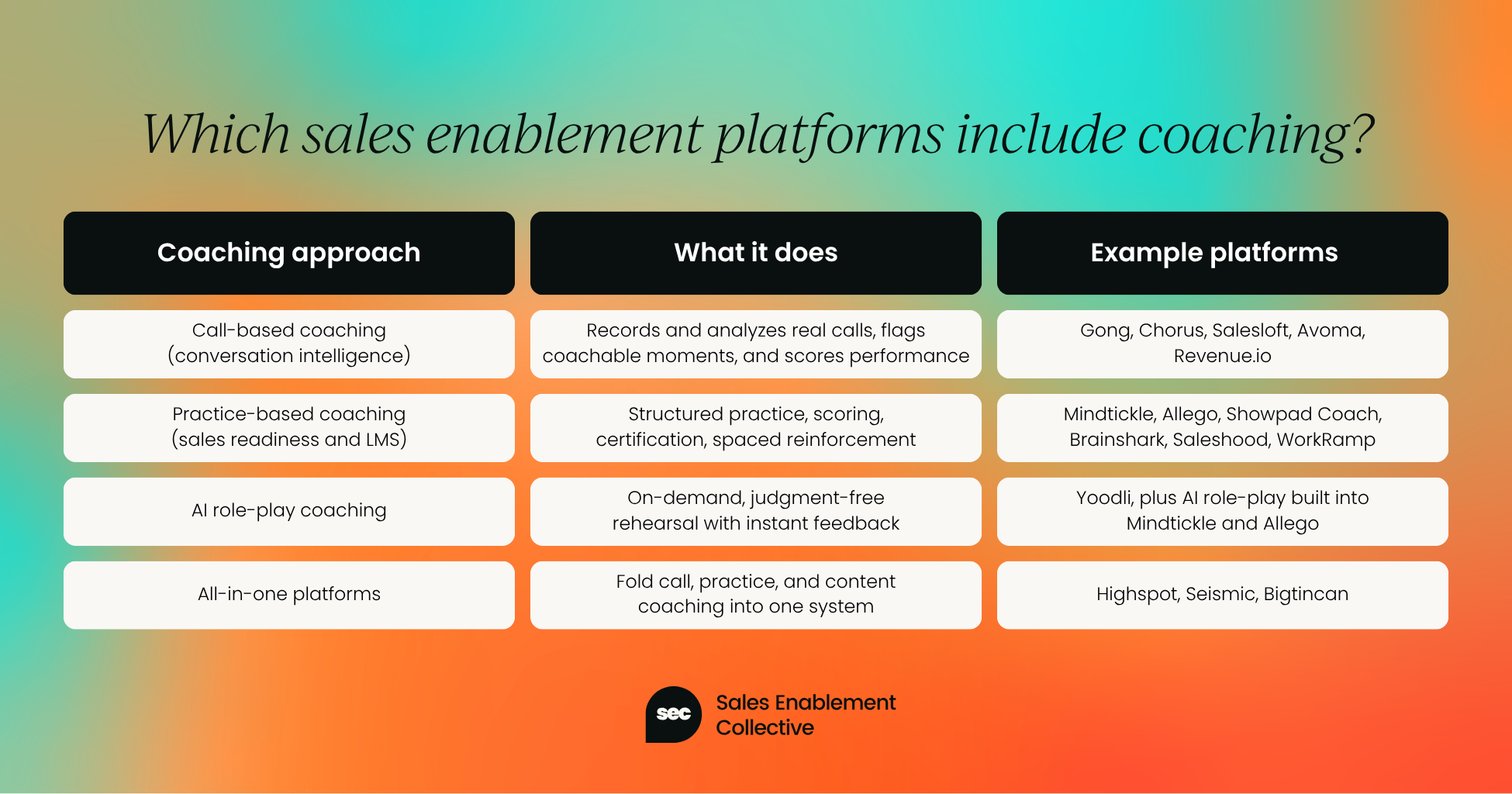
Which sales enablement platforms include coaching?
Most modern platforms now include coaching, but they approach it differently.
The right choice depends on where your coaching problem lies: live call execution, structured readiness before reps dial in, or low-stakes rehearsal.
Call-based tools work best when reps know the material but stumble in the room. Practice-based platforms fit better when the problem is readiness before the first conversation. The platform is only half of it, though.
As we explored in our work on why coaching often fails to stick, the manager and the surrounding culture decide whether any of it changes behavior.
How do you know if it is paying off?
Measure before you buy, not after. Record content usage, ramp time, win rate, and quota attainment as a baseline, then watch how they move once the tool is live, ideally against a group that adopts later.
Leading indicators shift first: content usage rate, proposal-to-close, and the share of reps hitting readiness milestones all change before the revenue line does.
Only 25% of sales organizations directly measure the leading behaviors that predict results, according to research by ValueSelling Associates and Training Industry.
The teams that measure them can tell whether the software earned its cost or added another login.
Is sales enablement software worth it?
For most growing teams, yes, on one condition: treat it as a system, not a purchase.
The returns in content usage, ramp, and win rates are real, but they belong to the companies that reinforce the tool with coaching, adopt it fully, and measure the behaviors it is meant to change.
Buy it to solve a named problem and manage it after the contract, and it pays back. Buy it for the feature list and leave it alone, and it joins the long list of tools reps quietly stop opening.


Sales enablement insider
Thank you for subscribing
Level up your sales enablement career & network with sales enablement experts.
An email has been successfully sent to confirm your subscription.
 Follow us on LinkedIn


.svg)

Start the conversation
Become a member of Sales Enablement Collective to start commenting.
Sign up now