










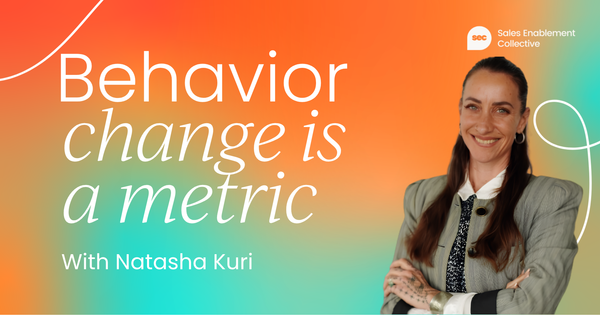
I don't have all the answers on metrics, and I won't pretend otherwise.
What I have is a pathway shaped by experience and a fair few mistakes, along with a belief that most organizations measure sales enablement without looking closely enough at the people doing the work.
Start with people before the spreadsheet.
Most metrics conversations jump straight to pipeline coverage, deal size, and conversion rates. We'll get there. Start there, though, and you miss the point.
Think of decision-making as an iceberg. We rationalize our decisions, yet most of what drives them sits below the waterline in the emotional layer: fear of rejection, not being heard, status, and reputation. If you want to embed new behaviors or win buy-in for a metrics framework, you first need to understand what people fear.
That's why I measure soft metrics alongside hard ones. Behavioral change and internal engagement earn their place on the dashboard. When I polled the room at the start of my session, those were the two areas people found hardest to measure, which didn't surprise me.
Stay curious and keep asking why until you understand. Curiosity is part of the enablement role, and if you wait for someone else to shine the light, you'll wait a long time.
Co-design metrics with your leaders
Metrics are a negotiation with leadership. What matters most to the business, and how does it connect to the organizational vision?
At KPMG New Zealand, our vision is to fuel New Zealand's prosperity, and it shapes the metrics I build into our leadership team's goals. I've set metrics around modern slavery conversations, climate change, and sustainable finance. Metrics that don't connect to what the organization cares about get deprioritized the moment things get busy, and things always get busy.
Start with what the organization is trying to achieve and work backward to the behaviors and outcomes that support it. Look past the sales funnel to the purpose. Nature as a stakeholder and the wellbeing of future generations are increasingly what CEOs are measured on, so they belong in your conversations with senior leaders.
Read the market your leaders are operating in
A CEO survey I ran produced some telling New Zealand figures:
- 75% of New Zealand CEOs expected their sales pipeline to come under scrutiny in the next year.
- 87% saw global challenges, particularly income inequality, as a threat to long-term growth.
- 90% planned a hiring freeze within six months.
- Globally, one in five CEOs worried about people keeping up with digital transformation, and 50% believed they needed to boost productivity to respond to economic uncertainty.
To make a business case for your function, you need to speak your leaders' language. Right now, that language is economic pressure, ESG accountability, and doing more with less.
Sales enablement is often seen as a cost center. When I'm charged out, I cost $800 an hour. The pressure to demonstrate value is real, and metrics are how you make that case.
The five pillars and how I measure each:
People and capability development: I work to a 10/20/70 model: 10% training, 20% coaching, and 70% on-the-job learning. Stop feeding training to everyone and hoping it sticks. Show up during real client situations, where the learning happens and where senior people see you there when it counts.
The metrics here track behavioral change. How much on-the-job learning is happening, who does it well, and can you replicate it?
Sales process and methodology: This covers bids and tenders through to major account plans. We have 400 of our biggest clients on structured account plans, followed with rigor. The metric goes beyond whether a plan exists: when did we win bids, what did good process look like, and who ran it well?
During COVID, I posted a weekly coaching tip filmed in my kitchen, drawing on the fridge, reminding people to use account plans. Simple reminders carry more weight than people expect. You only need to know 5% more than your audience to be useful.
Client voice and feedback loops: We run client surveys for private and mid-sized enterprises. For our largest clients, sector leaders sit down with CEOs and ask how we did and what we need to improve. The link between that feedback and actual improvement is still a work in progress, so for now the metric is whether those conversations happen and whether we act on what we hear.
Tool activation: CRM activation, Power BI dashboards, and learning platforms all sit here. I often hear "we don't believe in the data," usually from people who didn't put enough into the system. The data reflects what you give it.
Content and insights: This is where market intelligence feeds into sales conversations. I built an ESG framework that maps external drivers, such as consumer shifts, fear of greenwashing, reporting requirements, and government policy, against where a business sits on a spectrum from disregard to sustainable value. The metric is whether those conversations are happening.
The hard numbers still count
You need hard numbers alongside the soft ones. A sample of what I track: average deal size, lead-to-engagement ratios, cost per conversion, time and resources charged, average sales cycle length, deal size and profitability per service line, lead indicators per business development manager, opportunity source, internal referrals, pipeline age and accuracy, forecast versus actuals, and win/loss debrief frequency.
Pull this from your CRM and tell the story with data. I present it to our board monthly, and it's how I show how the function connects to commercial outcomes.
One result worth highlighting: over 18 months, we went from 7,200 clients to 5,500, while growth rose from 8% to 12%. Fewer, better relationships and higher revenue per client support client segmentation.
Measuring behavioral change in practice
I run an influencing skills program for future partners, focused on C-suite conversations. Afterward, participants rate their comfort with specific behaviors:
- Shifting conversations from informal to commercial
- Reaching out to clients about new products or services
- Asking big-picture questions to uncover business issues
- Bringing new people and services into a client relationship
- Discussing sustainable value and impact
- Handling lingering concerns
- Asking for referrals
That last one matters most. "Who else can I speak to?" is one of the most underused questions in professional services, and it costs nothing.
Most skills tracked well. Sustainable value was the area where people felt least confident, which makes sense given it's newer territory, and that result tells me where to focus next.
Build layered KPIs
Design your own KPIs. Few people know the full scope of what you do, which gives you latitude. Decide what client growth should look like and articulate how you contribute to it.
At KPMG, every sector business development person reports first to their sector leader and second to me. Dual reporting lines create accountability on both the commercial and enablement sides, and they tie my work to business outcomes rather than learning activity alone.
I also use 360 reviews to capture behavioral data over time. Combined with self-assessments from programs like the influencing skills course, they give me a layered view of where people are developing and where they still need support.
Stretch goals, incentives, and business cases
Set stretch goals and link them directly to your business case. Otherwise, they're just numbers on a slide.
Incentivize the behaviors you want to change. If something is already happening, you don't need to reward it.
Use data when you build business cases for new tools or headcount. When I needed to justify expanding the sales enablement function, I asked my business analyst to build a model. It returned a 6.7 out of 7 rating with an 85% participation rate, and around 40 people confirmed the function creates value. Use the tools you already have.
How many metrics?
More than five, and they probably won't get the attention they deserve. At least one should be values-based and tied to your organization's vision. At KPMG, at least one senior-level metric has to connect to fueling New Zealand's prosperity, whether through a climate change conversation, a modern slavery review, or a sustainable finance discussion.
Three to five metrics, with one anchored to purpose, is a framework that holds.
Guarding against performative metrics
Metrics can become performative, with people gaming the system to look good instead of changing behavior. At a firm like KPMG, strong controls help, since many people look at the same data from different angles. Beyond that, if people treat metrics as a compliance exercise, find out why. Fear usually sits underneath it: fear of scrutiny, of falling short, of change. That's a human response, and it needs a human answer.
Leadership matters most here. Our executive chair and his wife, an ER doctor, worked in Africa with Doctors Without Borders, and he understands why purpose-linked metrics matter. He's the reason I'm at KPMG. Find your leadership allies, because metrics without genuine support at the top will always be vulnerable to box-ticking.
Hearts, heads, and hands
The frame that ties this together is three circles flowing at once.
Heads: they understand the strategy.
Hands: they're acting even before the strategy is fully formed.
Don't wait for perfect. Get people moving and model the behavior you want to see in every email, call, and meeting.
Start with people, co-design with your leaders, connect everything to the organizational vision, and measure both the hard and the soft. Then take a seat at the table and tell them you've got something to say.
Editor's note: This article is based on Natasha Kuri's talk at the Sales Enablement Summit in Sydney, 2022.


Sales enablement insider
Thank you for subscribing
Level up your sales enablement career & network with sales enablement experts.
An email has been successfully sent to confirm your subscription.
 Follow us on LinkedIn


.svg)

Start the conversation
Become a member of Sales Enablement Collective to start commenting.
Sign up now