













Most enablement teams have battlecards on their roadmap. Far fewer can say whether reps open them before a competitive deal.
Three practitioners have built battlecard programs in very different industries, and their conclusions overlap more than their contexts would suggest.
 Roi Talpaz
Brendan Ryan, Director of Enablement at Entravision, found that battlecards became the highest-performing content in his entire enablement platform. Karolina Janus, Global Sales Enablement Lead at Uber for Business, built 64 of them as part of a structured onboarding program. Alisa Kirste, Senior Director of Sales Enablement at The Standard, built up a competitive intelligence program from scratch with battlecards at the center.
Battlecards work when they solve a problem reps can feel
Ryan's experience at a prior company, a graph database and AI firm, shows why.
The business competed across multiple solution areas, so reps had to understand a broad landscape while holding a focused conversation about any single competitor. Marketing had barely invested in battlecards despite the obvious need.
"They started to produce battle cards and they turned out to be by far the highest performing pieces of content in our platform," Ryan said. The team built more as they saw how much reps needed them, always with the same framing: the conversation should never be about the competitor but about "why we're better."
Kirste's starting point at The Standard was more basic. Her company competes against Prudential, MetLife, and Guardian, often against six to eight rivals for a single piece of business, with close ratios around one in ten. Before the competitive intelligence program, reps relied on Google searches, LinkedIn, and whatever their distribution partners chose to share.
"Walking into that not knowing what you're walking into is an incredibly difficult position to be in," Kirste said.
Her battlecards give sellers a structured view of competitor differentiators, strengths, weaknesses, and responses to perceived weaknesses before a finalist presentation.
 James Shaw
Structure matters more than volume
Janus offers the most detailed look at what goes inside a card. Uber for Business built roughly 64 battlecards organized around two axes: core industries and core personas.
The team identified five core industries where clients originate, including financial services, consulting, media, and tech, then mapped those against the personas they sell to.
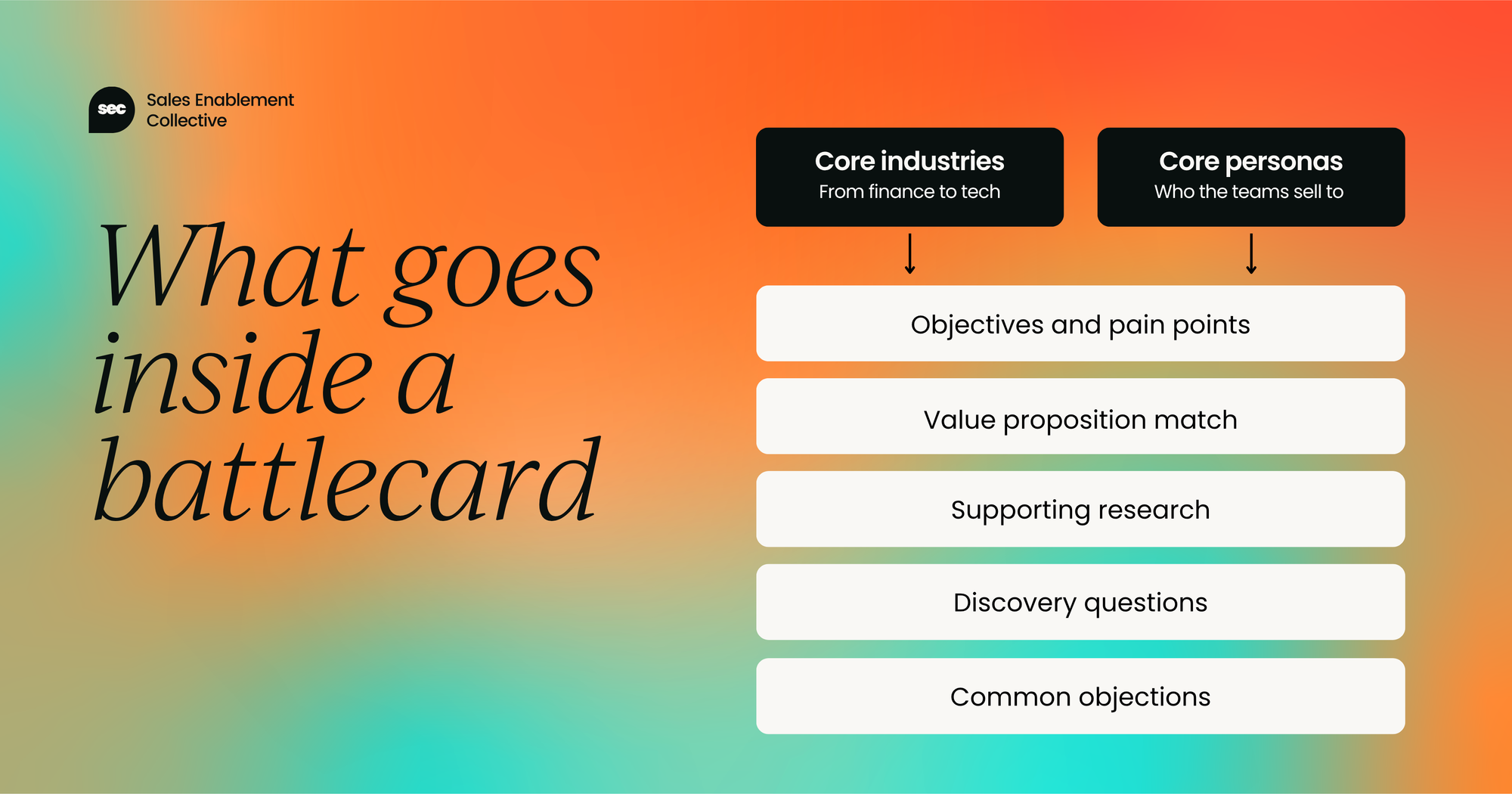
Every industry-persona combination follows the same structure. The card opens with the objectives and pain points that the persona faces. For a travel manager, that might be the inefficiency of managing expenses. It then identifies which of Uber's five value propositions will land hardest for that persona, supported by research and numbers, followed by discovery questions and the objections reps are most likely to hear.
"The more prescriptiveness, the more guidance, and the more outline you can give them, the better it will be and the more effective they will become faster," Janus said.
That approach differs from the common practice of organizing cards purely by competitor. Because the cards are built around the selling situation, a rep can pull one that matches the conversation they are about to have, without translating a competitor-focused document into their own context.
Worth noting on speed: Uber's team of eight, spread globally, used ChatGPT to draft the 64 cards in a fraction of the time their sales playbooks took. Those playbooks, covering each stage of the sales process, ran nearly a full quarter as a cross-functional effort.
Credibility comes from the intelligence underneath
Kirste's work highlights a dimension the other two touch on less directly: the quality and freshness of the competitive intelligence feeding the cards.
Her team previously managed competitive information through shared drives and Teams folders, with no systematic way to gather, analyze, or distribute it. Moving to Crayon, an AI-enabled competitive intelligence platform, lets them track competitor activity automatically and surface it inside Salesforce, where reps already work.
Content at The Standard draws on what reps hear in the field, what makes competitors different at the product and service level, where The Standard can position its own strengths, and where competitors are vulnerable. The cards also include responses to perceived weaknesses, meaning the things competitors say about The Standard that reps need to be ready for win/loss data feed the cards too.
Kirste's team went back to the start of the sales year and collected win information manually from reps, asking them to explain how and why they won specific deals.
"They're excited to talk about it, and they've been eager to put this information in so we can start to populate the system," Kirste said.
Patterns from that data, covering which reps win in which markets against which competitors, become raw material for cards that reflect real selling conditions rather than assumptions.
Delivery without enablement is a dead end
Ryan is firm that battlecards cannot simply be handed over. At his prior company, distribution came paired with structured practice. Reps were presented with objections and recorded themselves responding, rehearsing until the messaging was crisp.
At Entravision, he built similar exercises into the platform, including hot seat drills for objection handling and pitch courses where reps watch an example, receive the same slides and talking points, and then record themselves for feedback.
Janus reinforces this from the onboarding side. Forty percent of Uber for Business's live sales boot camp goes to practice, including role-plays and objection handling. Battlecards feed those sessions directly, giving new hires the language they need for real conversations. Practice is often the least popular session in the moment, yet it consistently scores well in post-training surveys.
Ryan's broader point about content and training applies here. Enablement teams often send collateral to sales without context, then wonder why nobody uses it. "We can throw that pitch deck over the transom to the sales floor if we'd like, but the sales reps are probably not going to use all those slides," he said. Hand a rep a document without helping them practice the conversations it supports, and adoption is left to chance.
Measure whether anyone is using them
Ryan inherited a shared Google Drive with 8,525 files at Entravision. After filtering for actual sales usage, fewer than 78 files, less than one percent, had been viewed two or more times in the prior year. That kind of analysis is what stops a team from rebuilding the same content graveyard in a new platform.
For battlecards specifically, he tracked content performance and fed it back to marketing, creating a loop that shaped what got produced and what got cut. Battlecards consistently outperformed other content types, so the team built more. A "Magazine Rack" channel for industry insights failed to gain traction, so they pulled back.
He also ran a correlation analysis comparing rep engagement with enablement content against quota attainment. The coefficient came in at 0.39, which an economist friend at the Federal Reserve told him was respectable given that perfect positive correlations are essentially impossible in the real world. Analysis like this gives enablement teams a way to connect the content they produce to performance in the field.
Kirste is earlier in her measurement work, tracking who accesses battlecards in Salesforce, which competitors get researched most, and where winning and losing patterns diverge across markets and reps.
What the three of them agree on
Janus provides the clearest blueprint for what goes inside a card: persona-specific pain points, mapped value propositions, supporting data, discovery questions, and common objections.
Kirste shows that the intelligence behind those cards has to come from real competitive data, kept fresh and surfaced where reps already work.
Ryan demonstrates that cards reach their potential only when paired with practice and measurement.
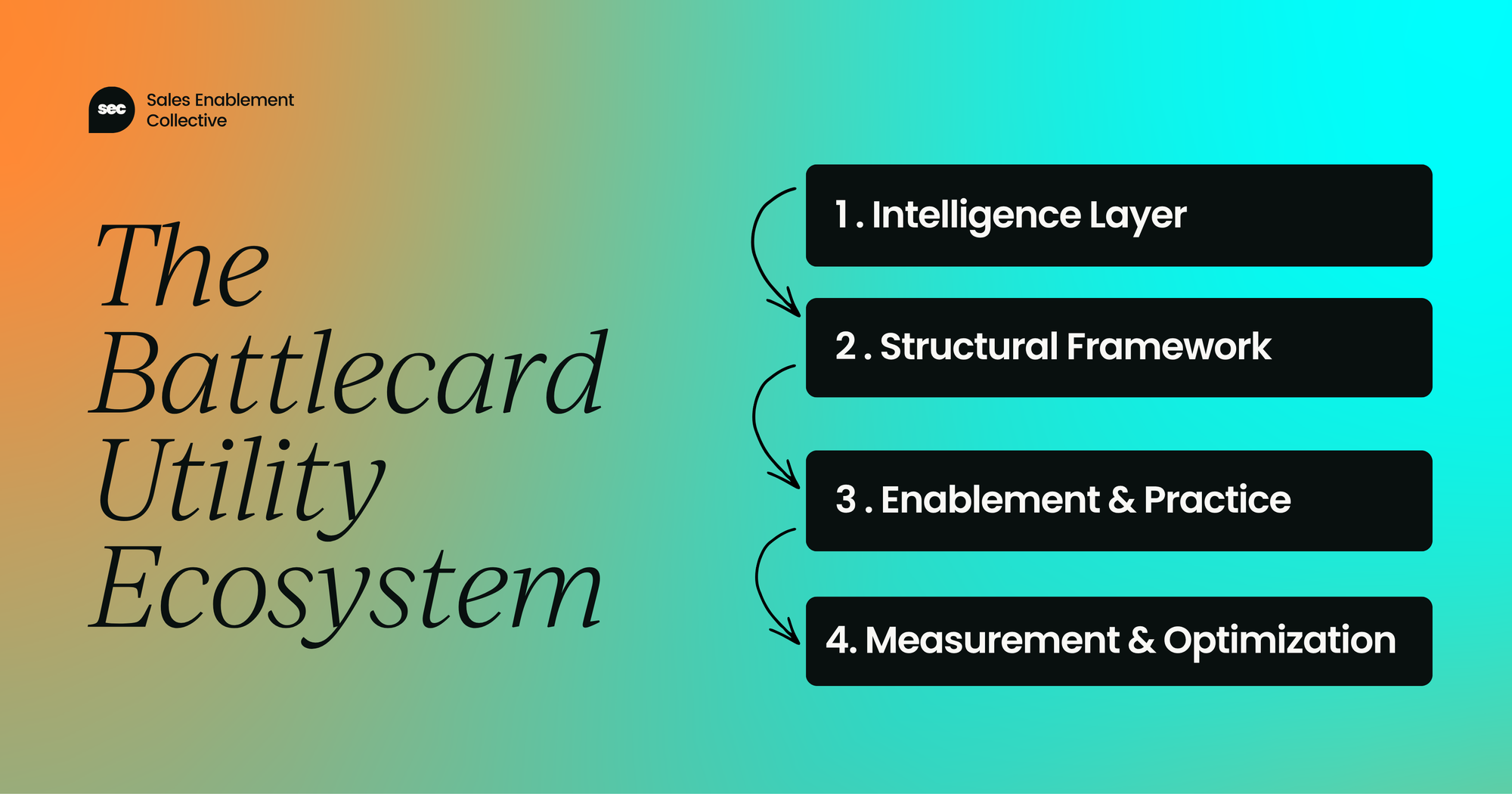
The card is a container. Its value depends on whether it holds the right information, whether reps know how to use it live, whether it is accessible at the moment of need, and whether anyone checks if it is working. Building the card is the easy part.


Sales enablement insider
Thank you for subscribing
Level up your sales enablement career & network with sales enablement experts.
An email has been successfully sent to confirm your subscription.
 Follow us on LinkedIn


.svg)

Start the conversation
Become a member of Sales Enablement Collective to start commenting.
Sign up now