

















Challenger selling works best in complex, multi-stakeholder B2B deals, long cycles, several decision-makers, high switching costs, and informed buyers whose real competition is the status quo.
Its advantage is thin in simple, transactional sales and it can actively backfire on renewals, commodity products, or when reps lack the industry insight to teach something worth hearing.
Most guides explain what Challenger is: the five rep profiles, the teach-tailor-take-control model, and the five phases from warm-up to close. If you need that grounding, start with our breakdown of the Challenger sales methodology.
This article answers the harder question enablement leaders actually ask before rolling it out: when is it the right tool, and when is it the wrong one?
Challenger's edge grows with deal complexity
When Dixon and Adamson studied more than 6,000 reps at roughly 90 companies, Challengers formed about 40% of top performers overall, but in complex sales that figure jumped to 54%, while the relationship builder, the profile most orgs instinctively hire was the weakest performer in complex deals.
In transactional selling, the profiles were bunched close together and relationship builders kept pace. In complex selling, the gap exploded.
That's the whole decision in one sentence: the more stakeholders, the longer the cycle, and the higher the switching cost, the more Challenger earns its place.
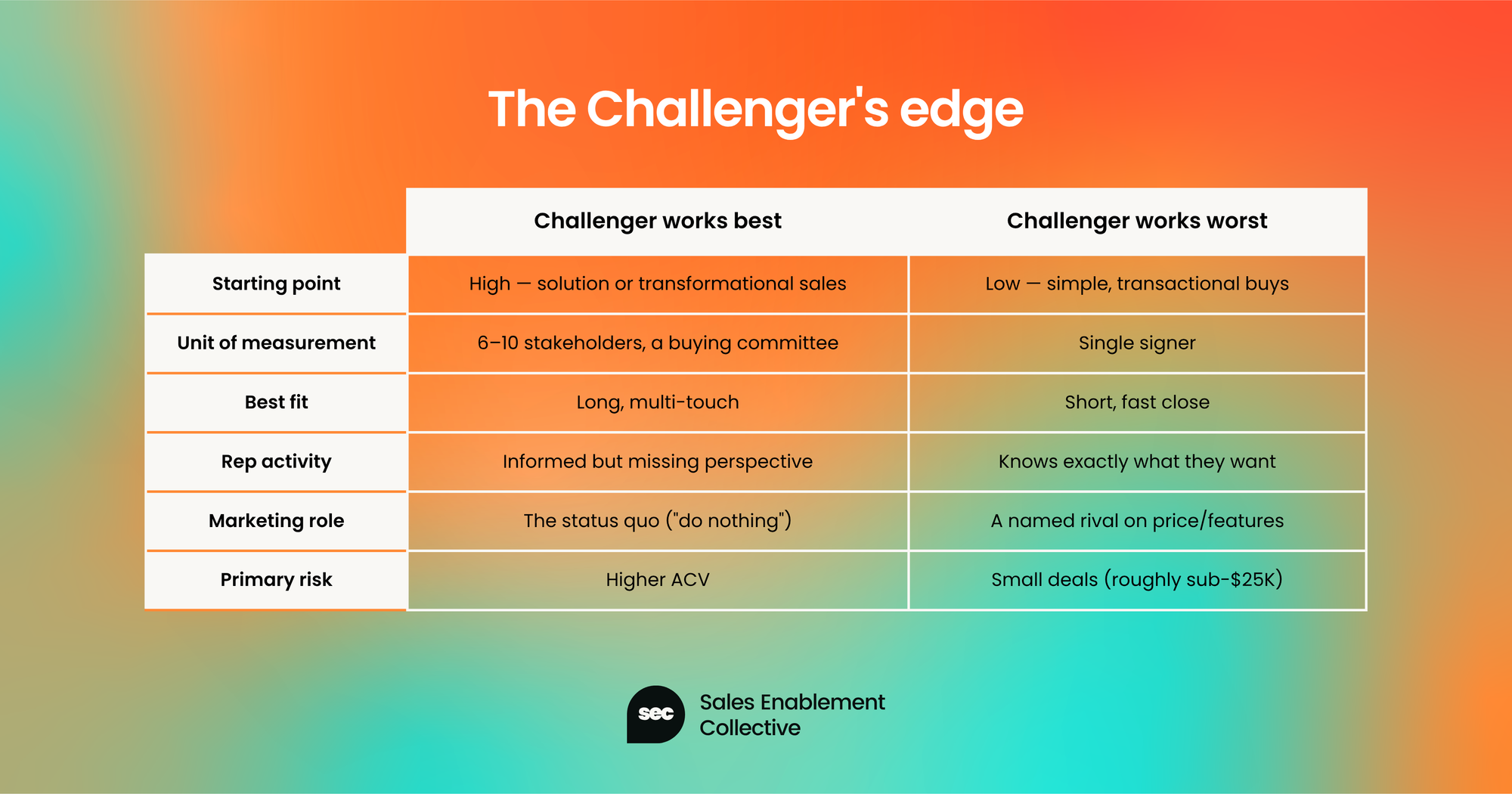
Now let's examine the four conditions where Challenger outperforms:
1. The deal is complex and multi-stakeholder
Challenger was built for the modern buying committee.
Gartner puts a typical B2B buying group at six to ten people, and the hardest competitor in that room isn't a rival vendor, it's the group's default to do nothing. A committee that can't align keeps the status quo.
2. "Do nothing" is your real competitor
If you routinely lose deals to inertia rather than to a competitor, the prospect stalls, re-prioritizes, or "circles back next quarter", Challenger is designed for exactly your problem.
Its rational-drowning step exists to make the cost of standing still feel more expensive than the cost of switching.
When you're losing to a named rival on features or price, other motions or a sharper MEDDIC qualification often serve better.
3. Your category is crowded or commoditized
When buyers can't tell you apart from five alternatives they've already researched, leading with features is pointless, they know the features.
Reframing the problem is the only way to stand out.
Challenger creates differentiation at the level of insight rather than product, which is why it tends to shine in saturated markets and struggle where your product is a genuine commodity with no meaningful angle to teach.
 Alex Walton
4. Buyers are informed but not insightful
Today's buyers arrive having read the comparison articles and half a Reddit thread.
They don't need a product pitch; they need a perspective they couldn't Google. Challenger works when there's a real "unknown unknown", a hidden cost, an unrecognized risk, or a counterintuitive opportunity that you can credibly reveal.
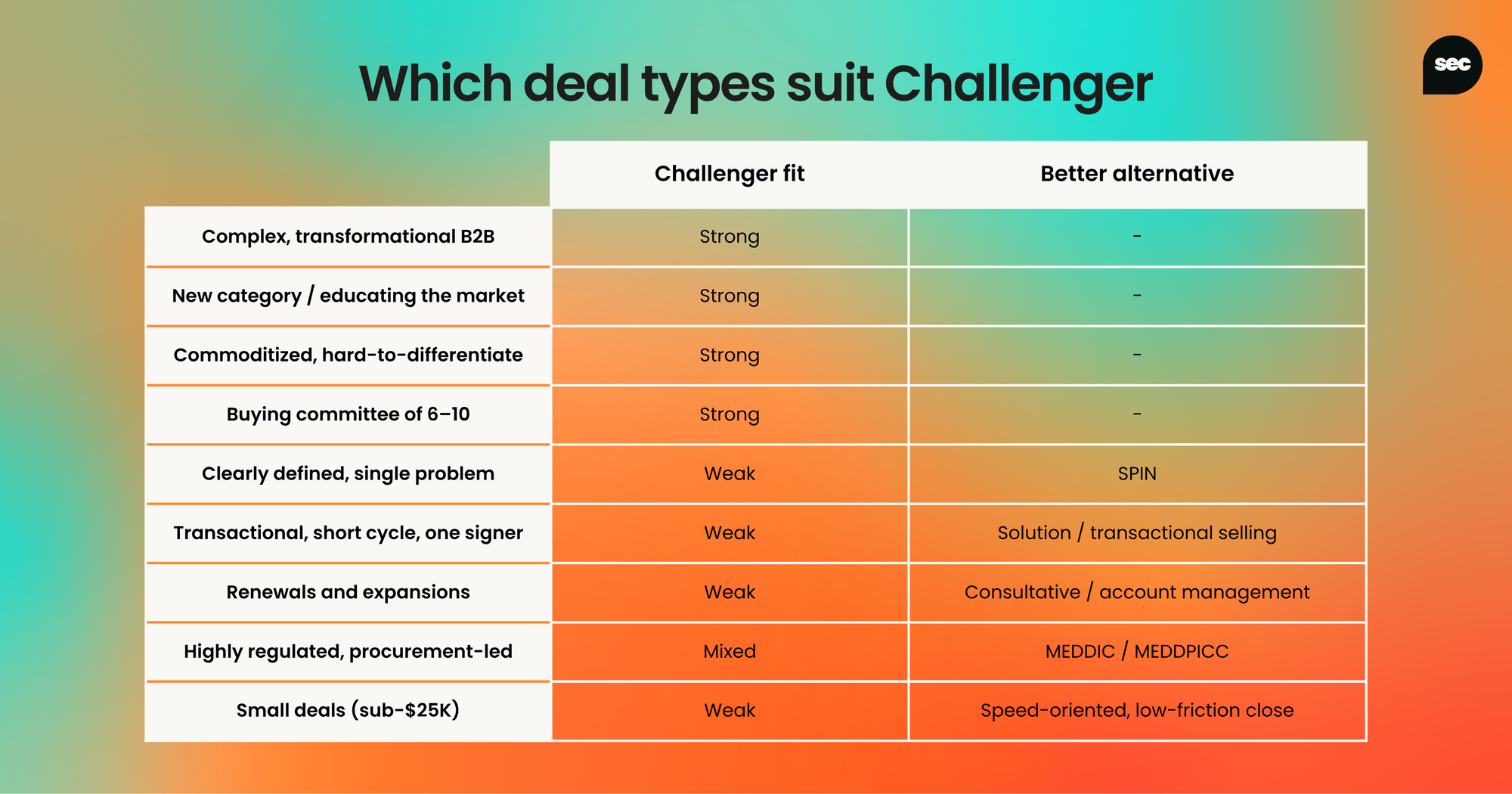
Where the problem is already well-defined and the buyer simply needs help mapping a solution, a question-led approach like SPIN usually fits more naturally.
Which teams should use Challenger selling
Challenger is a team capability, not just a rep behavior. Before you roll it out, check that three things are in place:
- Experienced reps who can teach credibly. A Challenger pitch built on a generic or wrong "insight" does more damage than a straightforward consultative call. The method demands reps who understand the buyer's business well enough to say something true and surprising. Green teams tend to weaponize the "take control" step and skip the credibility that earns it.
- A commercial insight engine. Reps can't manufacture reframes alone. High-functioning Challenger orgs feed the field with cross-industry data, benchmarks, and competitive intelligence, usually a marketing or enablement function producing the teaching content. Without that supply chain, "teach the customer something new" is a slogan, not a motion.
- A real coaching infrastructure. Challenger behaviors can be learned, but not passively. Our own data points the same way: teams that give reps structured, Challenger-style coaching see roughly 16.7% higher annual revenue growth and a 28% lift in win rates, and Challenger reps hit quota about 14% more often than other profiles. Those gains come from deliberate coaching, not osmosis, so pair any rollout with a structured sales coaching program.
If you have all three, momentum is on your side: around 35.5% of enablement leaders plan to increase investment in digital Challenger-style coaching this year.
If you're missing one, fix that first, the method amplifies whatever coaching culture you already have, for better or worse.
When NOT to use Challenger selling
Be honest about the deals where it hurts more than it helps:
- Transactional, single-signer sales. If the buyer knows what they want and just needs pricing and logistics, a six-step teaching pitch adds friction and slows the close.
- Renewals and expansions. Post-sale, retention runs on trust and reliability. Reframing a customer's worldview at renewal reads as manufactured tension, not value. This is relationship and account-management territory.
- True commodities. If there's no meaningful angle to teach, the "insight" will feel forced. You can't reframe your way out of genuine parity.
- Inexperienced or under-supported reps. No insight into the supply chain, no coaching, junior team, Challenger becomes aggression without substance.
- Procurement-led, spec-driven buys. When the deal is a structured evaluation against fixed criteria, tight qualification (MEDDIC/MEDDPICC) beats a teaching motion.
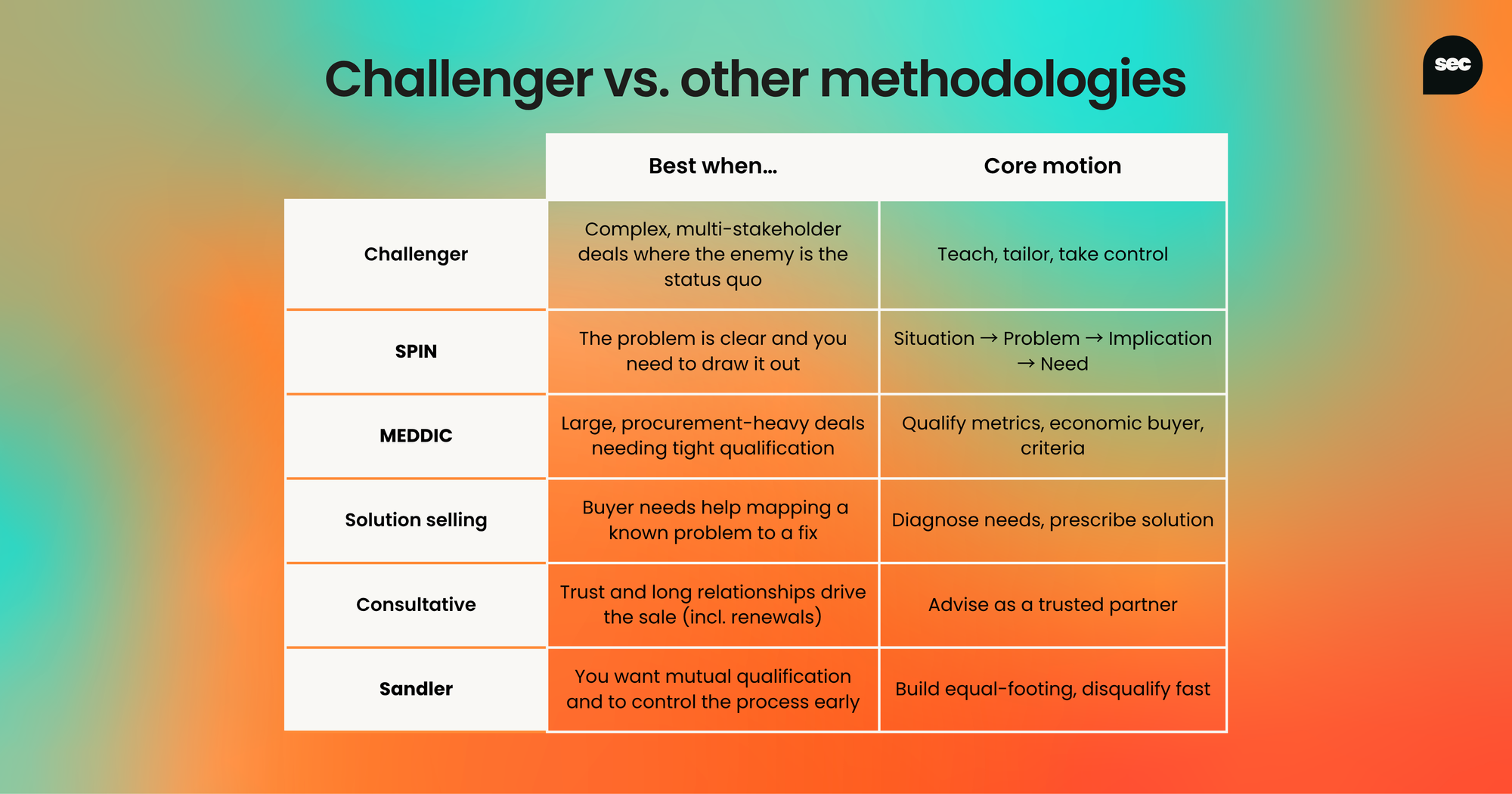
Challenger vs. other methodologies: which to use when
Challenger isn't a replacement for every other framework, it's the right tool for a specific job. Here's the quick decision map:
Don't wait a full cycle to judge the rollout. Watch these leading indicators:
- Status-quo losses drop. Fewer deals dying to "no decision" is the clearest sign the teaching motion is landing.
- Deals engage earlier and higher. Reps are getting into problem-framing conversations before the buyer has finalized their spec.
- Multi-threading improves. Challenger forces reps to tailor insight per stakeholder, so healthy adoption shows up as wider engagement across the committee.
- Discounting eases. When you win on insight rather than features, price pressure softens.
If instead you see longer cycles, more friction, and reps "challenging" buyers who just wanted to buy, you've likely applied it to the wrong deal type, revisit the fit table above.
Challenger is it's a precision instrument. Point it at complex, multi-stakeholder deals where inertia is the enemy and your reps have something genuinely worth teaching, and it outperforms almost everything else. Point it at a fast transactional buy or a renewal, and it costs you deals. Match the method to the motion, and the results follow.
FAQ
Is Challenger selling still relevant? Yes, arguably more so. Buyers now self-educate across roughly ten channels before contacting a rep, so a features pitch adds little. In complex B2B, the ability to reframe a buyer's thinking is where reps still add value.
Does Challenger work for small or transactional deals? Rarely. The research found the Challenger edge was minimal in straightforward deals and only widened with complexity. On fast, low-value, single-signer buys, a teaching pitch usually adds friction rather than value.
Is Challenger better than relationship selling? It depends on the deal. In complex committee purchases, Challenger tends to beat relationship selling because it moves a group off the status quo. In renewals, expansions, and transactional sales, relationship-led approaches typically win. They're tools for different jobs.
What size deal justifies Challenger? There's no hard line, but reframing tends to pay off as ACV and stakeholder count rise, and to add friction on smaller deals (a rough sub-$25K heuristic). Judge by complexity and buying-group size, not price alone.
Can any rep learn to sell like a Challenger? The behaviors can be taught, but only with real coaching and a supply of commercial insight to teach. Without both, reps default to the "take control" step without the credibility that makes it work.


Sales enablement insider
Thank you for subscribing
Level up your sales enablement career & network with sales enablement experts.
An email has been successfully sent to confirm your subscription.
 Follow us on LinkedIn



.svg)

Start the conversation
Become a member of Sales Enablement Collective to start commenting.
Sign up now