












Sales enablement means something slightly different at almost every company.
Ask five enablement managers what’s on their plate and you’ll get five different answers. Some own the full tech stack. Others are essentially content writers with a fancier title. A few are doing the work of an entire department with a team of one.
So what should a sales enablement manager own? And where does that responsibility reasonably end?
Here’s a clear-eyed look at the role as it actually exists today, including how AI is reshaping the hours inside it.
The short answer
A sales enablement manager owns seller readiness. That means onboarding, training, coaching programs, sales content, the enablement tech stack reps use daily, and the measurement that shows whether any of it actually moves revenue.
More recently, it also means governing the AI tools that now draft content and run practice sessions for reps.
Most people in this role arrive with a seller’s instincts, which makes sense.
According to our Sales Enablement Salary and Landscape Report 2025, 59.4% of respondents had held a sales role before moving into enablement, ranging from frontline selling all the way up to leadership.
The remit is widening, though, even as many teams shrink.
The same survey found that 23.6% of respondents’ teams had lost headcount over the previous 12 months. Enablement is most often reported in RevOps (39.4%) or Sales (25.4%). Fewer people, broader outcomes. Which is precisely why it’s worth being precise about what the role covers.
Seven areas an enablement manager owns
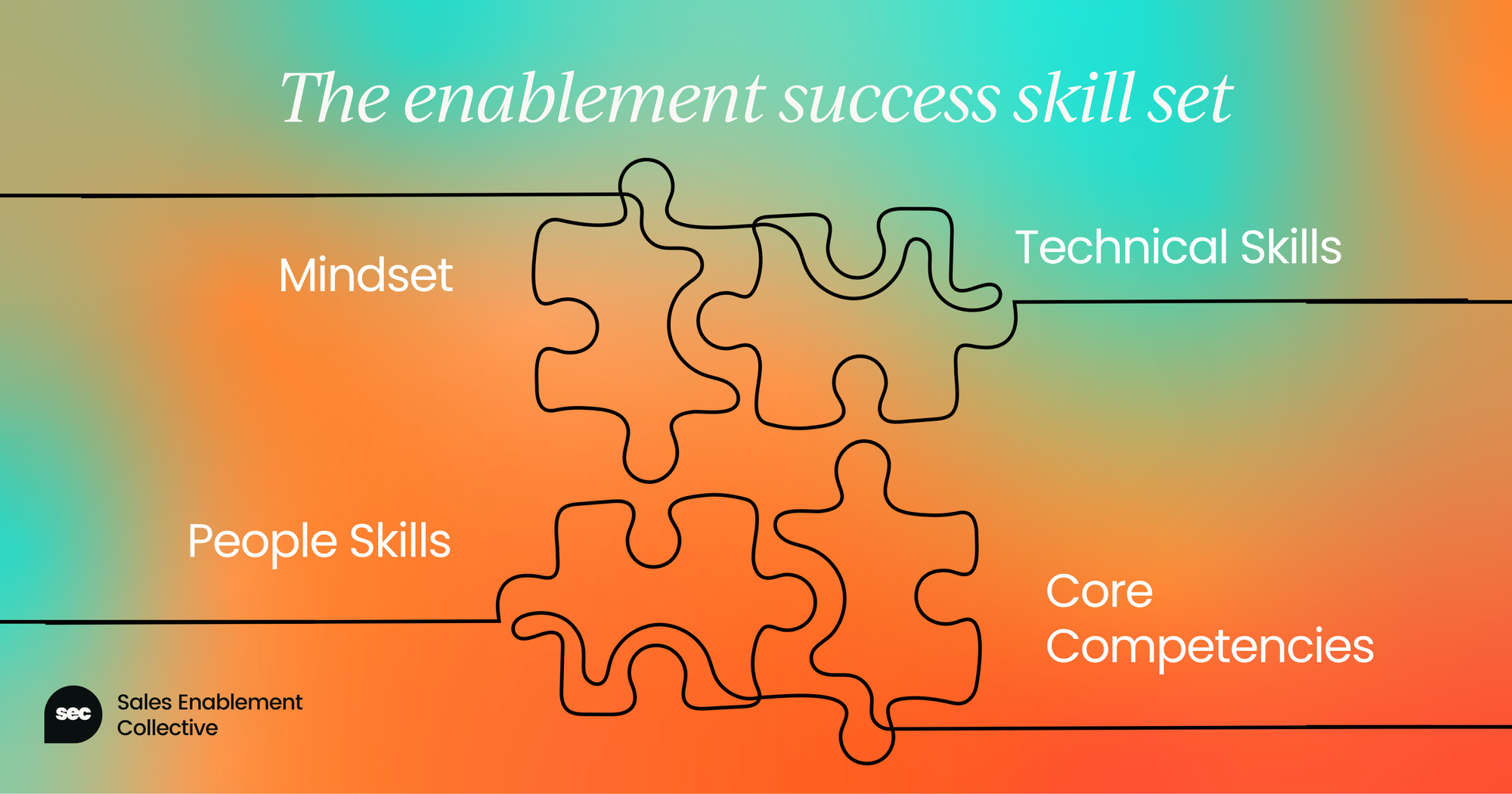
Job descriptions vary by company size and reporting line, but the core remit has settled into seven areas.
- Onboarding and ramp: You own the new-hire curriculum and the milestones that mark a rep as ready. AI roleplay lets new hires rehearse discovery calls and objection handling before they ever speak to a real buyer, changing how you design that ramp.
- Training and certification: Ongoing skills programs, product launch training, and certifications. AI can generate short practice scenarios for each launch instead of requiring you to build everything by hand, freeing up time for the design work that actually requires judgment.
- Coaching programs: You own the coaching framework sales managers follow and the scorecards behind it. AI call analysis handles volume; your job is designing where human coaching adds the most.
- Sales content: Playbooks, battle cards, talk tracks, buyer-facing assets. First drafts are now fast and cheap, so the work has shifted toward deciding which assets should exist, checking accuracy, and retiring anything stale.
- Enablement technology: Choose and roll out content and learning platforms, then drive adoption. AI features inside those platforms now need their own owners and guardrails, which adds a governance layer to the work.
- Field communications: How launches and messaging changes actually reach reps. Updates can now be pushed into the tools reps already work in, which is a meaningful shift from the old “send an email and hope” approach.
- Measurement: The KPIs that connect your programs to rep behavior and revenue. More activity data is available than ever, which raises the bar for showing cause rather than correlation.
The first three areas make up the readiness side of the job. Content and technology are the delivery layer and measurement holds everything else together. Without it, the other six areas are just activity.
How AI has shifted the enablement manager’s week
The areas of ownership have stayed broadly stable. The hours spent in them have shifted considerably.
Gartner’s April 2026 forecast, built on a survey of 227 chief sales officers, predicts that sales organizations with AI-driven enablement will achieve 40% faster sales stage velocity than those using traditional approaches by 2029.
Shayne Jackson, VP Analyst in the Gartner Sales Practice, put it this way: “Traditional enablement was built as a reactive support function, not as a system engineered to drive measurable seller performance.”
Sellers expect the shift too. Salesforce’s 2026 State of Sales report, drawn from more than 4,000 sales professionals, found they expect AI agents to cut research time by 34% and content creation time by 36%.
Four practical changes follow from this:
Production gives way to curation.
When a first draft of a battle card takes minutes, writing stops being the bottleneck.
Your time goes into deciding which assets should exist and when each one should be retired. That’s a different skill than writing well, and it’s worth developing deliberately.
Accuracy becomes a standing duty.
Generated content inherits whatever errors sit in its source material. Someone has to own the source of truth for pricing and competitive claims.
Enablement is well placed to hold that, working alongside product marketing, but it has to be an explicit responsibility rather than something that falls through the cracks.
Coaching splits between AI and human managers.
Research by Allego, published with us in April 2026, used EEG and eye tracking to compare how sellers respond to each type of feedback. Sellers remembered 50% more from AI feedback, while human coaching still mattered most for motivation.
You now design that blend, deciding where AI practice carries the load and where a sales manager’s conversation is worth the time.
Programs move into the workflow.
Gartner’s guidance to sales leaders calls for in-workflow, data-driven guidance in place of static content and training.
For you, that means fewer standalone sessions and more guidance delivered inside the CRM and the tools reps already open each day. If reps have to leave their workflow to access enablement, most of them won’t.
Where the role ends
A lot of the confusion around enablement comes from shared territory.
You rarely own an outcome alone, and the clearest teams agree in writing who leads each piece.
Positioning and messaging sits with product marketing. Your job is to turn that messaging into talk tracks and battle cards reps can actually use in a conversation.
CRM and sales process sit with RevOps.
You train reps on the process and use the data to measure your programs.
Compensation plans belong to RevOps and sales leadership. You can advise on which behaviors the plan should reward, but you’re not setting it.
Day-to-day coaching belongs to frontline sales managers. You design the coaching framework and equip managers to run it well.
Quotas and forecasts belong to sales leadership. You track how your programs affect attainment, but you’re not setting the number.
How enablement ownership gets judged
Ownership means little without agreement on how success is measured, and that agreement is still surprisingly rare.
In our survey, only 43.8% of respondents said they were aligned with senior leadership on metrics.
Asked about their greatest challenges, 61.2% named difficulty measuring the impact of enablement, making it the most common answer.
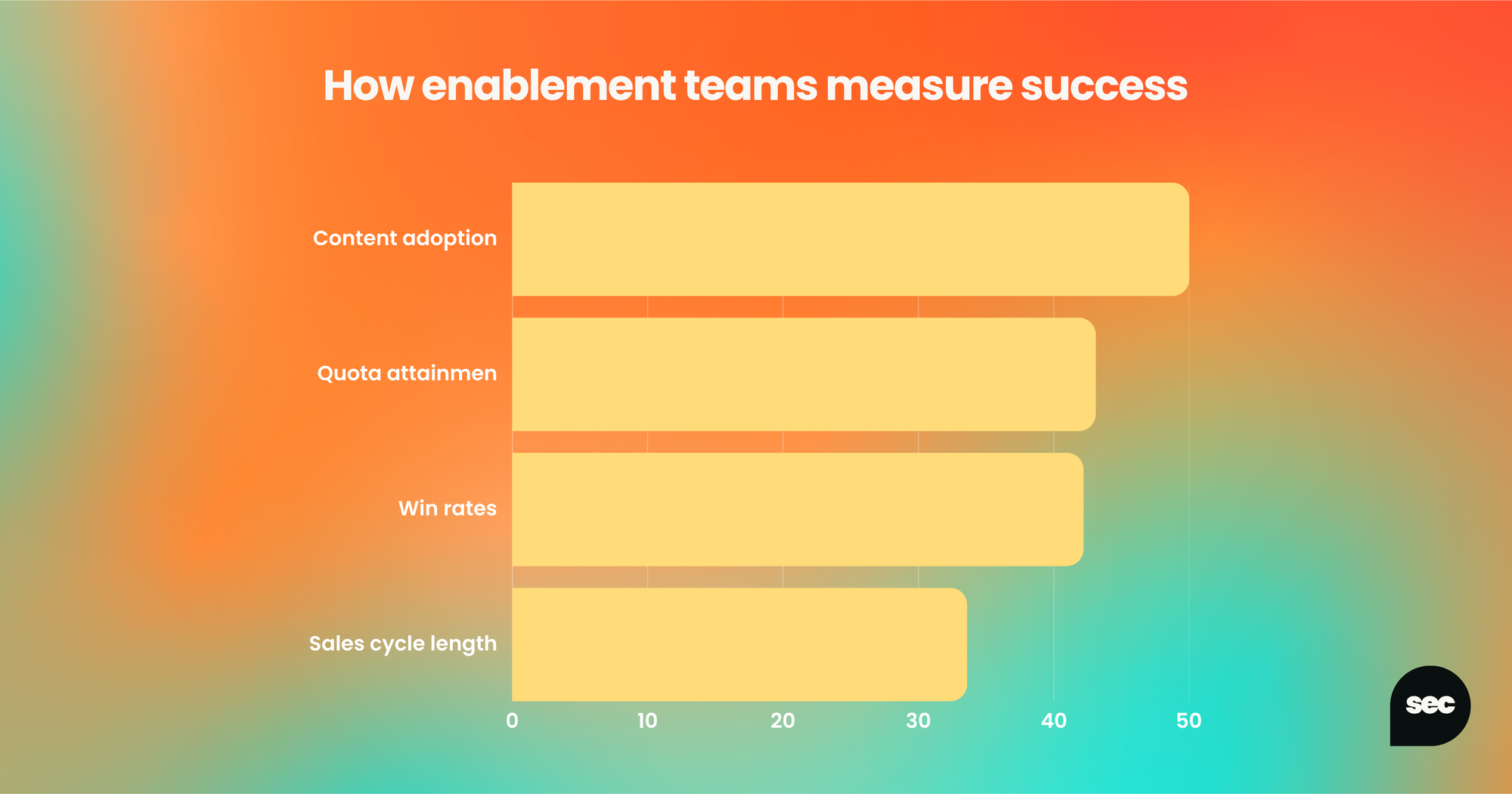
The two sides often watch different numbers. Leadership leans on lagging revenue measures: 54.3% of respondents used win rate to report enablement’s ROI upward, while 42.2% used it to track their own internal success.
The gap matters because it creates a credibility problem. If leadership is watching win rate and you’re reporting on content adoption, you’re having two different conversations about the same programs.
A strong enablement manager closes that distance before a program launches.
Agree on a short list of KPIs with leadership, pairing a leading indicator (content adoption, practice completion, ramp time) with a lagging one (win rate, quota attainment). Then report on both at a fixed cadence.
That way, you’re not scrambling to prove impact after the fact.


Sales enablement insider
Thank you for subscribing
Level up your sales enablement career & network with sales enablement experts.
An email has been successfully sent to confirm your subscription.
 Follow us on LinkedIn



.svg)

Start the conversation
Become a member of Sales Enablement Collective to start commenting.
Sign up now