
















Enablement teams face an urgent need to justify their strategic value to the business.
Stakeholders have demanding schedules, competing priorities, and limited patience for initiatives that fail to show clear commercial returns. Delivering brief, high-impact messages backed by clear data is essential to securing a place at the executive table.
Achieving that credibility requires looking closely at how we design our programs, how we measure success, and how we interact with commercial leaders during the initial intake process.
The opportunity within the messy middle
At Intuit, my focus as a high-performance program manager centers on moving sales performance from good to great.
When evaluating where to direct organizational investment across a sales force, targeting the middle tier of sellers yields substantial returns.
Top performers generally succeed regardless of programmatic interventions, while persistent bottom performers often face baseline fit or performance management challenges.
The core group in the middle consists of proficient sales professionals who possess tenure, understand the core methodology, and reliably execute standard processes. Elevating this substantial group creates significant compounding revenue gains.
Moving this cohort involves two primary stages:
- Codifying great practice: Identifying and defining what top-tier performance looks like in daily execution.
- Designing targeted programs: Implementing structured initiatives specifically engineered to shift middle performers toward those codified standards.
Shifting from content delivery to behavior change
Enablement historically operated under the assumption that asset creation was the core deliverable. Teams operated under the belief that if they produced a polished document, a comprehensive slide deck, or an intricate guide, sellers would consume it and immediately improve their performance.
Modern commercial realities require a distinct approach. Sustainable performance improvement requires sustained behavioral change rather than the passive distribution of collateral.
Looking beyond reaction metrics
For years, enablement functions relied heavily on initial learner sentiment to assess value.
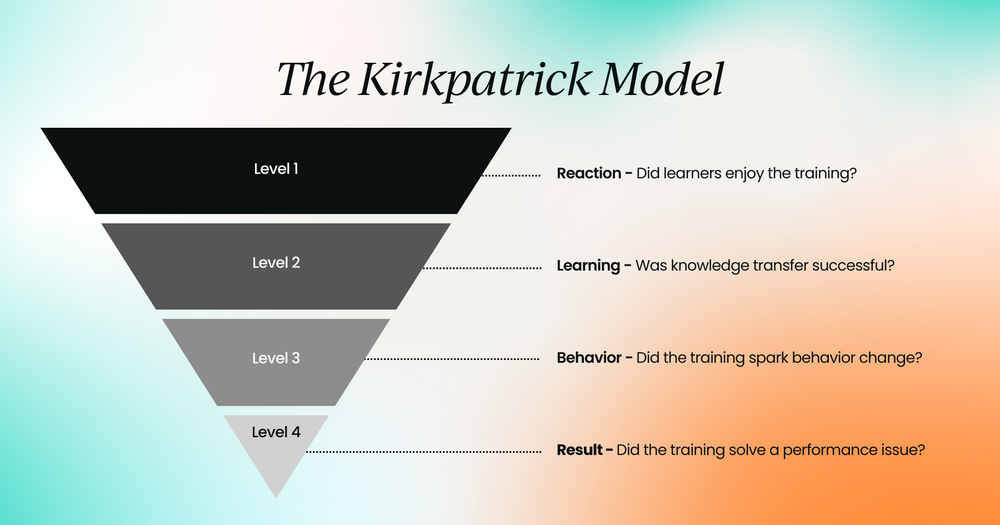
High satisfaction ratings, Net Promoter Scores, and positive survey responses were routinely accepted as indicators of success. These Level 1 and Level 2 measures on the Kirkpatrick evaluation model show only that participants attended a session and found it agreeable.
Our mandate today involves operating credibly within Kirkpatrick Level 3 (behavior change in the field) and Kirkpatrick Level 4 (business impact).
Demonstrating that transition requires discipline and precision. Claiming direct, unassisted causation between an enablement workshop and an immediate revenue spike damages credibility with business leaders.
Executives know that quarterly performance reflects multiple variables, including revised compensation plans, seasonal promotions, marketing campaigns, and territory adjustments.
Credible enablement teams track the complete operational chain:
- The initial enablement intervention.
- The verifiable change in seller behavior.
- The resulting output metric.
- The ultimate commercial impact.
Frameworks established by performance researchers such as Carl Binder provide the operational foundation for linking these stages together systematically.
Reverse engineering the business problem
Common sense frequently fails to translate into common practice across our profession. While establishing clear metrics is universally recognized as valuable, executing that discipline during early program design requires consistent rigor.
When an executive approaches enablement with a request to address lagging performance, the conversation must begin with the ultimate business impact. Enablement teams must analyze the exact revenue gap before designing any training material.
Deconstructing the performance chain
Consider a scenario where a sales leader identifies a sharp decline in conversion rates across a business unit. Rather than immediately launching a general refresher course on deal closing, the design process works backward through several diagnostic layers:
- Identify the business outcome: Determine the specific shortfall in conversion rates and its monetary impact.
- Determine the required output metric: Identify the leading indicators associated with healthy conversions, such as balanced customer talk time.
- Define the underlying behavior: Clarify what high-quality customer conversations entail, such as deep discovery questioning and problem diagnosis.
- Build the targeted intervention: Construct coaching, practice routines, and resources focused entirely on developing those specific questioning behaviors.
Every developmental initiative designed this way links directly to an executive-level priority from the very first working session.
Applying sales discovery principles to internal intake
Many enablement practitioners entered the field following successful careers in quota-carrying sales roles. Curiously, the core consultative disciplines taught to frontline sellers are often abandoned during internal intake conversations with company executives.
When speaking with a prospective buyer, a skilled account executive conducts thorough discovery. They investigate root causes, isolate business pains, define success criteria, and establish verifiable metrics.
Internal enablement consulting requires that exact approach. Treating leader requests as immediate work orders reduces the enablement team to administrative order-takers. Performing deep, rigorous needs analysis establishes enablement as a strategic commercial partner.
Structuring the leadership intake meeting
Securing valuable time with senior executives requires clear boundaries and advance preparation. Instead of scheduling an open-ended discussion to gather requirements, set clear expectations before entering the room.
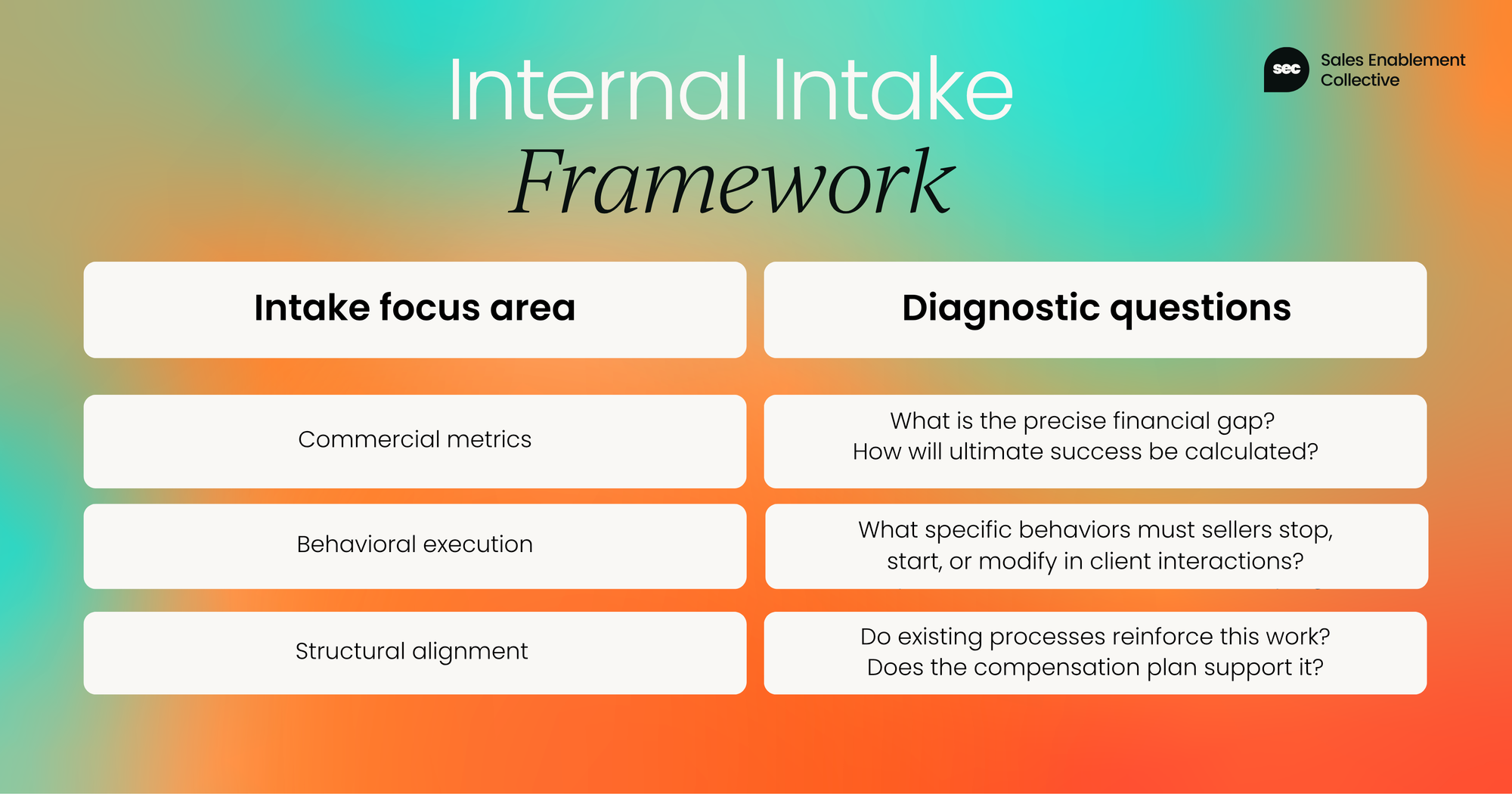
Distribute an agenda outlining the specific diagnostic areas that will be addressed during the session:
- The primary business outcomes and baseline revenue metrics under review.
- The specific observable behaviors that need to change in customer interactions.
- The operational workflows, management inspection cadences, and systems required to sustain new habits.
- The alignment of current commission structures and incentives with the desired behaviors.
Sending these strategic questions in advance changes the dynamic of the conversation entirely. It shows business leaders that enablement evaluates performance through a complete operational lens. This approach builds instant credibility and establishes a collaborative partnership before program development begins.
Developing executive presence through business outcomes
Professional development within enablement often centers on building curriculum design skills or mastering presentation software. While instructional design remains important, career progression toward senior leadership requires building strong executive presence.
Executive presence develops through the ability to hold high-stakes business discussions calmly and credibly with senior operators. When enablement professionals lead discussions focused on commercial outcomes, unit economics, and behavioral adoption rather than slide decks and delivery formats, executive perceptions change immediately.
Framing internal programs around clear commercial metrics confirms that enablement understands the broader financial goals of the business. Approaching enablement as a continuous discipline of behavior change and rigorous discovery ensures our teams deliver predictable, measurable value to the organization.


Sales enablement insider
Thank you for subscribing
Level up your sales enablement career & network with sales enablement experts.
An email has been successfully sent to confirm your subscription.
 Follow us on LinkedIn



.svg)

Start the conversation
Become a member of Sales Enablement Collective to start commenting.
Sign up now