
















Here's something most organizations won't admit out loud: competitive intelligence is treated as an afterthought.
It lives in static battlecards that haven't been updated in months. It gets distributed via one-way emails that land in inboxes and are promptly ignored. It gets discussed in well-meaning meetings with the wrong people in the room, and then everyone moves on, assuming the job is done.
I've seen this pattern play out more times than I can count, and the uncomfortable truth is that this approach fails, especially in fast-moving sales environments where the market shifts faster than your documentation does.
Too often, it gets run like a one-way radio show. Someone broadcasts information out to the field, and that's where the conversation ends.
That's the problem I want to talk about.
Where valuable intelligence actually lives
Your sales team holds insights your business can't afford to miss. They're having the conversations. They're hearing how objections are evolving. They're seeing shifts in buyer behavior in real time. They're picking up on competitive dynamics long before those dynamics show up in a report or a dashboard.
 Sales Enablement Collective
The challenge is that most organizations aren't capturing any of it in a consistent, structured way.
When I was working with our Sales Enablement, Marketing, and Competitive Intelligence teams at Cologix, we had a shared realization: some of the most valuable intelligence in our organization already existed. We weren't doing anything with it. Conversations were happening in weekly calls and individual check-ins, but the insights were fragmented and scattered. They surfaced, and then they disappeared just as quickly.
We needed a way to capture what sellers were learning in the field and build a repeatable process for turning those insights into action.
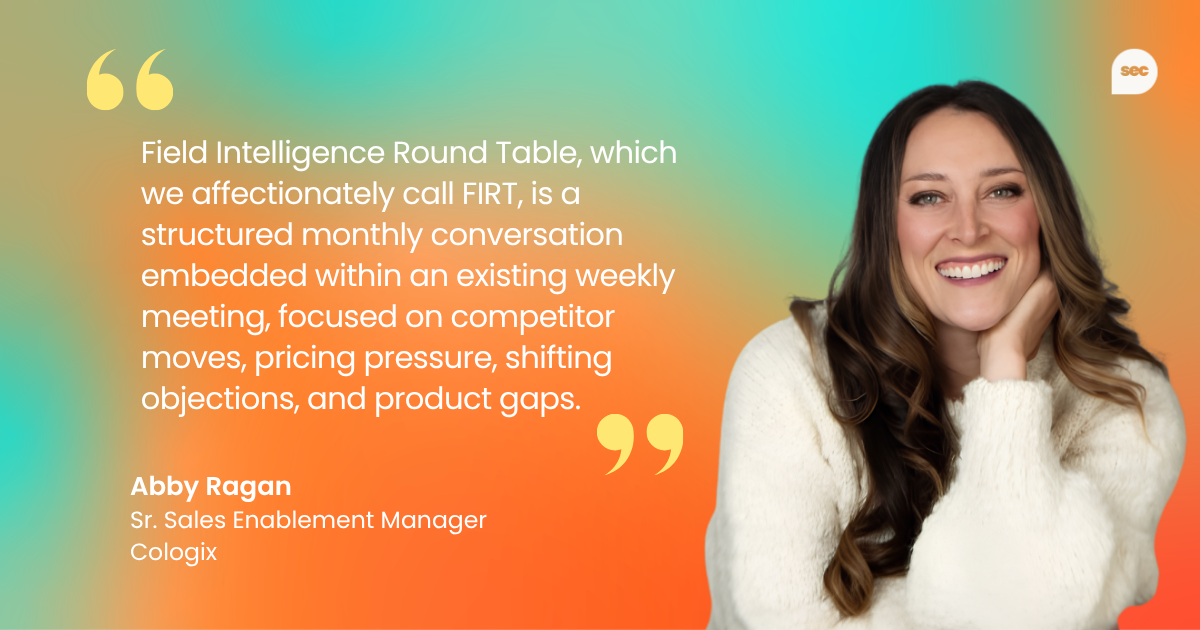
That's how the Field Intelligence Round Table, which we affectionately call FIRT, came to life.
Over time, we've built a system where reps understand the value of their input and can actually see what happens as a result.
Sellers are the best real-time market intelligence tool your organization has. The question is whether you're building an environment where that intelligence can flow freely.
What happens when feedback loops don't exist
When competitive intelligence isn't flowing back into the business, things start breaking in ways that aren't always immediately obvious.
Product teams keep prioritizing roadmaps based on assumptions rather than what buyers are actually saying. Marketing keeps pushing messaging that resonated six months ago but no longer lands. Battlecards go stale the moment they're published. Sales teams create their own workarounds, and before long, everyone is operating from a different version of the truth.
The downstream effect isn't just internal misalignment. It directly impacts revenue. Deal cycles get longer. Win rates suffer. Valuable insights disappear into meeting notes and email threads and are never seen again.
One of the biggest misconceptions about field intelligence is that it's purely about competitive positioning. In reality, it surfaces all kinds of signals that can shape your strategy in ways you might not expect.
During one of our FIRT sessions, a rep raised what appeared to be a pricing challenge. On the surface, it seemed familiar: a prospect felt our solution was too expensive. But as we dug deeper, the picture became more interesting. The prospect wasn't pushing back because our pricing had changed. Material costs in their business had increased significantly during the sales cycle, shifting their budget realities and changing how they evaluated the opportunity.
That insight didn't lead to a change in our commercial strategy. What it did do was provide critical context on the market conditions affecting customers in that region. It helped us adjust our deal strategy and, perhaps more importantly, it gave us the foundation for a more transparent conversation with that customer, and transparency builds trust.
Without a structured conversation, that insight would have stayed isolated to a single opportunity. One rep would have known it. No one else would have.
If the market is changing faster than your organization can learn, you're already behind. That's not a dramatic statement. It's just the reality of operating in a competitive environment.
 Simon Gilks
Building a dynamic feedback system
The answer to improving competitive intelligence efforts isn't collecting more information. Most organizations already have plenty of information.
The challenge is building a system that turns information into action.
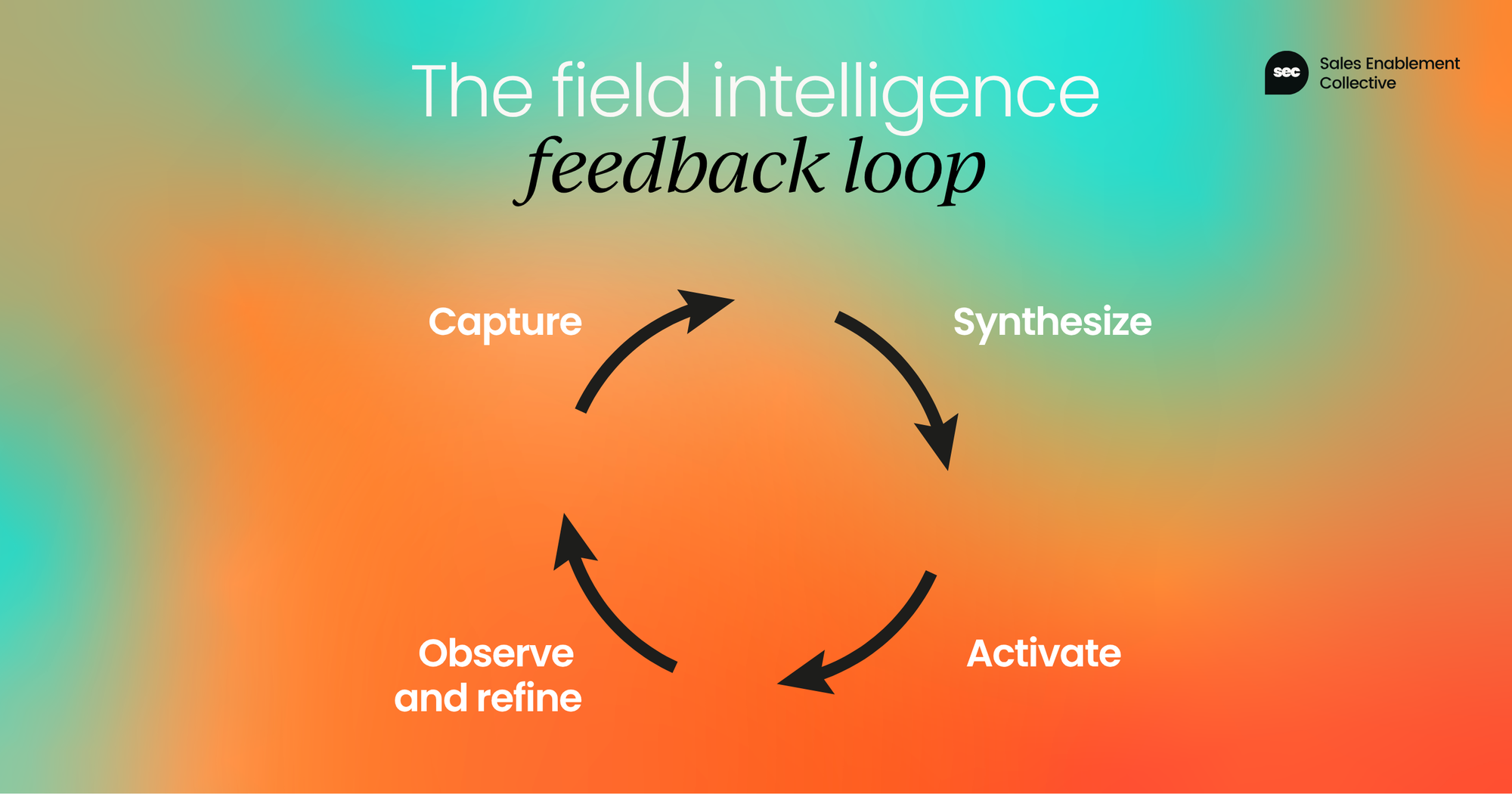
What we're building at Cologix is what I call the Field Intelligence Feedback Loop. It has four stages: capture, synthesize, activate, and observe and refine.
I'll be honest with you: we're still maturing this process. We're at a point where we're watching for patterns and signals rather than measuring the direct impact of every action that comes out of FIRT.
Are the same objections still surfacing? Are sellers using updated talk tracks? Are new competitors showing up more frequently? Are pricing concerns becoming more or less common over time?
That kind of observation matters because feedback loops don't become valuable only when they're perfectly measurable. They become valuable when the business starts listening, responding, and learning faster than it did before.
What actually works when building the loop
Capturing intelligence from the field
One of the most common mistakes organizations make is expecting sellers to go out of their way to contribute intelligence. If the process creates extra work, adoption will be low. Full stop.
The most effective feedback loops are embedded into existing workflows.
For us, FIRT sits inside a meeting that was already happening. Sellers aren't being asked to do something on top of everything else. They're being asked to bring their thinking into a space that's already part of their week.
Making sense of the signal
Here's something I've learned from facilitating FIRT over time: sellers are often right about the problem, but they're not always right about the cause.
A clear example of this: our team repeatedly surfaced concerns that we were losing deals because of pricing. Had we stopped there and taken that feedback at face value, we might have responded with discounting guidance or pricing concessions.
Instead, we investigated further. What we uncovered was that the real issue wasn't pricing. It was value articulation, and a lack of shared understanding around how competitors were pricing across the industry and different markets.
Our sellers needed a deeper understanding of where we sit in the market from a pricing perspective, and stronger ways to communicate the value behind that investment. They also wanted better context on how competitors were positioning themselves so they could walk into customer conversations more prepared. Once they had that context, the conversations improved.
The field had correctly identified that something was wrong. The feedback loop helped us figure out what was actually wrong.
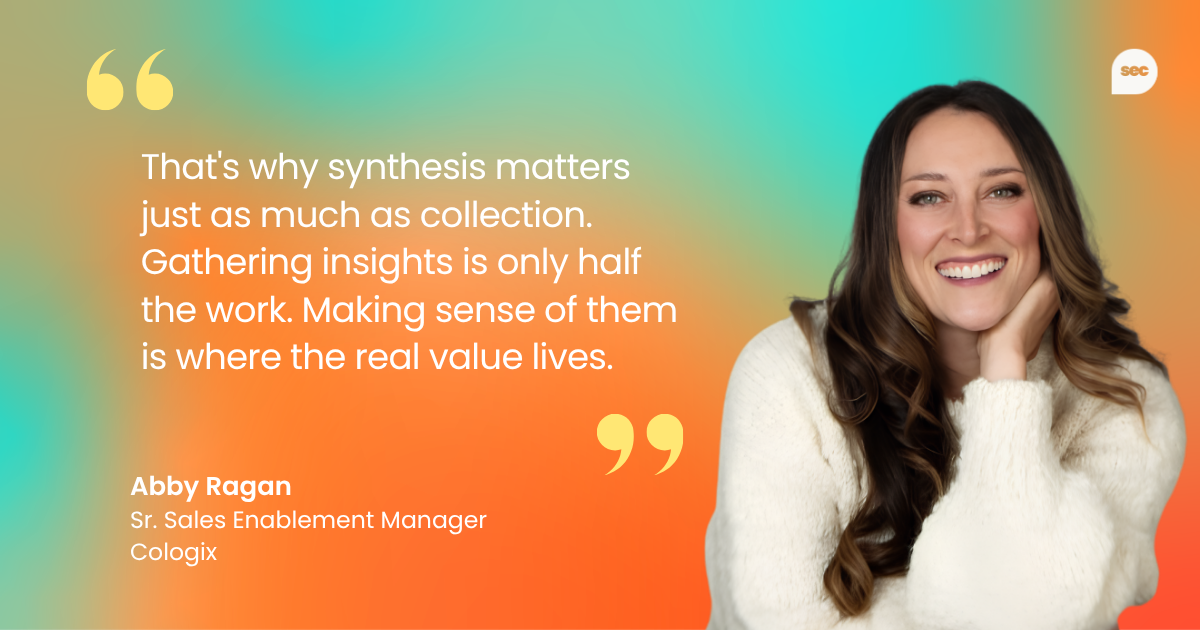
That's why synthesis matters just as much as collection. Gathering insights is only half the work. Making sense of them is where the real value lives.
Closing the loop back to sales
This is the part I feel most strongly about. My biggest frustration in this work is when sales teams invest time sharing feedback and never see any action taken as a result.
If that happens consistently, participation dies. People stop contributing because they don't see a return on their investment. The fastest way to lose trust is to ask for feedback and then do nothing visible with it.
To address this, we created a formal response process we call the Field Session Response, or FSR.
When sellers see that their input leads to action, participation grows. It really is that straightforward.
Connecting intelligence to the broader business
Field intelligence, when it's captured and synthesized well, reaches further than sales. It informs product strategy. It shapes marketing positioning. It influences leadership decisions and competitive planning across the organization.
During one of our FIRT sessions, we uncovered an unexpected competitor for one of our services. This was a company that the broader organization hadn't fully recognized as a competitive threat in that particular space because the insight surfaced through a structured process; we were able to prioritize a competitive analysis and get ahead of the threat before it became a bigger problem.
That's what happens when you treat field intelligence as a strategic input rather than anecdotal noise.
Measuring impact: proving CI earns its place
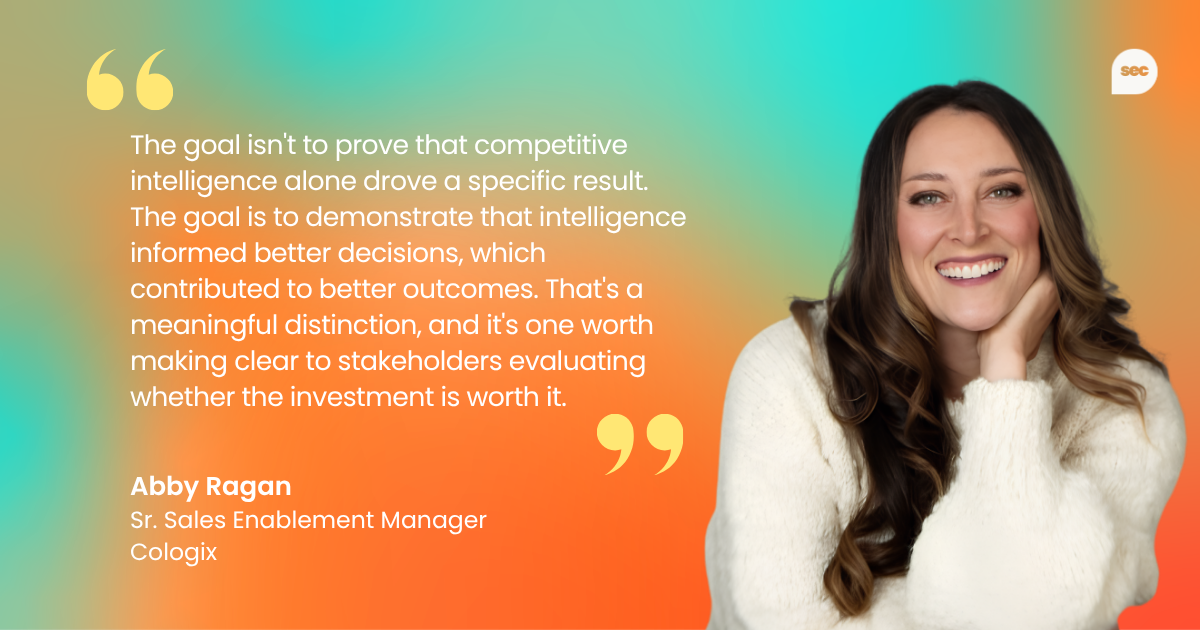
Competitive intelligence often struggles with perception. People see battlecards, newsletters, and updates. What they don't see, at least not easily, is the business impact behind those assets.
Demonstrating value matters, and the way you measure it will evolve as the program matures.
In the early stages of building a feedback loop, focus on observing change and establishing consistent participation. That's where we are today.
As the program develops, it becomes important to track both leading and lagging indicators.
- Leading indicators might include participation rates in sessions like FIRT, asset usage, intelligence submissions, and engagement with feedback programs.
- Lagging indicators include competitive win rates, deal velocity, deal size, and overall revenue performance.
What I learned from running FIRT
One thing I didn't anticipate when we started this was how much effort it would take to build genuine participation.
The first few sessions were hard. Participation was low. Conversations felt forced. Reps weren't entirely sure what kinds of insights we were looking for, or what would happen after they shared something. There was a reasonable amount of skepticism about whether it was worth their time.
We learned quickly that sellers need preparation and context. They need to understand what types of insights are valuable, how those insights will be used, and most importantly, that their time is worth investing. Trust became the foundation of the entire program.
 Richard Bracchi
Over time, participation improved because sellers started seeing action come from the conversations. They saw competitive analyses get prioritized. They saw messaging evolve. They saw updates reflected to the field through the FSR process.
The moment sellers realize their feedback actually influences decisions is the moment participation starts to accelerate.
I've also come to believe something through this process that feels important to share: the highest-performing organizations don't necessarily have more data. They learn faster.
Competitive intelligence is only as strong as its loop
If there's one mindset shift I'd encourage you to make, it's this:
Stop viewing sales as a team that consumes competitive intelligence and start viewing sales as one of the richest sources of competitive intelligence available to your organization.
No team spends more time talking directly to prospects. No team hears objections firsthand more consistently. No team is better positioned to understand how competitors are showing up in the market, or to identify emerging trends before they show up in a research report.
Yet too many organizations treat those insights as anecdotal rather than strategic. The conversations happen. The insights surface. And then they evaporate because there's no system to catch them.
They build cultures where information is shared, challenged, refined, and acted upon. They create environments where sellers feel that contributing intelligence is worthwhile because they can see the results.
Build the loop. Close it consistently. And keep listening to the people who are closest to the market.


Sales enablement insider
Thank you for subscribing
Level up your sales enablement career & network with sales enablement experts
An email has been successfully sent to confirm your subscription.
 Follow us on LinkedIn
Sales enablement insider
Thank you for subscribing
Level up your sales enablement career & network with sales enablement experts
An email has been successfully sent to confirm your subscription.



.svg)
